
So, @eff I appreciated your article, but y'all wrote it showing some clear ignorance of some finer points of tabletop gaming history (link for context: https://www.eff.org/deeplinks/2023/01/beware-gifts-dragons-how-dds-open-gaming-license-may-have-become-trap-creators)

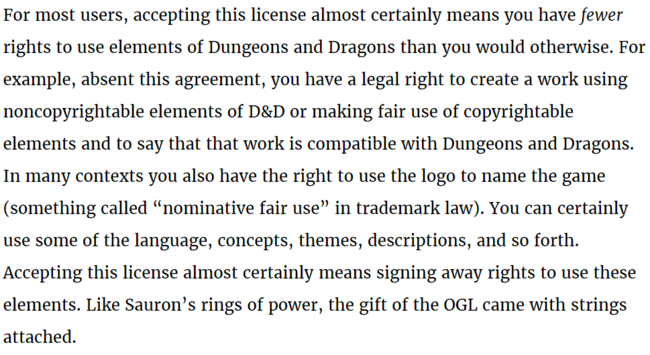
Specifically - this bit right here:
Beware the Gifts of Dragons: How D&D’s Open Gaming License May Have Become a Trap for Creators

The company that owns Dungeons and Dragons (D&D) is planning to revoke the open license that has, since the year 2000, applied to a wide range of unofficial, commercial products that build on the mechanics of the game.
Electronic Frontier Foundation

@CountZeroor @eff There was a lot good in that article, but I think it missed the boat on understanding the role of both Product Identity and Open Game Content. The original D&D 3.0 SRD contained ZERO product identity. Designating it ALL as OGC meant that no one had to parse the legal minutiae of "is this specific thing subject to copyright?" -- just use it.

Product Identity, in contrast, was a term that gave publishers confidence to add their own material to the body of OGC without

@Johnnephew @CountZeroor @eff it’s a good agnostic summary of the legalities (and probably a good explainer-balm for people if the OGL 1.0a “goes away”), but I also had the sense that they’d glossed over some of the history in so doing.

eliminating the risk of legal minutiae was the whole point, and for the industry, that was a very important point at the time.