 Melanie Green
 jeremyfreese
Your chance to prove that mastodon has a hive mind too, even on a Sunday: any recommendations for readings@on/connected to social network analysis for a seminar of first-year students?
 Pamela Herd
@jeremyfreese probably already in your list, but seems fun for undergrads https://journals.sagepub.com/doi/full/10.1177/0003122416650149
 Kristen Olson
@jeremyfreese Here is a syllabus for Robin Gauthier’s social network class at UNL a couple of years ago: https://soc.unl.edu/SOCIOLOGY/fall/902%20Networks%20Syllabus%20f20%20Gauthier.pdf
@jeremyfreese And here is Jeff Smith’s undergrad and grad social network class syllabus https://soc.unl.edu/SOCIOLOGY/spring%202015%20syllabi/398-898%20Special%20Topics%20Social%20Networks%2C%20Theory%2C%20Methods%2C%20and%20Applications.pdf
 Elizabeth Wrigley-Field
(1) The friendship paradox—perfect for the Facebook era; less clear for today’s social media (I don’t use the stuff the kids use so I dunno)
(Too mathy to assign to my undergrads but I lecture it)
https://www.jstor.org/stable/2781907
(2) Nancy DiTomaso’s book The American Non-Dilemma, or this NYT piece by DiTomaso explaining the argument that white people perpetuate racism in hiring less through discrimination than by being helpful & generous to their own networks:
 Tina Fetner
@jeremyfreese vaccine propaganda on YouTube? https://www.sciencedirect.com/science/article/pii/S1386505619308743
Ideological divisions among activists in the Egyptian revolution? https://meridian.allenpress.com/mobilization/article/23/1/23/82923/SOLIDARITY-OR-SCHISM-IDEOLOGICAL-CONGRUENCE-AND
 Philip N Cohen
@fetner @jeremyfreese I like STIs to talk about networks. This is in my book
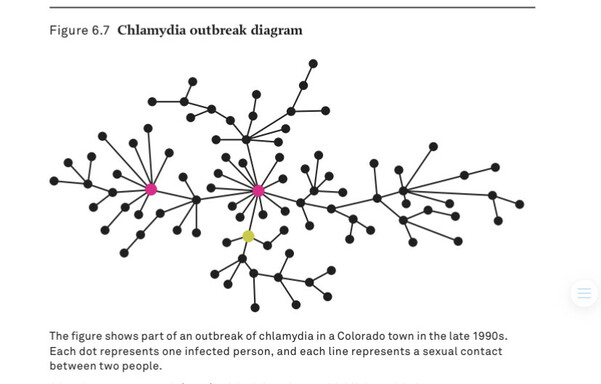
@philipncohen @jeremyfreese are you kidding me? I love it!!
@philipncohen @fetner DO KOALA CHLAMYDIA NEXT
 Klaus Pforr
@jeremyfreese probably stating the obvious:
Burt Structural holes and Granovetter weak ties
Burt Structural holes and Granovetter weak ties
 Jonathan Horowitz
@jeremyfreese first year undergrads? I teach the excerpt in Grusky's inequality reader on Burt and structural holes--for third year students. But if you wanted a more in-depth and drawn out look that might be appropriate for a slower pace, Brokerage and Closure by Burt should do it.
@jeremyfreese Maybe also something on the small world phenomenon? Like the Travers and Milgram study?
Mario Small's "Someone to Talk To", potentially.
 Elyas Bakhtiari
@jeremyfreese For a first introduction I like @kjhealy’s Paul Revere example https://kieranhealy.org/blog/archives/2013/06/09/using-metadata-to-find-paul-revere/

Using Metadata to find Paul Revere
London, 1772. I have been asked by my superiors to give a brief demonstration of the surprising effectiveness of even the simplest techniques of the new-fangled Social Networke Analysis in the pursuit of those who would seek to undermine the liberty enjoyed by His Majesty’s subjects. This is in connection with the discussion of the role of “metadata” in certain recent events and the assurances of various respectable parties that the government was merely “sifting through this so-called metadata” and that the “information acquired does not include the content of any communications”. I will show how we can use this “metadata” to find key persons involved in terrorist groups operating within the Colonies at the present time. I shall also endeavour to show how these methods work in what might be called a relational manner.
 Laura K. Nelson
@elyas @jeremyfreese @kjhealy I second this one, and the Mobilization piece it's based on. But when I taught it I was in Boston, so it perhaps resonates more there.
@LauraNelson @elyas @kjhealy Paul Revere is absolutely on the syllabus. It’s a class called “The Data Scientist as Detective” so it is extremely on point.
 pengzell.bsky.social
@jeremyfreese I assigned Chetty et al:s recent pair to my methods undergrads this year. Perhaps not much network analysis per se but lots to pick apart, I used it for a session on reverse causality and measurement error.
https://www.nature.com/articles/s41586-022-04996-4
https://www.nature.com/articles/s41586-022-04997-3
https://www.nature.com/articles/s41586-022-04996-4
https://www.nature.com/articles/s41586-022-04997-3
