Religiously, Congress doesn’t reflect America.
Even though nearly three in 10 claim no religious affiliation — a rate that is steadily rising — only two of the 534 members of Congress publicly identify as such.
Nearly 88% in Congress identify as Christian, compared with only 63% of U.S. adults. 57% of congresspersons identify as Protestant and 28% as Catholic, both higher than national rates. 6% of Congress identifies as Jewish, compared with 2% overall.
https://apnews.com/article/survey-congress-religious-affiliation-b707939002cc7ed43e7f346cd33a66cc
Survey: Religiously, Congress doesn't reflect America

Religiously speaking, the incoming 118th Congress looks like America — that is, the America of decades past, rather than today. Congress is far more Christian, and religious overall, than today's general population.

Associated Press
@AtheistAdvocate That's to be expected. If 70% of voters are religious, then they're likely to elect someone who's 100% religious. You'd only get a statistically representative distribution if the electorate was divided into different districts along the same lines -- that is, if 3 in 10 DISTRICTS were areligious. But instead, 70% of EVERY district is religious, so every district is likely to elect a 100% religious representative. It's not certain, but that's how the dice work.

@wesdym -
1) What you say is true.
2) But by your logic, a Catholic should never be elected in a majority Protestant district, and there should only be a couple Jews in Congress.
3) The exception to those numbers is that in many districts, more than 50% of Democrats are non-religious, so, by the numbers, we should nominate a lot of non-religious Democrats.
4) The problem is much more than the numbers.
...more...

https://theconversation.com/why-is-it-so-hard-for-atheists-to-get-voted-in-to-congress-146748

Why is it so hard for atheists to get voted in to Congress?

Despite growing numbers of non-religious Americans, self-declared atheists are few and far between in the halls of power – putting the US at odds with other global democracies.

The Conversation
@wesdym -
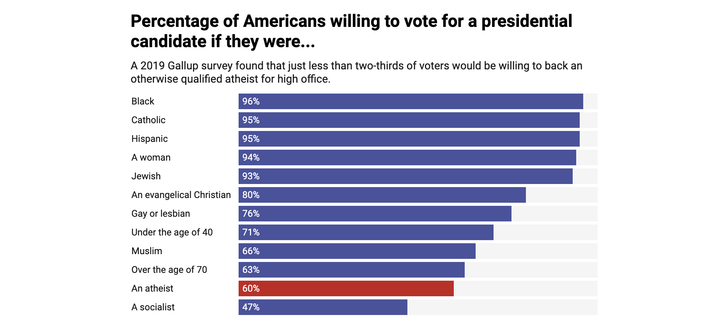
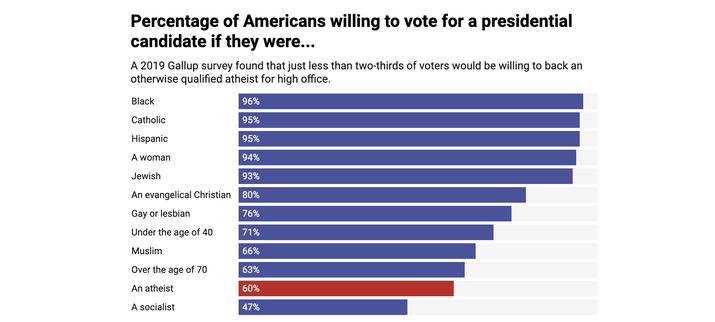
... Many religious are unwilling to vote for ANY non-religious candidate, while we non-religious have failed to advocate for our own.
@AtheistAdvocate @wesdym I think this can be traced back to Falwell’s moral majority movement in the late 70’s. I’m giving my age away here, but Falwell’s organized movement had deeply religious people calling and knocking on doors to promote the notion that they all need to vote in lockstep for GOP candidates only. Compare the sheeplike behavior to liberals who are more likely to be novel, independent thinkers (like herding cats at times) it’s a plausible hypothesis.
@DaveLa @wesdym -
What you say about Falwell's influence is certainly true, but the cultural bias that equates being non-religious to being immoral dates back centuries, millennia.
@AtheistAdvocate @wesdym Religious claims of morality is cringeworthy when you think about all the sex offenders in the clergy, and that’s not just Christianity. A web search will find several girls as young as 12 who’ve died giving birth because their Islamic faith allows child marriage, which anyway you look at it is nothing more than rape justified by religion. I also just read a story today about more than 180 Catholic priests are suspected of child abuse.