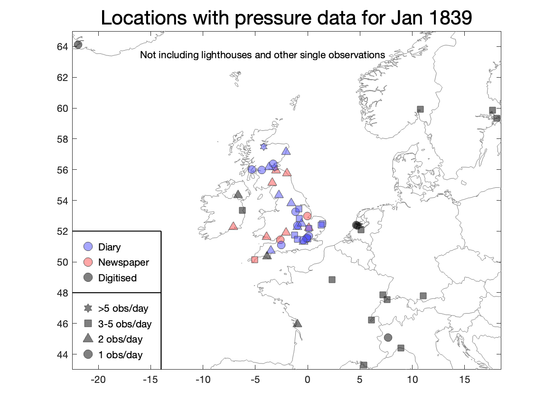

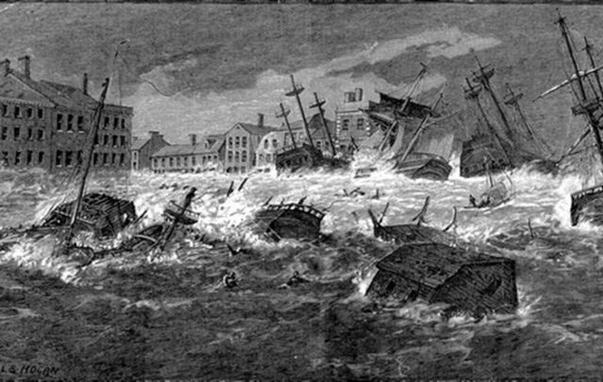
184 years ago today an extreme windstorm hit Ireland & the UK, known as the 'Night of the Big Wind'. This event was one of the most severe & damaging windstorms to ever hit these islands.

We now need some help to learn from this event... #Archives

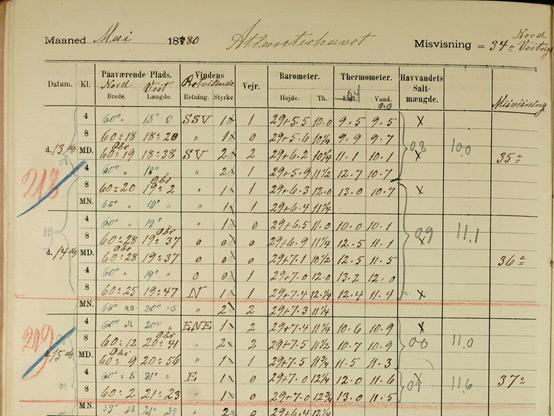
We have found a surprising number of locations with barometer measurements of pressure during Jan 1839. This should allow us to build a reanalysis to inform about the risks of such events today.

But, are there other sources we have not yet found?
Have been told about one new source in south Wales which is great. Am certain that local and regional archives or institutes will have other sources.
@ed_hawkins Have you tapped the dendochronology researchers? Bet they have something on that. Try Valerie Trouet at U of Arizona... I know her team has been assembling some European data over the past few years. And check out my conversation with her in Ep. 65 of @TransitionShow: https://xenetwork.org/ets/episodes/episode-65-climate-science-part-9-jet-stream/
[Episode #65] - Climate Science Part 9 - Jet Stream | The Energy Transition Show

The changing jet stream is associated with many of the extreme weather events in recent years, and tree-ring data shows that climate change is to blame.

The Energy Transition Show
@chrisnelder Thanks Chris! The dendro data is useful for many aspects but for this specific purpose we need instrumental observations of atmospheric pressure to constrain the reanalysis. 1839 is pushing the availability of such data close to its limits!
@ed_hawkins I see... well I wouldn't rule it out... there also ought to be ship-measured data from that period... maybe @hausfath can point you to something useful.
@ed_hawkins @frankdeboosere any ideas where they could find more data?
@ed_hawkins Old ship logs? I know someone who used them on Twitter, but I can't seem to find his account anymore.
@vickyveritas thanks - yes, there are lots of ship logs in the UK National Archives but not managed to look at them yet.
@ed_hawkins You probably already have https://www.met.ie/cms/assets/uploads/2017/08/Jan1839_Storm.pdf . I always love the stories about Irish people looking for pensions in the 20thC offering the claim they remembered the 'night of the big wind' as proof of age!
@clodagh_tait they are great stories! We need to ideally find the original logbooks or diaries. Sadly the Limerick source is unavailable as the diary is so fragile it can’t be opened and needs restoration.
@ed_hawkins suspect @MartinStendel might be are to help... 😊

@Ruth_Mottram @MartinStendel

I’ve not managed to get to the UK National Archives to examine the ~60 logbooks of naval ships based at UK ports. But we suspect many did not take observations. The Danish logbooks that Martin is digitising will hopefully include lots of valuable information too!

@ed_hawkins I am right now setting up a huge list of all voyages in the Frydendahl data (name and type of ship, first and last date, route and where to find originals and Frydendahl's transcripts). Now at box 3 of 8, so I will soon be able to answer your question...

We do have rather old pressure data from merchant ships (not yet digitised either), but I've only seen maybe a permil of the data so far. I can't say by heart when exactly these batches will be scanned. So stay tuned...

@MartinStendel wonderful to see this progress already!
@ed_hawkins
Adding #astronomy & #naturalists in case anyone knows of any 'gentleman/lady' observer types active at the time
@lime_green_gnome @ed_hawkins I'd suggest schoolmasters at the older schools. There were plenty of schools not attached to religious institutions and weather observations are the sort of science they've done long term. Perhaps contact the Independent Schools Association and ask if there are any records or diaries in school archives (or where those archives went if they're deposited elsewhere).
@ed_hawkins there may be more observations (if not barometric, perhaps descriptions of the effects) in Irish - it is known as Oíche na Gaoithe Móire. If they were documenting in Ireland they would have been using the old Irish script, which few people can easily decipher now.