Shavua tov and Pope Gregory's shana tova!

Sometimes life gives you a whack, then a few more just to remind you it can. I am glad to have time for this again!

But for the purpose of time management, I'll be addressing the #JWHIA #SchoolLetters in a bit less depth. That said, if I skip something you're curious about, @ me!

onward to the latest #DearParent letter:
QRT https://babka.social/@jewwhohasitall/109602817664790710

#Gveret (also Geveret, G'veret) /'g(ə)veret (Hebrew)/ = lady, madame, Ms

(but see Gever, below!)

1/

🇺🇸 JewWhoHasItAll (@[email protected])

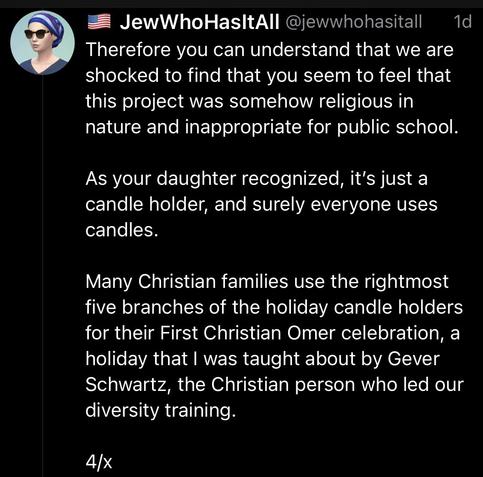
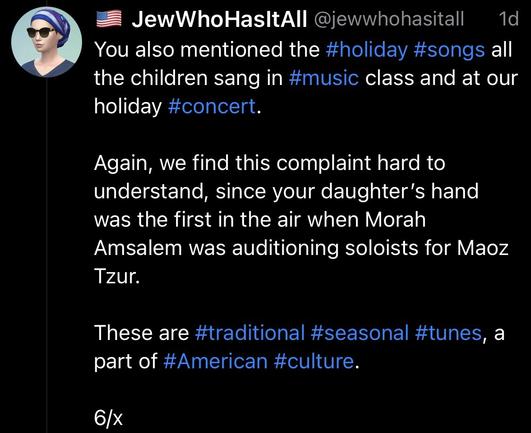
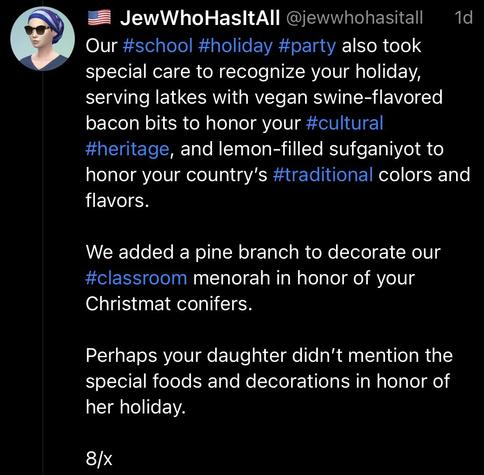
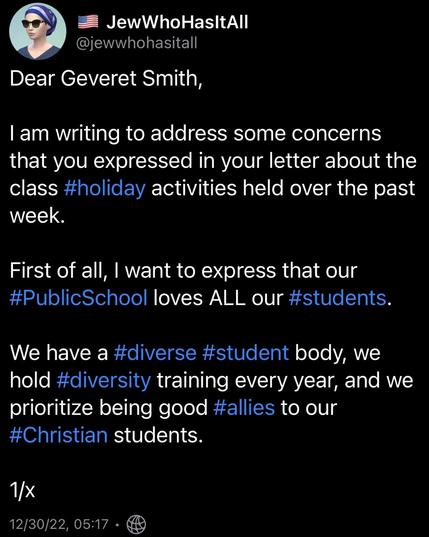
Dear Geveret Smith, I am writing to address some concerns that you expressed in your letter about the class #holiday activities held over the past week. First of all, I want to express that our #PublicSchool loves ALL our #students. We have a #diverse #student body, we hold #diversity training every year, and we prioritize being good #allies to our #Christian students. 1/x

Babka Social

#Omer /'ʕomer (Hebrew), 'omɛɚ (Jewish English)/ = 1. (Biblical Hebrew) sheaf (of wheat, grain); 2. with “the” (i.e. Ha’Omer), the 49-day period from the 2nd day of Pesach (=Passover) through Shavuot (Feast of Weeks, =Pentecost); on the 1st & last days of the Omer, Jews traditionally make an offering of a sheaf of barley. Full name is S(e)firat Ha’Omer (=“counting [of] the sheaf [of grain]”)

2/

#FirstChristianOmer = Advent (the 1st waiting period of the Christian liturgical year; as opposed to Lent, the 40-day period before Easter, the Second Christian Omer)

#Gever /'gever (Hebrew), 'gɛvɛɚ (Jewish English)/ = 1. man (i.e. adult male, not "humankind"); 2. strongman; 3. hero. From the Semitic root G-V-R (generates words related to strength, grow, victory, confirm)

The same word with feminine inflection is Gveret, which can be used as a title (i.e. Ms).

3/

It's my understanding that in modern Israeli Hebrew, 1) #Gever and #Gveret aren't actually equivalent: Gveret is a title but Gever isn't, it just means "man," and the titles used instead are Mar (=Mr) or Adon (=Mr, Lord); but also 2) people default to first names in most contexts and don't really use title+surname as a common form of address.

The JWHIA folks do everything intentionally, so what's up? some hypotheses:

4/

1) The language of Medinat America isn't Hebrew, it's English (albeit with even more Hebrew influence than "real-world" Jewish English). Once words are borrowed into a new language, they behave like words of the new language, not the source language. The rules governing the behavior of "Gever" in the English of Medinat America are not the same as the rules in Hebrew.

5/

2) JWHIA (the character) doesn't speak fluent Hebrew. She speaks some Hebrew because in Medinat America it would be a common "foreign" language in schools, not to mention the percentage of families and synagogues that emphasize Hebrew would almost certainly be greater than in our world, given the majority Jewish population. But she's actually pretty likely to make Hebrew errors without realizing it, the same way that many US English speakers make Spanish errors without realizing it...

6/

...e.g. "No comprende" to mean "I don't understand" (it means: he/she/it/you (formal) don't understand).

3) Gever can actually mean Mr even in modern Israeli Hebrew, but my language informant hasn't used it that way

7/

#Moreh /moˈre (Hebrew), ˈmɔreɪ (common alternative pronunciation among US Jews/ = teacher, instructor (male; feminine inflection is "morah")

#Amsalem (also Amsellem, Amshalem, etc) = Sephardic Jewish surname. Etymology is murky (though I have a new resource on the way which may clear this up for me, stay tuned): possibly from Hebrew am + shalem (= "people/nation + whole/complete", i.e. "united people");

8/

...it's also speculated that it's a Berber placename or derived from a Moroccan/Algerian Arabic term for Jews meaning roughly "obedience to G-D" (but I haven't been able to confirm the actual existence of this term or its meaning. If you know Arabic and want to weigh in please do).

#maoz (also ma'oz) /maˈʔoz (Hebrew), ˈmaʔoz (Jewish English)/ = fortress, stronghold, refuge. From Semitic root '-Z-Z (generates words related to vigor, defiance, strength, triumph, courage, refuge, gather)

9/

#tzur /t͡sur (Hebrew), t͡sʊɚ (Jewish English)/ = rock, cliff. Also a boy's name and a surname.

#MaozTzur (also Ma'oz Tzur, Ma-oz-tzur, etc) = "fortress/refuge (of) rock" [roughly Mighty Stronghold/Refuge, or O Fortress, O Rock, depending on the translator]. The name of a Chanukah song whose lyrics originate in (probably) the 12th century CE. The title is taken from part of the first line of the song, "Ma'oz tzur yeshu'ati" which means, roughly, "O Fortress, O Rock of my salvation," i.e. G-D.
10/

lots I could say about this toot, but I'm only going to highlight #Christmat:

Modern Israeli Hebrew uses a /t/ sound for the letter tav (ת) where in some instances Ashkenazi Hebrew (and Yiddish) uses /s/ (e.g. Sukkot vs Sukkos) (= "booths", & a multi-day holiday in the fall) and Sephardic Hebrew (and Biblical Hebrew) uses /θ/ (that's the "th" sound in "think," not in "the," i.e. Succoth).

11/

The name of the holiday is Christmas (/s/ at the end of the word, no standard dialectal variation that I know of where it is pronounced Christmat in the real world). But JWHIA is defaulting to "standard" Israeli Hebrew pronunciation in the formal context of this letter to lend herself authority, but in so doing applies a language pattern to a word where it doesn't actually apply, because she doesn't have enough familiarity with Christmas to know that it wouldn't apply.

12/

lots to say here as well but I'll stick to the names.

#Shemtov (also Shem-Tov, Shem Tob, etc) /ʃemˈtov (Hebrew), ˈʃɛmtav (Jewish English)/ = Jewish (Ashkenazi and Sephardic) surname literally meaning "good name" (shem=name + tov=good); also sometimes a given name, usually transliterated as 2 words or with a hyphen

13/

@jewterpretor are you sure? I've always understood Shem Tov (eg as in the Baal Shem Tov) as meaning Good Name.

I guess it's possible that Yom (day) might get pronounced as Shem (name) in some accents but I doubt that's where it comes from.

@regordane

Yes! Thank you! you are right! This is what happens when you speed edit your own work. I'll fix that when I'm back at my computer.