Yvonne Madelaine Brill was born #OTD in 1924. She was a rocket scientist who invented the hydrazine resistojet, which increased the payload capacity of satellites by reducing the weight of propellant they require. JWST uses hydrazine thrusters!

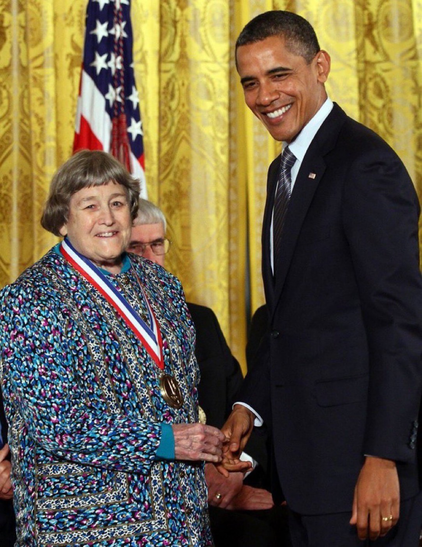
Photo: W. McNamee/Getty
Yvonne Madelaine Brill studied Chemistry and Math at the University of Manitoba. She wanted to study engineering, but women weren't allowed at the time.

She initially worked at Douglass Aircraft. By the mid-40s, she was believed to be the only woman in the US working as a rocket scientist. (At least, that’s the claim in this 2013 obituary in the Toronto Sun.)

https://torontosun.com/2013/03/30/pioneer-canadian-rocket-scientist-dead-at-age-88

Pioneer Canadian rocket scientist dead at age 88

A Canadian-born rocket scientist whose innovations are still being used today has died.

Toronto Sun

Brill took time off to raise her children, then returned to work in 1966, when she joined RCA Astro Electronics in Princeton.

In an interview with the Society of Women Engineers she recalled many of the challenges she faced.

https://ethw.org/Oral-History:Yvonne_Brill

Oral-History:Yvonne Brill

ETHW

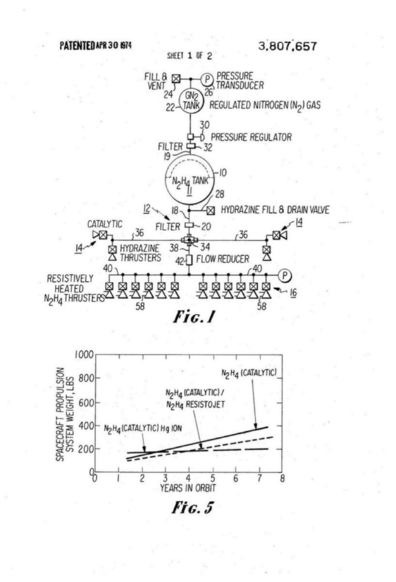
The following year, in 1967, she designed the electrothermal hydrazine thruster (EHT) — more commonly referred to as the hydrazine resistojet. It allowed for more efficient positioning of satellites, and reduced the weight of propellant they had to carry.

https://patents.google.com/patent/US3807657A/en

US3807657A - Dual thrust level monopropellant spacecraft propulsion system - Google Patents

A flight auxiliary propulsion system for velocity trim, station keeping, momentum adjustment for a spacecraft comprising rocket or reaction motors, also designated thrusters, utilizing thermally decomposable monopropellants such as hydrazine and other derivatives, thereof hydrogen peroxide, and isopropyl nitrate. The thrusters are arranged in a distribution or manifold system so that one set of thrusters provides for relatively large thrusts of force in the order of 1 to 5 pounds and another set of thrusters develop low thrusts in the millipound range. The large thrusts are developed by the catalytic decomposition of the monopropellant into a thrust chamber and through a throat and expansion nozzle to the ambient externally of the spacecraft. The low level thrusts are developed by heating catalytically or thermally decomposed monopropellant by electrical heating elements more commonly known as resisto-jet elements. Dual thrust levels may also be achieved by a common motor with a controllable resisto-jet and variable throat-area control.

(When JWST deployed, and it was announced that they should have enough fuel to remain in service for over a decade, they were talking about the supply of hydrazine! Also dinitrogen tetroxide, which is used with hydrazine in the SCAT thrusters.)

In the early 1980s, Brill left RCA to serve as director of the space shuttle solid rocket motor program at NASA. After three years she returned to RCA, then eventually took a position with the International Maritime Satellite Organization.

Yvonne Brill was inducted into the National Inventors Hall of Fame in 2010, and was awarded the National Medal of Technology and Innovation by President Obama in 2011 (the photo in the first post).

Yvonne Brill passed away in 2013.

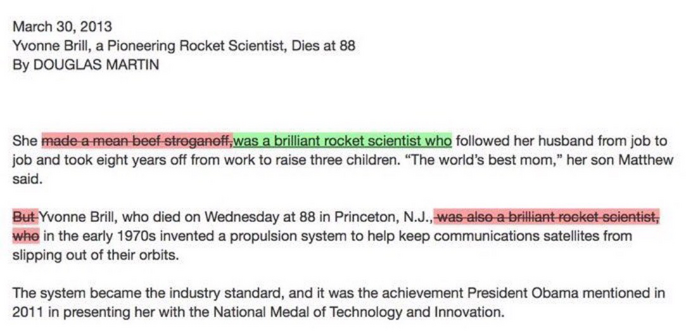
The NYT ran an obituary that was roundly criticized as sexist. It mentioned her beef stroganoff, following her husband, and raising her children before acknowledging her work as a rocket scientist.

Look at these edits:
http://www.newsdiffs.org/diff/192021/192137/www.nytimes.com/2013/03/31/science/space/yvonne-brill-rocket-scientist-dies-at-88.html

The NYT had to change the first line from “She made a mean beef stroganoff…” to “She was a brilliant rocket scientist…”

This was only nine years ago!

Anyway, Yvonne Brill’s hydrazine resistojet, first used on a satellite in 1983, is still an industry standard.
@mcnees I'm not confident the NYT would get it right even today. It's a sorry shadow of what it once was 🙄

@mcnees Hmm, I wonder why I don't recall seeing her mentioned in John D. Clark's "Ignition!"...I WONDER.

(I don't wonder at all)

@mcnees It's my whole claim to fame, being the Finkbeiner of the Finkbeiner Test.
@mcnees And in case my claimed-fame isn't that famous, here's the test: https://en.wikipedia.org/wiki/Finkbeiner_test
Finkbeiner test - Wikipedia

@AnnFinkbeiner @mcnees Very interesting and a good test of good journalism. I hadn’t heard of it before, but it makes sense. Cool stuff :)
@AnnFinkbeiner it should be posted on newsroom walls!

@AnnFinkbeiner @mcnees

To pass the test, an article about a female scientist must not mention:

* [ ] That she is a woman
* [ ] Her husband's job
* [ ] Her childcare arrangements
* [ ] How she nurtures her underlings
* [ ] How she was taken aback by the competitiveness in her field
* [ ] How she is a role model for other women
* [ ] How she's the "first woman to..."

https://en.m.wikipedia.org/wiki/Finkbeiner_test#Checklist

Finkbeiner test - Wikipedia

@hobs @AnnFinkbeiner @mcnees

Has any article ever passed that test?

@hobs @AnnFinkbeiner @mcnees Complementary to this, it would be great if we could see more articles about how male scientists nurture their underlings and are therefore role models for other men.
@AnnFinkbeiner @mcnees - well Finkbeined, that Finkbeiner!

@AnnFinkbeiner @mcnees marvellous!…whenever I read a news article about a scietific breakthrough and it begins with “A lady who….” I always think they are about to start an Austrian yodeling song.

I grew up in a working household of brilliant working women (and my Dad) in the UK. I have never understood why so many men demean women & the utterly pivotal role they play in society, the arts and the sciences.

@mcnees Ugh. I wish that was surprising. Maybe for my granddaughters things like that will be real head-scratchers.