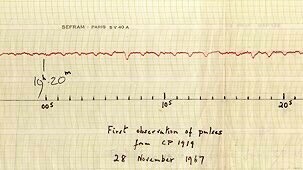
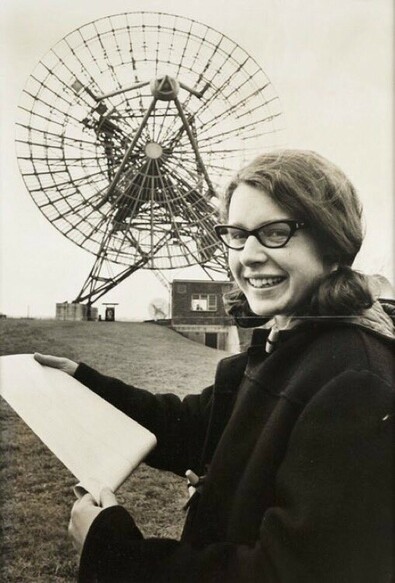
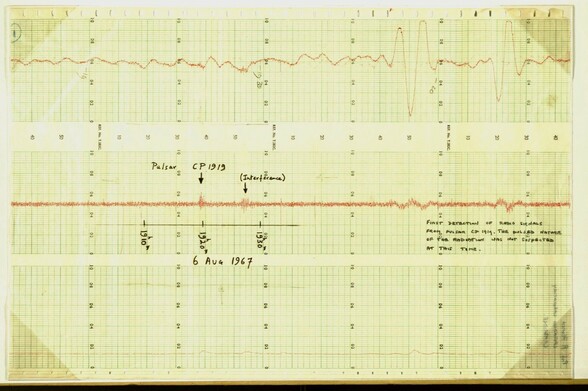
Jocelyn Bell Burnell transformed astronomy #OTD in 1967 when she made the first observation of a pulsar.

She and advisor Antony Hewish initially dubbed the object LGM-1 (“Little Green Men”) for its regular signal, but soon identified it as a rotating, magnetized neutron star.
#astronomy #pulsars #neutronstars #JocelynBellBurnell

Bell, a grad student, and advisor Antony Hewish constructed a low frequency radio array to study the solar wind’s effect on nearby radio sources. During the commissioning phase, while analyzing data by hand, Bell discovered a regular signal with a stable period of about 1.33s.

Bell and Hewish ruled out terrestrial interference or a problem with the instrument as explanations. Imagine seeing that remarkably regular signal, and not knowing of an astrophysical source that might produce something like it. They joked that it must be "Little Green Men."

Here is Bell recounting the discovery, during an after-dinner speech during the Eighth Texas Symposium on Relativistic Astrophysics.
http://www.bigear.org/vol1no1/burnell.htm

Cosmic Search Vol. 1, No. 1 - Little Green Men, White Dwarfs or Pulsars?

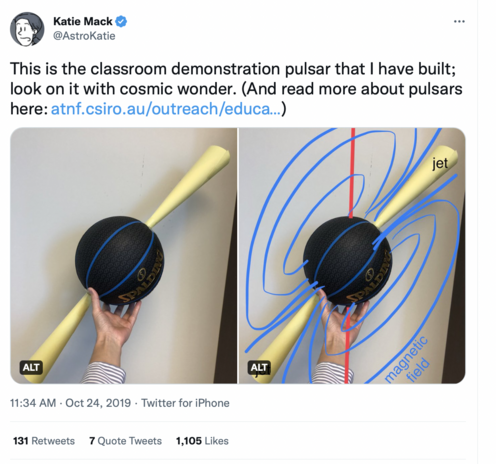
Before long, the sources were identified as rotating, magnetized neutron stars. A tightly collimated beam of radiation is ejected along the neutron star's magnetic axis. We see regular pulses as it rotates, hence “pulsar."

Here, let me show you with this old tweet by @AstroKatie. (The link in the tweet points to https://www.atnf.csiro.au/outreach/education/everyone/pulsars/index.html)

An Introduction to Pulsars

An introduction to pulsars

Anyway, in 1974 Antony Hewish received the Nobel for his "decisive role in the discovery of pulsars."

As per the Nobel Prize's long tradition of sexism, Jocelyn Bell Burnell was not included. A grad student won the Physics Nobel the previous year, so awarding to a grad student wasn’t the issue.

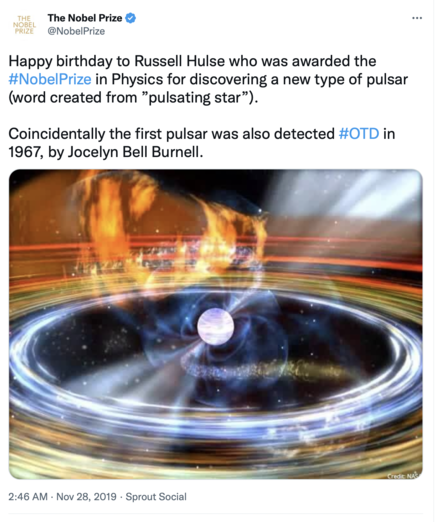
And a few years later, graduate student Russell Hulse was (righfully) awarded a share of the Nobel Prize in Physics for a pulsar-related discovery.

Today happens to be Hulse's birthday (again, he was very deserving of his share of the prize).

The Nobel used to note this every year, along with a casual mention of Jocelyn Bell Burnell's discovery.

What they always failed to mention was that both Burnell and Hulse were 24 year old grad students when they made their discoveries. Hulse is a man, so he got a share of the prize. But Burnell is a woman, so the prize was given to her supervisor.

They don't post it anymore.

In 2004, Jocelyn Bell Burnell wrote

"Although I was not included, I celebrated that first award in 1974 of the Physics Prize for an astronomical discovery. Now I celebrate the fact that we have a better understanding of the teamwork necessary for scientific progress."

https://www.science.org/doi/full/10.1126/science.304.5670.489

In 2018, Dame Jocelyn Bell Burnell was awarded the Breakthrough Prize in Physics for her discovery of pulsars. The judges and founders of that prize did what the Nobel Committee should have done.

She used the prize money to set up a fund supporting students from under-represented groups who want to become researchers in physics and astronomy.
https://www.bbc.com/news/science-environment-45425872

Bell Burnell: Physics star gives away £2.3m prize

One of the UK's leading female scientists donates her £2.3m science prize to help more women, ethnic minority and refugee students to become physics researchers.

BBC News

Happy 55th birthday to pulsars, which were discovered by Jocelyn Bell Burnell.

Image Credit: NASA Goddard Space Flight Center

Image warning: A very flashy (but very cool) gif of a pulsar.

I marked the gif in the last post as "Sensitive," so hopefully the very flashy gif won't autoplay. Thanks very much to @transponderings and @llewelly for helpfully pointing this out!

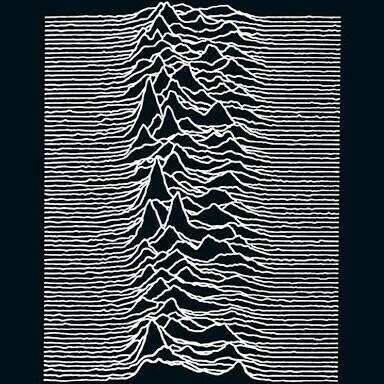
Evening addendum: The image on the cover of the Joy Division album "Unknown Pleasures" is from a plot that radio astronomer Harold Craft made for his PhD dissertation, using data collected at Arecibo while studying the pulsar discovered by Jocelyn Bell Burnell.

This Scientific American article tracks down the original sources and links to video of an interview with album cover designer Peter Saville:
https://blogs.scientificamerican.com/sa-visual/pop-culture-pulsar-origin-story-of-joy-division-s-unknown-pleasures-album-cover-video/

Pop Culture Pulsar: Origin Story of Joy Division’s Unknown Pleasures Album Cover [Video]

Sure, I was familiar with the graphic—and I’m not alone. Drop this image (right) on someone’s desk and chances are they’ll reflexively blurt, “Joy Division.” The band’s 1979 Unknown Pleasures album cover leaned entirely on a small mysterious data display, printed in white on black.

Scientific American Blog Network

@mcnees
A #Fortran "Unknown Pleasures" figures generator is available in this #gtkfortran repository, with some bibliography about the history of that iconic figure:
https://github.com/vmagnin/gtk-fortran-extra/tree/main/unknown_pleasures

It was adapted from this original #javascript version:
https://github.com/MaxHalford/procedural-art/

#CP1919 #UnknownPleasures #JoyDivision #GTK

gtk-fortran-extra/unknown_pleasures at main · vmagnin/gtk-fortran-extra

New examples to start your own gtk-fortran application (MIT license). - gtk-fortran-extra/unknown_pleasures at main · vmagnin/gtk-fortran-extra

GitHub