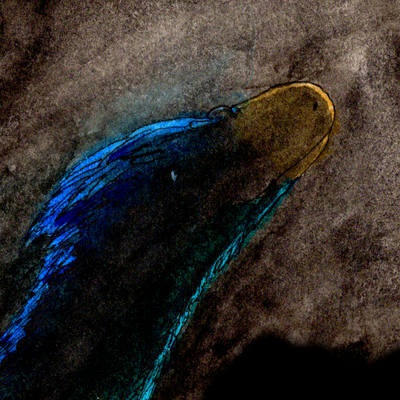
#MyArt in 2022 (thread)

January: Humans and our Cousins. This series starts out a human, then our closest relative (a bonobo), then the next closest (gorilla) etc all the way down to the bacteria, represented by E. Coli. This project is actually what got me into paleoart, as I felt the gap between the monotremes (represented by the Platypus) and the sauropsids (represented by the macaw) was just too big a leap. So I drew some extinct synapsids as a bonus and never stopped drawing paleoart.

February: #Saurornitholestes leaps across the water, startling a drinking #corythosaurus. #paleoart #MyArt #dinosaur
March: #Moschops in love. Two female Moschops share a moment of affection by the shore. These friend-shaped #synapsids are thought to be semi-aquatic, and I tried to make them look the part. #paleoart #myArt #permian #therapsid
April: #Mammals and Mammaliaforms of Jurassic China. Mesozoic mammals are far more diverse and interesring than they’re often depicted, and middle-Jurassic China in particular featured quite a motley arrangement of them. We’ve got #Volaticotherium gliding after a bug, #Agilodocodon in the tree, #Docofossor underground, and of course #Castorocauda swimming. In the background, Yi qi, Xiaotingia, and an Anurognathid join them. #myart #paleoart
May: The last #Edmontosaurus. This idea came to me after reading Riley Black’s The Last Days of the Dinosaurs. The idea is that during the shockwaves caused by the meteorite’s impact, an Edmontosaurus egg got buried and survived the ensuing global firestorm underground. After hatching, she emerges into a devastated world. #myArt #paleoart #kpgextinction #dinosaur
June: #Troodon playing in a pile of autumn leaves. This one was born from a Prehisroric Planet watch party where I learned angiosperms had already become the dominant plant group by the end of the Cretaceous. #paleoart #troodontid #dinosaur #MyArt
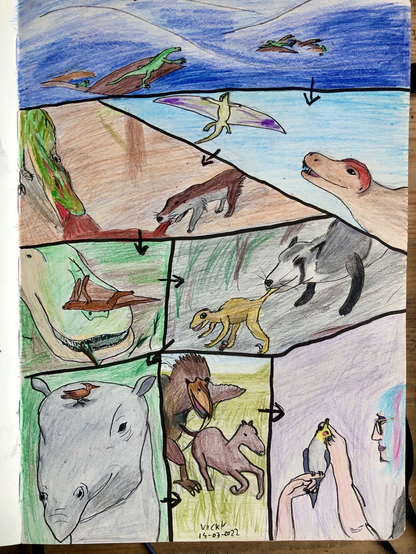
July: #Synapsids and #sauropsids through the ages. This one delicts the amniote common ancestor species splitting into two back in the Carboniferous. Each subsequent panel moves one period forward and shows a synapsid and a sauropsid interacting in some way. The sauropsid is always on the left and the synapsid is always on the right. #paleoart #evolution #MyArt
August: Raptor Red. I read #RaptorRed by Robert Bakker in August and ended up drawing a couple of scenes from it: Raptor Red morning her mate, her introduction hiding in the leaves, and running into her sister again. #utahraptor #dromaeosaur #dinosaur #paleoart #MyArt
September: assorted birdy #dromaeosaur and #troodontid sketches. I took some bird pictures and drew dinosaurs based on them. #dinosaur #paleoart #myArt
October: Stargazing #Zhenyuanlong. My Beasts of the Mesozoic Zhenyuanlong modeled for this one. #dromaeosaur #dinosaur #paleoart #myart
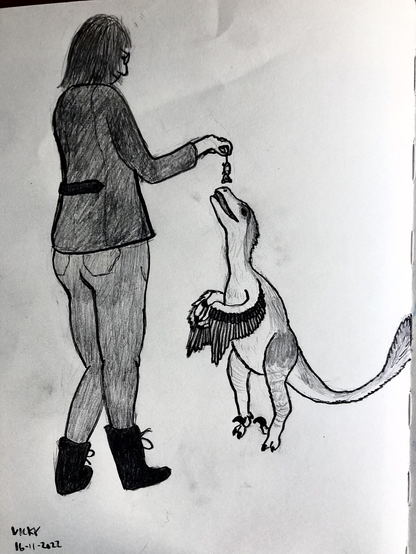
November: Giving my pet #velociraptor a snack. Please be a more responsible pet owner and put some sort of claw glove on your pet dromaeosaurs.
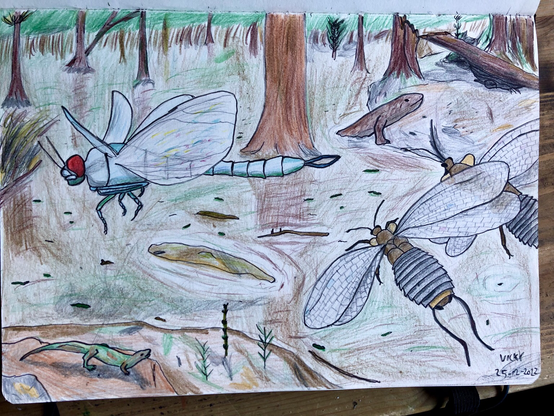
December: #Mazothairos chase a passing #Meganeura in a Carboniferous swamp. It’s been a little while since I did a full #paleoart scene, backgroubd and all, and I wanted to explore a different period than usual. #myart
So I have learned that #castorocauda does not appear to have pinnae (ear flaps). Which is extra awkward for this piece, because none of the living monotremes have them either, so that kind of suggest they only evolved in therian mammals. Which means none of the ones in this piece would have them. Whoops! Not the first time ears have given me trouble. #paleoart #mammals #myArt
@Vickysaurus Echidnas do have small, subtle pinnae. Platypuses may have lost them as part of adaptations to swimming. So you're safe on the true mammal (Volaticotherium), at least.
@Vickysaurus Now that I think about it, I suppose it's possible Castorocauda could have lost pinnae as an adaptation to swimming, too. Maybe less likely, though?

@keesey Yeah, that seems possible, but also like a fairly big assumption until other basal Mammaliaformes with soft tissues that clarify the situation one wsy or the other are found.

Good point about the echidna ears! I had to look them up specifically, those are easy to miss! Now I really do wonder if they were a recent innovation to the monotreme-therian common ancestor that the therians ran with a lot harder.

http://www.wiresnr.org/images/EchidnaEar-canal-leoniByronJackson.jpg

@Vickysaurus

🙂

Saurornitholestes was found on both sides of the N American ocean - and also has a strangely flat humerus. It may have only only weighed about 10kgs - the same as a swan.

I don't think other types like it are from both sides, and everything points to it being volant. It would have used its legs of course - not just for lift, but for flapping thrust.

So you'd just have to change "leaps" to......😉

@strangetruther That’s very intetesting! I was already imagining it flapping its wings to extend its leaps, perhaps this is a proper flutter/flight across.

@Vickysaurus

I think your pic covers many possibilities!

My first pinned toot describes my view on vodrom flight, which you might find interesting🙂