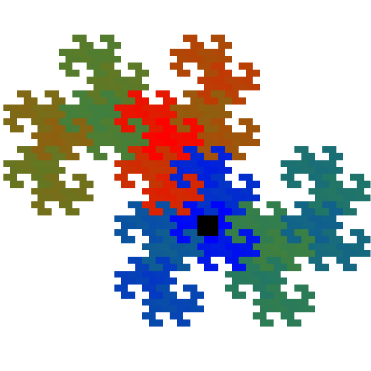
I think part of why derivatives are hard to understand the first time you learn about them, is because they're introduced in 1D instead of 2D

the derivative is just the velocity of any given function!

to be more precise, given a function f(t):

f(t) = position at time t
f'(t) = velocity at time t
f''(t) = acceleration at time t
f'''(t) = jerk/jolt at time t
@acegikmo Hm, not sure why 2D helps there? The same position/velocity/acceleration can and is also taught with 1D functions?
@HeNeArXn the issue with 1D is that we usually visualize it with time as a spatial x axis, rather than, actual time, and it superficially looks like a 2D space object with a physical slope, when slope is just an artifact of that particular representation
@acegikmo @HeNeArXn
that's definitely the problem. The realization for me came in my second semester of uni, doing multivariable calculus. It was only by introducing more dimensions and possible interpretations that the concept of slope got pushed to the side.
@acegikmo
you're doing such a great job at making me understand what i've learnt in school (but didn't precisely understand why it was useful), thank you 👍
@acegikmo to me in HS a derivative of a function was exactly explained as the rate of change at some point which is synonymous with calling it “the velocity of a function” (and velocity of the velocity, which is acceleration etc) with examples of, for example, a graph of a function representing the distance a car has traveled which then intuitively gives us its velocity and acceleration.
@acegikmo *snap crackle and pop* :D
@acegikmo There are so many extra concepts going on in this (beautiful!) gif that I'd be surprised if a n00b could understand just "derivative" out of it. You've added discontinuities, vectors, phasors and splines.

@davidr I mean, obviously yeah, my goal wasn't to teach high school students about derivatives for the first time using this .gif

I just took what I had on hand to showed something related that might be useful and/or interesting even to more experienced people

@acegikmo do you have any way to create an intuition of jerk/jolt?

I have internalized all the others, but I never managed to actually understand what jerk/jolt really “meant” beyond symbolic manipulation. Like, it feels like it must have some sort of physical interpretation, but I never managed to get it.

@cafkafk @acegikmo laws of movement says we can't generally tell the difference between no movement and some movement with a fixed speed. that mean what we actually feel is acceleration.

jerk is a change in that. between being in a car that accelerates smoothly (low jerk) and the same car running into a wall (high af jerk), you should be a able to feel a difference :p

@cafkafk oh! yes, acceleration is the velocity of the velocity vector

so, jerk/jolt is the velocity of the acceleration vector

I visualize this in my spline video (timestamp!)

https://youtu.be/jvPPXbo87ds?t=3318

@acegikmo my highschool was trying an experiment so I was co-taught physics and calculus, two teachers one double length class, and this was definitely how they presented it.
@acegikmo No lie: your spline videos have finally helped me nail down the whole "a derivative is the rate of change" thing I never grokked in high school. Thank you for that.
@acegikmo Interesting idea. You could teach a 1D derivative on a number line for the same idea --- I wonder if that would be helpful too.
@acegikmo uh oh. now *I'm* confused!
@acegikmo I'm with your right up until the third derivative. What is "jerk/jolt" if not acceleration? Having a hard time wrapping my head around that one specifically.