
The New York Times has editorialized angrily against forced arbitration -- a system designed to protect companies from accountability.

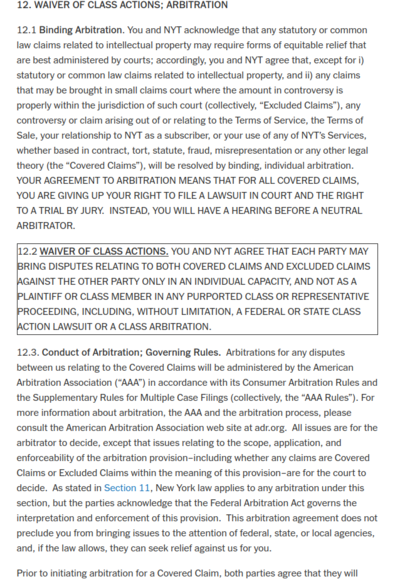
So guess what I found in my inbox this morning. Yes! Subscribers to the NY Times must now submit to forced arbitration if there's a dispute:

https://help.nytimes.com/hc/en-us/articles/115014893428-Terms-of-service?launch_id=18232205#12
@dangillmor Is this legally binding in the USA? Arbitration in many countries does exist, but the right to litigate for a court can never be signed away. These clauses tend to be considered null-and-void by judges when a litigant seeks immediate access to a court in a dispute. But they are often honored if arbitration is tried first and then a disgruntled loser moves the case to the courts.
@HendrikRood Yes, you can absolutely sign that right away in America. I thinks some folks are trying to push back on it being legal for contracts of adhesion, though, I don't think they've had much success so far.

@LouisIngenthron
In Europe this applies.
1993 Directive on unfair terms in consumer contracts

Article 3
1. A contractual term which has not been individually negotiated shall be regarded as unfair if, contrary to the requirement of good faith, it causes a significant imbalance in the parties' rights and obligations arising under the contract, to the detriment of the consumer.

Full text: https://www.eumonitor.eu/9353000/1/j9vvik7m1c3gyxp/vhckkmr0y3zb

Council Directive 93/13/EEC of 5 April 1993 on unfair terms in consumer contracts - EU monitor

@LouisIngenthron
I am currently in a 10+ yr class action on such a term vs a mortgage bank. Litigation already went up and down the court system and might ultimately end at the European Court of Justice.

Some people took the arbitration route vs the bank. They learned they pulled the short straw as arbiters chose the banks side.

Those who moved straight to the courts however had several (partial) wins.
Courts took the case and sidelined the dispute arbitration articles in the contract.

@LouisIngenthron The key question is probably whether it is "material".

Judges and Justices aren't fond about corporations, who try to use "legal fine print" with forced arbitration clauses, to keep disputes with large material impact (tens to hundreds of millions actual damages) outside the Court system.