 Lea Verou, PhD
Once more I replied to an issue in one of my open source projects with something along the lines of "Yeah, you can't just open HTML files like that, you need to use a localhost".
It makes me think our community may be suffering from tunnel vision. 🧵
Once more I replied to an issue in one of my open source projects with something along the lines of "Yeah, you can't just open HTML files like that, you need to use a localhost".
It makes me think our community may be suffering from tunnel vision. 🧵
We assume that everyone creating web apps is comfortable with the command line, build tools, npm etc.
We build more and more abstractions on top of these, because we assume these are bread & butter by now.
Yet it appears some still struggle with …localhost.
I’m not against higher level abstractions, far from it. Abstractions are how you make a platform more powerful!
But somewhere along the way we lost the smooth learning curve of the earlier Web, and I just wish we could have had both. 😕
👉🏼A platform doesn't need to be hostile to novices to be powerful for experts.👈🏼
But novice-friendliness does not just happen. It needs to be a priority.
In the Web Platform, somewhere along the way we prioritized other things over approachability.
Experienced devs are far more vocal than novices, which gives a skewed view to stakeholders.
Novices are not typically part of the public discourse. They don't blog, don't post on lists, and don't follow anyone on Twistodon. It’s hard to reach them even when seeking them out.
@leaverou truth.
I recently came back to modern web development from being able to make websites in the noughties, having given up at some point when either Flash or JS/JQuery took over, and "View source" stopped being readable, or even actually related to what I was seeing on screen.
That learning curve was steep and bewildering.
Web dev has gone the way of other types of software development, where you need a lot of setup and a particular environment before you can make something happen.

@leaverou I've used Twitstadon. And posts are also twoots.
@leaverou this insight is spot on and deeply felt as I worked on my first Astro project this month. The framework was so thin in how it applied its own top-layers, and in many cases shined most where the basics of web were just left exposed.
As bulky and clunky as past frameworks and abstractions have been, there is now a great opportunity to cut out the confusion rather than continue to build it up!
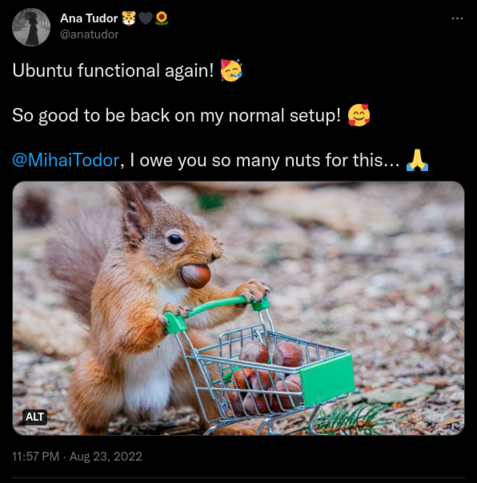
@leaverou I summon the command line fairy @mihaitodor whenever something is beyond copy-pasting a few lines. Even when that doesn't go successfully.
Build tools or npm are far beyond my understanding.
I've never managed to do something like a pull request right. Fucked up every single time.
I struggled with localhost during uni too. Eventually, someone helped me out, but yeah...
I'm just not a computer person. I can code, understand algorithms... but I'm just not a competent computer user.
@leaverou Strongly agree! On top of it, many functionalities are HTTPS-only which can be even harder for newcomers to set up.
Could the browser start a static server when someone loads a .html file? With some security warnings?
@leaverou I keep getting ridiculed for postulating that we need to assume authors, not “Programmers” as the people mainly building on the platform. Because _obviously_ that is “naiv”, because developer needs express the capitalistic needs of companies, without the web wouldn’t run. 🙄
I call bullshit. We need to do exactly what you are talking about. Devs are often ignorantly complicit in turning the web into a divided place of consumers and companies. The web is for everyone.
@leaverou one bright spot in all this is the unification that has happened in tooling to a large extent around NPM and package.json (and scripts)
I think the best way forward is to build user-friendly tools that further entrench common conventions without losing the power we now have.
 Corné Dorrestijn
 Sara Joy
 Florian Reuschel
 Tom Walker
 Kerri Hicks 🧶 📚 🧼 🧬 💻
 isaacs
 moopet
 Elly Loel
 Andrew Walpole
 Asbjørn Ulsberg
 Donnie D'Amato
 Amit Bahree 🌎💾
 Ana Tudor 🐯
 Sandrine
 Thaddée Tyl
 mostlyfocusedmike
 Thomas Michael Semmler
 André Scar
 Naman
Naman