It appears, at least in my little archipelago of Mastodons, that there's a Great Quote-Tweet debate happening.

One person I respect asked pointedly to see data that proved QTs were abusive. Since I've been researching affordances of social media platforms I pulled some bits and bobs out of my hideous pile of papers and thought I'd share some insights with y'all about this question.

Cards on the table: I think QTs are a net negative. But nothing's ever simple.

First and foremost, there's just not a lot of good research on this specific question. The idea that QTs are a sluice of harassment is kind of an intuitive canard at this point--and with good reason. Getting a hostile QT *is* an express maglev to Paintown.

But in terms of establishing how frequently quote tweets lead there, there's only a bit of data on the ground. It's often a small part of research into other, larger issues.

Let's first consider "Echo chambers revisited: The (overwhelming) sharing of in-group politicians, pundits and media on Twitter" by Magdalena Wojcieszak and colleagues--Andreu Casas, Xudong Yu, Jonathan Nagler, and Joshua A. Tucker.

In short, it's what it says on the tin. They studied how Twitter users interact with posts by political elites on the platform to try and put some empirical handles on whether there are indeed "echo chambers" on the platform (spoiler: yes.)

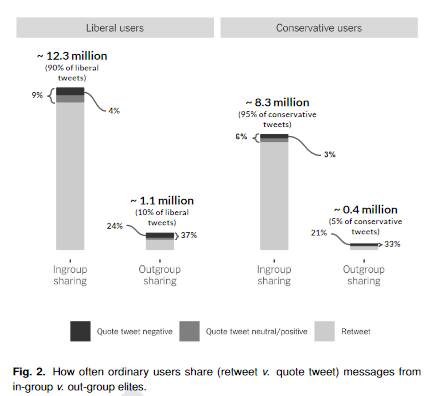
Here's the relevant bit on quote tweeting, drawn from a large sample. Classifying how ordinary users responded to liberal and conservative elites' posts (journos, politicians, etc.).

If you suspected conservatives live in a tighter echo chamber, congrats, here's some data for you. But liberals' isn't that much larger.

And here we see that most QTs when directed at *out-group* members are negative. Overhwhelmingly so.

This may confirm our intuitions that QTs are often negative; Wojcieszak also argues that the ingroup sharing helps reinforce a certain amount of ideological conformity, even when positive.

But bear in mind the limitations. This is how us ordinary slobs interact with the powerful. Some might argue it's *good* that we give them a reality check, say.

This is the problem with this kind of data. Determining what it means is hard.

If you want to read the whole thing for yourself, check it out here! https://osf.io/xwc79/

Taking a broader view, the evidence we have is mixed. Alice Marwick's "Morally Motivated Networked Harassment as Normative Reinforcement" interviews numerous harassment victims and moderators; one cites quote-tweeting as an abuse vector.

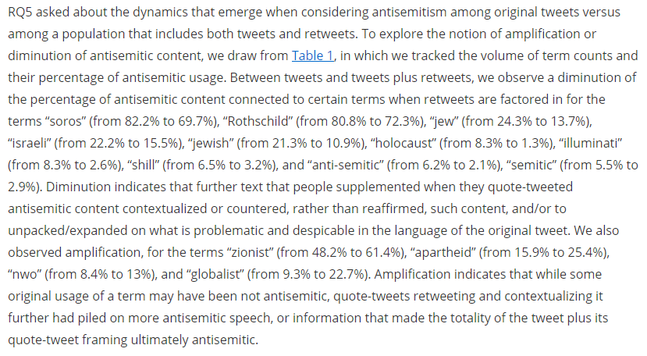
In "Platformed Antisemitism on Twitter," Martin Reidl, Katie Joseff, and Samuel Wolley find evidence that QTs both amplified antisemitic content *and* recontextualised and neutered it.

The relevant section is here if you want to read for yourself. Basically, it's swings and roundabouts. In the Great Mastodon Debate, I've seen people take both sides here, emphasising one over the other.

But the truth is that this is always going to be hard to quantify. In doing this sort of content analysis on large data sets we're always in "is it a particle or is it a wave?" territory as we try to operationalise our variables--making them into things that can be counted.

The question of "what does this mean?" or "what should we value?" invariably gets into philosophical territory.

Which brings me to my next point--

There is every possibility that if we were to count up every QT and were able to objectively label them as harassment or neutral or positive in tone, we might find harassing QTs outnumbered. But then we get into quality over quantity.

What if the abusive QTs just matter more? What if they loom larger in the public consciousness? What if they generate more engagement? What if that engagement is itself largely abusive? (And this is the heart of the problem, by the way.)

The QT itself matters. But what *really* gets us is the second-order effects, which can be hard to accurately measure. This is the networked harassment Marwick describes--and she brilliantly covers how moral motivations often drive abuse--or the harassment campaigns *I've* studied. A quote tweet may flood with abuse in its comments, and it may also *inspire* more monadic abuse being hurled from all sides.

That's tough to measure, but it often overwhelms positive use cases in scale.

That doesn't mean the positive use cases don't exist, mind you. Nor that they're not important. *I* miss quote-tweeting a lot because of the way you could easily 'yes-and' someone worth amplifying and bring a constructive conversation to your followers.

Or as Reidl and colleagues observed, the ability to recontextualise hostile content and provide a robust counternarrative.

The question to answer is: is this worth all the downsides? And numbers can't answer that for you. Only you can.

Addendum: another qualitative point to consider is the psychological impact of certain kinds of QTs.

So, as a trans woman I find myself following a lot of other community members who frequently make a habit of QT-dunking on some bigot (indeed, I was just kvetching about this a little while ago on here). Recontextualisation is happening, an epistemic battle is being waged--and perhaps even won.

But constantly seeing the words of people who hate you? Not exactly ideal.

And that very issue kind of explodes the negative/positive QT binary. Because even a constructive or resistive use can have negative second-order effects. The panopticon of doomscrolling has many sources, after all.

So that's something else to consider, and something else that's harder to measure (a methodology using interviews would be a better approach here, for example).

@Quinnae_Moon
As someone who was part of science communication / academia Twitter, QTs are so important to the way we do science outreach. It has really impacted the way I am able to impart things to the folks that follow me.

I can't just boost that nifty paper from Nature because that's not outreach. That doesn't help the folks that aren't in medicine understand what that paper means. I don't want to just boost information on vaccines, I want to talk about what's good about the information, what's not so good about the information. I want to point out what certain terms mean. I want to teach you about what I'm boosting.

I want people to understand my job in the clinical lab. How to advocate for themselves. Why this news article is bullshit and how to spot similar issues with the media blowing medical discoveries out of proportion. This is why QTs are extremely valuable. They help us teach.

@warkittens @Quinnae_Moon Could you not do all those things with a regular link, or screenshot, or quoting by copying the text in quotation marks, or some combination? I cannot help but feel like members of the media quote tweeting everyday and especially marginalized people does so much more harm than science and academia could possibly counterbalance.

@robotrecall
@Quinnae_Moon
It's an effort thing tbh. I spend my day in the lab dealing with COVID, flu, RSV, etc samples. It's stressful and I get paid shit all. By the time I get home I'm toasted. I'm lucky if I even eat dinner.

If you talk to scientists that do this, you're gonna talk to people are passionate about teaching people. The majority of us also are low on spoons.

I guess I just hung out on a completely different part of the birb because it just never was an issue where we were. I think it's completely unfair to expect the same result in a new space.

@warkittens @Quinnae_Moon I’m also disabled, so I get the spoons thing. But that’s a major part of why a dogpile can drain me so badly even if it’s a battle I sort of got to choose. They don’t have to have even slightly good arguments if there are enough of them. They just have to have enough people leveraging dangerous rhetoric even very badly that it overwhelms you.

If the defense against people who have opinions on other people for a living is exhausted scientists with no time who aren’t even focused on that aspect of harm because it’s outside their purview, then I feel bad for the scientists, and I am worried about larger issues, but my much more immediate safety concerns have to come first. No one steps in to help us. They’re either not concerned with that issue, or they’re too close and it’s too risky to get involved. We’re all alone.

So no, I don’t think that more work for the sake of other people’s safety is too much to ask. If it’s impossible, that sucks a lot, but still no.

@robotrecall
@Quinnae_Moon

Let's think about it this way — Nothing is stopping these people from copying a link to your post and doing the same thing.

Some instances put a preview of what you post, so it's pretty much like a QT. Some instances already HAVE QTs and it's not blockable. Anyone running Misskey has them.

That's kind of the problem with open source, people can just add features if they want them. And the way Mastodon works is that you'll never know because it won't render for anyone without that option built into their instance, it will just look like a link and OP won't get pinged. We went thru this entire process today as someone coded up the feature as a test.

What do you do in this case?

@warkittens @Quinnae_Moon If it doesn’t ping, then whatever, fine? That’s not the boost function with a quote ability, it’s a link with a preview. I’m not against links on the internet. I think I asked about whether links with a screenshot would suffice in my first reply? That’s even less control for the original author. A screenshot won’t update if the post changes or vanishes. To me, that’s not much like a quote tweet. It’s not an interaction, it’s a source link. Links can absolutely be used to do terrible damage, but my goal is not to fight everything that could possibly do harm with no differentiation or priorities. The existence of other bad things does not invalidate my position.

It’s been a very difficult Christmas, and I’m not a web programmer anyway, so I do nothing. From a networking perspective, wouldn’t an instance with quotes have to be exactly as blockable as any other instance, though?