Just because queer people and other folks built the fediverse or its protocol to avoid some kinds of harassment and violence doesn’t mean that the fediverse cannot be home to other kinds of violence or marginalization.

Put simply, a queer history does not preclude a present that enables structures of oppression. I want to be specific about this because much of the violence I’ve experienced in queer spaces is at the hands of white queers.

Now, this isn’t generally the case on mastodon/the fediverse, but the queer history of the fediverse hasn’t stopped racists or norms of whiteness from taking up shop and organizing the space. A queer history didn’t keep racist slurs out of my mentions.

To be clear, I’m not denying the queer history of the fediverse: I’m rejecting its use as a counter-argument against structures of oppression on the fediverse. I’m also rejecting the immediate assumption that queerness = anti-racist.

This latter is important because we have to understand that a queer history or queerness itself does not ensure freedom from all other forms of oppression.

Let me put it another way: queer people might’ve built the fediverse, but they threw open the doors to everyone. And, insofar as online spaces are continuous with offline spaces, assholes found their way in.

But this isn’t the fault of the queer devs who built this place, and I’m not ascribing blame. What I’m saying is that a queer history is no defense against an oppressive present especially given the nature of the fediverse and its instances.

Now, if we wanted that history to matter for the present, we’d need to make it matter in concrete’s ways. We’d need to do more than say “queer people built this place,” and leave it at that.

We’d gave to learn why it was built like this, how it sought to enable freedom from violence, and why that history doesn’t prevent current issues. We’d actually have to be intentional about the values that founded this place.

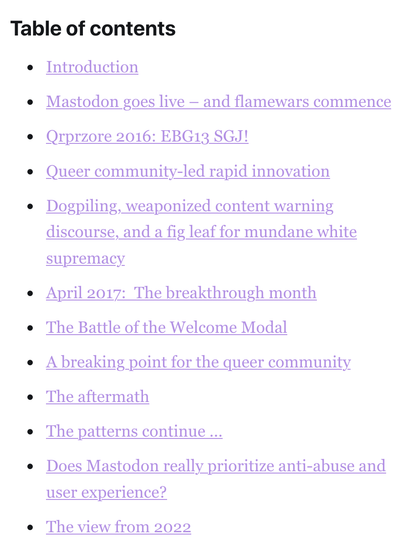
Mastodon: a partial history (DRAFT)

https://privacy.thenexus.today/mastodon-a-partial-history/

As @shengokai says ⬆️, if we want Mastodon's history to matter for the present, we need to look in detail about how and why it was built. Here's my (draft) attempt to do that -- highlighting the amazing contributions of the early community (much of which has never been properly credited) without whitewashing the past.

Feedback and discussion welcome!

#mastodon #history

Mastodon: a partial history (DRAFT)

I'm flashing!

The Nexus Of Privacy
@jdp23 @shengokai Thx so much for both of you for reminding of key lessons, and thx for crafting this text, it helps a lot!
@stefanlaser glad it's useful!
@jdp23 One more thing: can I cite this partial history in an academic article? I'm part of a collective that's tinkering with Mastodon hosting, and we're submitting this tiny comment next week. Your text gives an excellent overview of the movement side of Mastodon.
@stefanlaser I'm flattered ... feel free! I've added a few more links (and fixed some typos) since the first draft, just updated it with a new section on the early fediverse

@jdp23 A brief update: here's our piece with a reference to your text. If you find the time (which is certainly rare at the end of the year!), feel free to jump in and comment. There are certainly many shortcomings in our reflections on how the system operates.

https://www.easst.net/article/the-environmental-footprint-of-social-media-hosting-tinkering-with-mastodon/

The environmental footprint of social media hosting: Tinkering with Mastodon

A growing body of literature on waste and discard studies has crafted a powerful critique of waste management and politics (Callén and Sánchez Criado 2015; Liboiron and Lepawsky 2022; Gille and Lepawsky 2022; Ek and Johansson 2020). In today’s dominant waste regime, waste is naturalized as a burden

EASST
@stefanlaser thanks, looks like a very interesting paper! i'll have a look at it but probably not until next week....