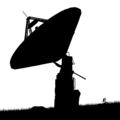
We often hear about light pollution being terrible for night sky observing (amongst many things). This is related to human-generated artificial light in our cities and towns that creates a 'fog' that blocks out the fainter objects in the sky.

Anyone living in any of the big cities only ever sees the brightest stars, and often when heading to a remote location, are overwhelmed with the beauty and amount of stars that we are robbed off.

But EM pollution can also occur in the radio regime, and the equivalent of light pollution for radio astronomy is radio frequency interference (RFI) - generated by mobile services, TVs, satellites, wi-fi, airports, radars, etc.

A growing problem of RFI is starting to come from above, rather than around us - that is, satellite RFI. Yesterday, I was observing my pulsar with Parkes when the NAVSTAR-27 satellite moved into the beam. It killed my signal-to-noise! (image 1). There are so many satellites above our telescope at any given time (blue crosses in image 2) with more going up with large constellations. So more chances of RFI from the sky for us.

Human dominance in Low-Earth Orbit is becoming a big risk for radio astronomy.

#Astrodon

@CosmicRami I remember reading an article about setting up radio telescopes on the moon. Do you think that will be a feasible solution to this problem?

@timothynewman great question! I might be exploring this a little further in my PhD in next couple of years.

I think it is doable, but there are still many challenges. For example, the type of telescope being built is a big challenge. A dipole antenna is easy to set up, but doesn't collect much data. A dish antenna is better, but requires building, then ongoing maintenance. All these things are costly and need humans there to do some engineering.

We have to consider lunar geology ('moon quakes'), accurate atomic clock timing, micrometeorites, and solar radiation.

Then there is the problem of data. Radio telescopes collect A LOT of data per second, so we either need to process the data on the Moon and beam it back, or send the data back to be processed here.

Lastly, the far side of the Moon is protected from Earth's EM radiation. So we need to protect this heritage as well.

So its doable in theory, but just not yet!

@CosmicRami Navstar's are the GPS satellites, right? Were your observations done close to their 1.5/1.2GHz navigation signal bands, or was it likely interference due to their telemetry transmitters?

Do you use tooling to plan observations around satellite 'occultations' for sats which are likely to generate OOB interference?

@INCO We use the ultra-wideband receiver, so that covers a bandwidth range of 3.3 GHz (from about 700 MHz - 4000 MHz). This particular RFI was at 1575 MHz. Don't use any tools, just try and avoid them as much as we can!

@CosmicRami Some years ago I worked on a study on interference of W/E-band communication (so ~70-80GHz) with radio telescopes, although there we only took into account the bands with special protection status in accordance with ITU methods and regulations.

Your description supports my worries that this set of regulations is inadequate to protect radio science applications in the face of increased space traffic. :/