1/ The relatives of missing Russian and 'LDPR' soldiers are being targeted by scammers, including fortune-tellers, "white magicians" and fake journalists, while soldiers themselves say hundreds have been left wounded on the battlefield for days without help or evacuation. ⬇️
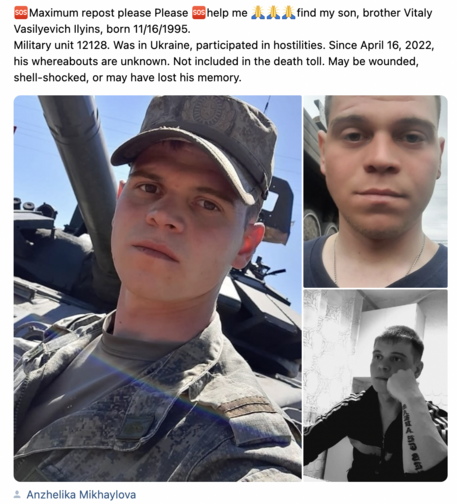

2/ The independent Russian media outlet Verstka reports that after relatives post about their missing loved ones on social media, they are often contacted by strangers offering to help them for fees of thousands of dollars, or asking for ransom payments.

One scam involves relatives being told by someone posing as a journalist for Ukraine's NewsOne TV channel that their relatives were being held by the Ukrainian armed forces. The relatives were invited to pay a $5,000 fee to submit an "appeal".

3/ Another similar scam involves someone posing as a member of the Wagner mercenary group involved in negotiating prisoner exchanges. The person invited relatives to transfer money to the account of an apparent career criminal in Novosibersk.

This wasn't a sophisticated scam – he "sent a screenshot of a video with two young men in Russian uniforms against the background of the Ukrainian flag", in which a missing soldier's head was "roughly photoshopped" onto the torso of one of the soldiers.

4/ "White magicians", clairvoyants and fortune tellers are also cashing in. The falsity of their statements is shown by the wildly differing claims they make about missing soldiers, as Verstka points out:

"Some write that the same soldier is "alive and will soon make himself known", others write that "according to Destiny, he is at risk of a lung wound at the age of 40-42 (in wartime)", while others say that the Tarot reading shows a cell card, which means that he is a prisoner of war."

5/ Yet another scam involves 'selling' places on Russian prisoner exchange lists. This might actually be happening – the lists' criteria are unclear and can likely be manipulated. One apparent scammer has contacted relatives offering places in the lists on a sliding scale of payments.

"A place in the top ten for an exchange was estimated at 300,000 rubles ($4,600), in the top twenty – 200,000 ($3,000), thirty – 120,000 ($1,850), other places from 51 to 60,000 ($780-920)", Verskta reports.

6/ Verstka contacted the scammer to find out what other 'services' were being offered. "From 3,000 to 20,000 rubles – photographs of a soldier in captivity. From 1,000 to 5,000 rubles – conversation with a prisoner. From 30,000 – rescue from captivity."

Offering conversations with wounded or captured soldiers appears to be a popular scam. Verstka transcribes a call from a self-described 'PMC [mercenary] coordinator':

7/ "He has a wound in his thigh. Tell me when you pay, I'll tell them to give you a phone number. Don't worry, he's on a drip with painkillers. I can help with communication if you need it. Here's this card number <...> 400 rubles, and that's solely because of you, so you don't have to worry. Talk to me and maybe you'll calm down."

8/ Verstka tracked down this particular scammer, a recently-released ex-convict named Vladimir who is targeting the relatives of other convicts recruited by Wagner. A former cellmate and a corrupt prison guard are providing details of the recruits.

"I use this data to search through VKontakte and Odnoklassniki for his relatives", Vladimir says. "I write to them: so-and-so so-and-so, call sign so-and-so, asks to contact you. But we are abroad, so we need money to make the call.

9/ A regular call costs 400 rubles ($6.17), while a video call costs 800 ($12.34). She transfers 400 rubles to me, and I call her back in 15-20 minutes and tell her that he does not want an ordinary call but wants to make a video call. Either I transfer 400 rubles back to you now, or you pay more. She was like, "That's it, let me pay extra." And that's it, she pays more, then I call her back in about 30 minutes and tell her:

10/ "The man is in a tragic situation, he needs painkillers, I need another one and a half (thousand rubles) ($23.12)." And then that's it, I stop talking to them."

The amounts are relatively small, under 2,500 rubles ($38.54), as Russian law provides for only limited criminal liability for petty theft up to that amount. Nonetheless, the sums add up. Vladimir says he has made up to 220,000 rubles ($3,400) in only a month.

11/ Russian prisoners' rights and soldiers' mothers groups report that relatives throughout Russia are being subjected to outright extortion. After they publish photographs of missing soldiers on social media, they receive messages from strangers using Ukrainian phone numbers.

The relatives are told that the caller is from the Ukrainian SBU (Ukraine's domestic security agency) "and that the missing person is in the pre-trial detention center in Lviv, asking for money.”

12/ In some cases, families are told that if they do not transfer money, their relatives will die. Others are told that they must pay for information on where their relatives are buried.

The "Russia Behind Bars" group suggests that the calls are being made by Russian soldiers using looted Ukrainian mobile phones. They note that it would be easy for mobilised prisoners – presumably serving with Wagner – to engage in such scams after being sent to Ukraine.

13/ The relatives' plight is being made worse by the lack of information on what has happened to their loved ones in Ukraine. They are relying on word of mouth between soldiers' families, but are getting little or no help from the Russian authorities.

Survivors have also provided relatives with information on the missing, though the very high level of casualties has meant that entire units have been wiped out.

14/ In some cases, they say that hundreds of wounded have been left to die on the battlefield with their comrades forbidden to attempt to rescue them.

After one battle, survivors told relatives that "there were about 100 people left on the field after the shelling who could not leave on their own. They had simply been abandoned. For another 10 days the survivors screamed and cried for help, but no one came for them.

15/ The survivors were forbidden to go back for their wounded. They were told it was dangerous, a trap set by the Ukrainian army.

A survivor told the niece of a missing soldier that "the wounded remained on the battlefield, and he himself was among them. My uncle was there too. For several days they crawled across the field, and this man followed my uncle. But at some point he lost consciousness, and when he woke up, he no longer saw him."

16/ Russian soldiers sent up quadcopters to look for the missing. "The fighters say they see bones and military uniforms lying on the ground, but they cannot take them away because this area is under fire."

One relative notes that "there are a lot of missing Russian servicemen now, and almost no one talks about it. For the dead, we know at least approximate statistics, but for those who went missing, nothing."

@ChrisO_wiki tooting this around here for the first time