@xs4me2 First let us point out the irony of a Hearst founded media outlet complaining about “The issue is [..] that they[social media] increasingly have the power to influence democratic discourse without appropriate checks and balances. They might make mistakes. They might make decisions that offend the basic norms of a free society. They might inadvertently design systems that harm the democratic process.” when the Hearst Corp. literally started the Spanish-American war by manipulating newspaper coverage.
Even in spaces this article lauds as success we see the critical failures of censorship, “After a British teenager took her own life in 2017—the tragedy that prompted the UK Parliament to review its laws—Facebook and Instagram removed around 35,000 posts relating to self-harm and suicide every day.” The result is that people who want to have a serious conversation about the topic have had to resort to using the word ‘unalive’ to avoid over-bering filters.
“So what would a better system look like? It would start by ranking platforms according to their level of social risk. At the lower end would be modest online spaces like community forums, hobbyist groups and fansites.” Who does these rankings? Is Gab a community forum or a large important platform? Does the answer change depending on who won the last election?
“Lawmakers might, for example, decide that platforms should have reasonable or proportionate systems in place to reduce the risk of online harassment. Or that platforms should have reasonable or proportionate systems in place to reduce the risk of foreign interference in the political process.” Again who defines ‘reasonable and proportionate?’ Does it change if Doanld Trump wins a second term in 2024? Does Polish President Andrzej Duda get a say in EU regulations?
“There would be no government “censor” scrutinizing individual moderation decisions or pieces of content. Platforms would be entitled to make mistakes, as long as their overall systems were adequate.” I don’t think Jamie Susskind understands just how much of a chilling effect this will have on speech. there is no way to know where the line is and so social media platforms will be forced to err on the side of over-bearing censorship while the government gets to wink and say “we did nothing it was the platform’s own choice.” What will happen when, as an example, any discussion of race or sexuality is removed because those discussions too often lead to on-line harassment?
We can see this clearly with Elon Musk taking rules against disclosing private information and using it to censor ElonJet for “doxxing” him and then censoring journalist for covering it.
The article is written under the delusion that good people will always be the ones making the tough calls and that they will do so in good faith. The reality is that such power attracts the worst kind of people (c.f. Musk) and that they will use regulations to act in their own self-interest.
 Parker Molloy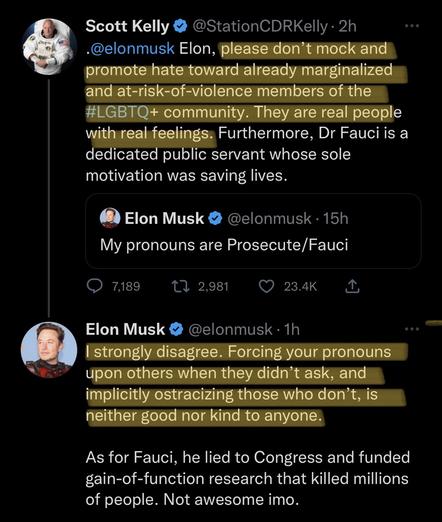
 xs4me2
 Reach for the Stars

