Émilie du Châtelet, who hypothesized conservation of energy, established kinetic energy as distinct from momentum and proportional to (speed)², and combined work by Newton and Leibniz with her own original ideas in "Institutions de Physique," was born #OTD in 1706.

Du Châtelet is an important figure in the development of classical physics, but she is not nearly as well known as many of her male contemporaries.

Portrait: M. Q. de La Tour
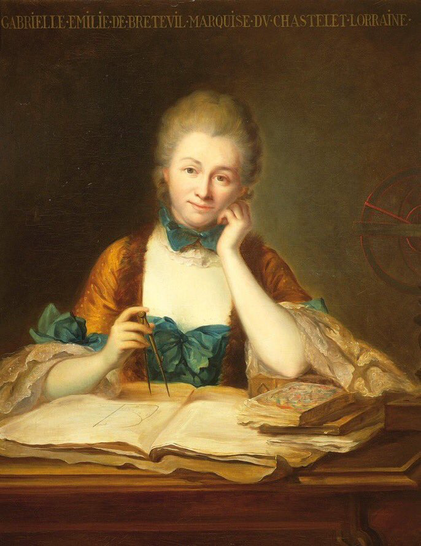
Born Gabrielle Émilie le Tonnelier de Breteuil, part of the French aristocracy, she was fascinated by astronomy, math, and physics. Her mother found her interests inappropriate but her father supported them. He invited many well-known scientists to their home.

After marrying, she continued her education on her own. She invited prominent scientists like Maupertuis, Koenig, and the Bernoullis to her home (which had a huge library and a laboratory) where they would discuss science and mathematics.

In 1737 du Châtelet submitted "Dissertation sur la nature et la propagation du feu" for a contest held by the French Academy of Sciences.

In it, she hypothesized different colors of light transmitted different amounts of heat, and guessed at the existence of infra-red radiation.

Then in 1738, she published "Eléments de la philosophie de Newton" in Journals des Savants, advocating for Newton and arguing against Cartesian ideas of gravity. This contributed to the decline of the latter, which at the time was still relatively popular in France.

Du Châtelet’s work on Newtonian ideas led to a book written with Voltaire: “Elements of Newton’s Philosophy.”

Voltaire’s name appeared on the cover, but he was clear that it was her work as much as his. Their contemporaries knew that she was by far the superior mathematician.

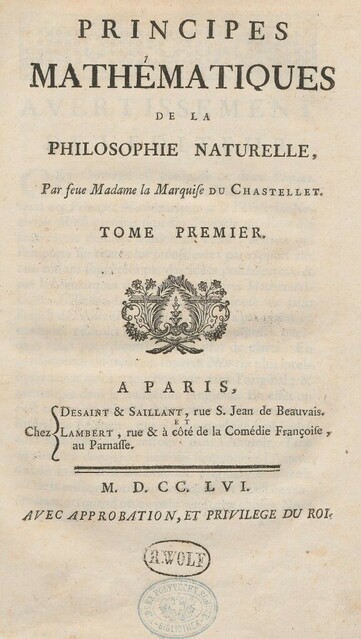
In 1740, du Châtelet published "Institutions de physique." It was presented as a textbook for her 13 year old son, but was in fact a significant work of natural philosophy that synthesized ideas of Leibniz and Wolff to establish a metaphysical basis for the work of Newton.

In the book, she develops Leibniz's idea of vis viva — what we now call kinetic energy.

Using experimental ideas of Dutch natural philosopher Willem Jacob 's Gravesande, du Châtelet established that it was proportional to the *square* of an object's speed.

This led to an extended and very public argument with Jean-Jacques d'Ortous de Mairan, the Secretary of the French Academy of Sciences.

In an essay, de Mairan had asserted that the quantity we now know as kinetic energy should be proportional to the product of mass and velocity.

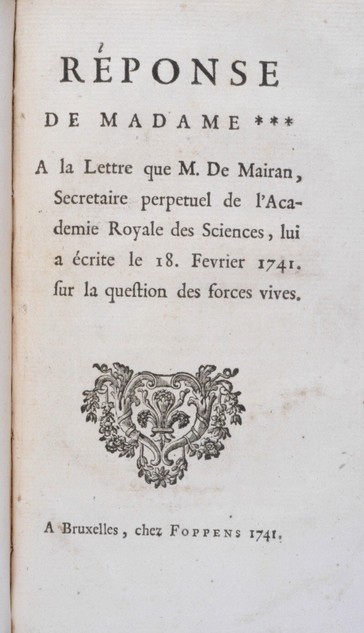
The argument raged for a few years and took a great toll on du Châtelet. Her rebuttals were eventually published as "Réponse de Madame la Marquise du Châtelet."

Photo: D. Lockard, Chemical Heritage Foundation

In retrospect everyone agrees that the argument was a bit one-sided: de Mairan was simply outclassed by du Châtelet. But du Châtelet's mentors and colleagues had failed to publicly support her. She resented them for it, and felt isolated.

A few years later, around 1748, she began working on a French translation of Newton's Principia. While working on the translation she learned that she was pregnant with her fourth child.

At age 42, du Châtelet was concerned that the pregnancy might be dangerous. She began working around the clock on her Principia translation. The work was completed just before the birth of her child.

Less than a week after giving birth she passed away.

Du Châtelet's translation of Principia remained unpublished for around ten years. The full work finally saw print in 1759, when the first predicted return of Halley's comet led to a surge of interest in Newton's mechanics.

Voltaire contributed a preface, in which he said of her:

"For a long time she moved in circles which did not know her worth and she paid no attention to such ignorance."

Émilie du Châtelet's translation of Newton's Principia contained a great deal of commentary, derivations, and supplementary material, and is still regarded as the definitive French translation of the work.

In a letter to Frederick of Prussia, who apparently did not like her at all, du Châtelet said:

"Judge for my own merits, or lack of them, but do not look upon me as a mere appendage to this great renowned scholar or that, that I am in my own right a whole person, responsible to myself alone for all that I am, all that I say, all that I do."

"It may be that there are metaphysicians and philosophers whose learning is greater than mine, although I have not met them. Yet, they are but frail humans, too, and have their own faults; so, when I add the sum total of my graces, I confess that I am inferior to no one."
@mcnees my kids just got a science lesson that Einstein came up with conservation of energy -- I sent them to her Wikipedia page. Very tickled to see this thread just a week later!
@mcnees Thank you for this fascinating thread!
@mcnees
I was pretty sure I'd not heard of Madam du Châtelet, but apparently it is only my memory that is at fault.
I pulled Volume III of the History of Science in Western Civilization text book for the course I took junior year at Cornell in the late '70's; while the index fails to include du Châtelet, she is included in the section titled "French Science during the Century of Lights". She's introduced as Voltaire's mistress, an accomplished mathematician and translator of the Principia.
@joeinwynnewood While I think it’s true that they had an affair, when books lead with that it detracts from her skills and accomplishments. And she really accomplished quite a bit!

@mcnees
No argument from me.

The text book was written ~50 years ago, when the authors were building a cadre of graduate students aiming to staff university history of science programs and departments.

One of the authors, L. Pearce Williams, was my prof, described (self-described?) at the time as a "Renaissance Man".

I remember him being hard on everyone, open to well reasoned & documented arguments, but very much a center-right white male ensconced in a white male milieu.

@mcnees French is easier than the original Latin (I have only the Latin version).
@mcnees a moving story. Such a visionary who helped spread of science

@mcnees THIS IS SO COOL.

... THAT IS NOT A PUN.

@mcnees I recognize her name .. but didn't know she was a woman.
@mcnees I just had a student do a project on her in my History of Math class.
@mcnees
I'd say you are right. I majored in physics in the 60s and hadn't heard of her.
@mcnees She looks like she’s pretty much conserving energy right there
@mcnees Along with her illicit lover and friend Voltaire, du Châtelet were wild cultural elites. It is sad she died at such a young age during child birth.
@mcnees oui c'est vrai. Une injustice. Quand même je préférerais qu'on quitte les narrations des inventrices et inventeurs particulièr(e)s pour comprendre les millieux et circonstances.
@mcnees example of why more women historians are needed