 Conrad Hackett
Here is a 🧵 of Pew Research Center's striking findings from 2022
https://www.pewresearch.org/fact-tank/2022/12/13/striking-findings-from-2022/ #PewResearch
https://www.pewresearch.org/fact-tank/2022/12/13/striking-findings-from-2022/ #PewResearch
Christians may be a minority of the US population by 2070.
Depending on whether religious switching continues at recent rates, speeds up or stops entirely, #PewResearch projections show Christians of all ages shrinking from 64% to somewhere between 54% and 35% of all Americans by 2070. Over that same period, “nones” would rise from their current 30% of the population to somewhere between 34% and 52%.
https://www.pewresearch.org/religion/2022/09/13/modeling-the-future-of-religion-in-america/
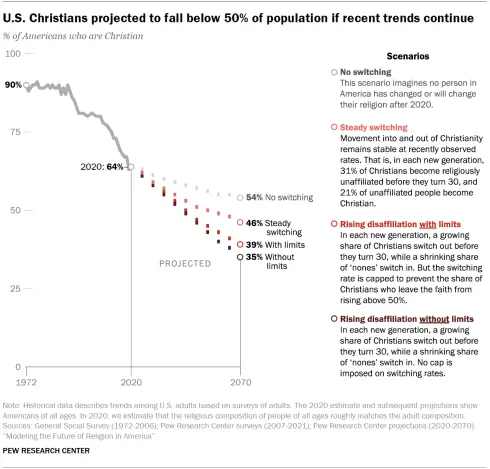

Since the 1990s, large numbers of Americans have left Christianity to join the growing ranks of U.S. adults who describe their religious identity as atheist, agnostic or “nothing in particular.” If recent trends in religious switching continue, Christians could make up less than half of the U.S. population within a few decades.
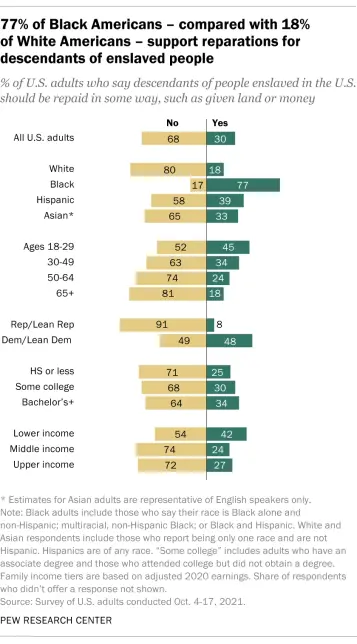
77% of Black Americans – compared with 18% of White Americans – support reparations for descendants of enslaved people.
Among Democrats and Democratic-leaning independents, views are split: 48% say descendants of enslaved people should be repaid in some way, while 49% say they should not. Only 8% of Republicans and GOP leaners say these descendants should be repaid in some way, and 91% say they should not.
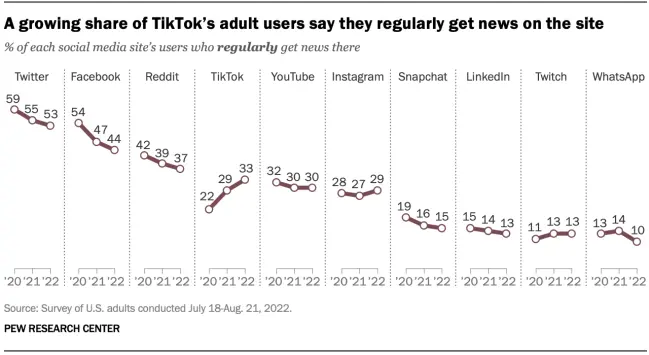
US: 33% of TikTok's adult users regularly get news on the platform, up from 22% two years ago. News consumption on many other social media sites has either decreased or stayed about the same in recent years.
53% of Twitter users regularly get news on the site, which is higher than the share of users who get news from Facebook, Reddit, or YouTube.
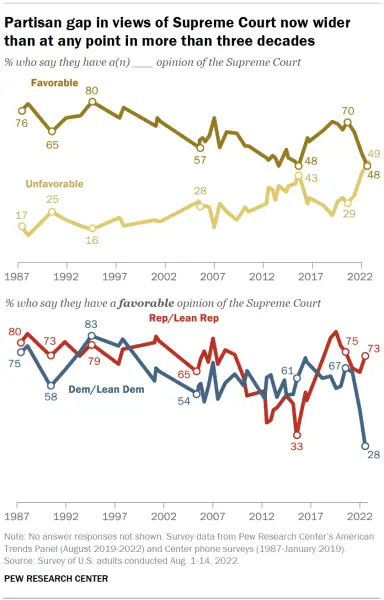
US: The size of the gap between how Republicans and Democrats view the Supreme Court is larger than it has ever been in more than three decades of polling.
73% of Republicans view the Supreme Court favorably
28% of Democrats view the Supreme Court favorably
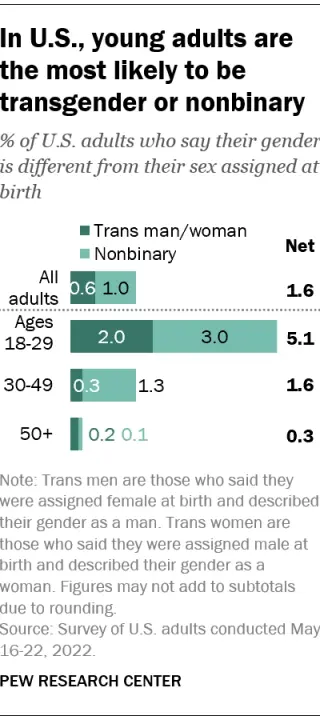
Transgender or nonbinary US adults, among those age
18-29: 5.1%
30-49: 1.6%
50+: 0.3%
44% of US adults personally know someone who is trans.
20% know someone who is nonbinary.
In focus groups with trans and nonbinary adults, most participants said they knew from an early age – many as young as preschool or elementary school – that there was something different about them, even if they didn’t have the words to describe what it was.
@cafkafk I understand and appreciate this concern. Are you more concerned with the survey itself or my post about the results? How would you describe the survey results?

 cafkafk