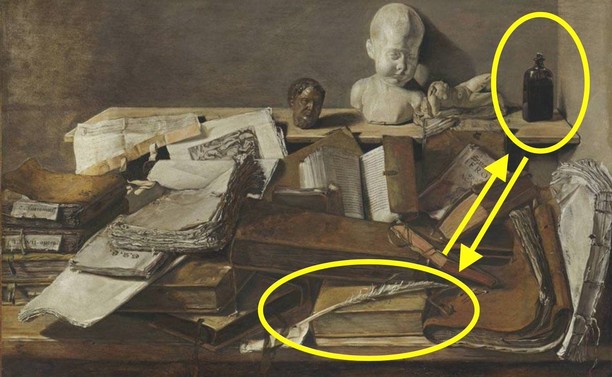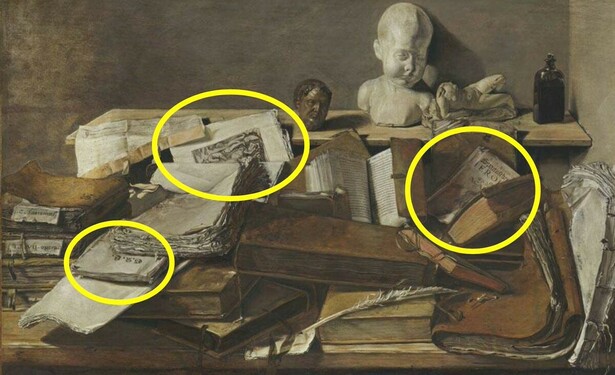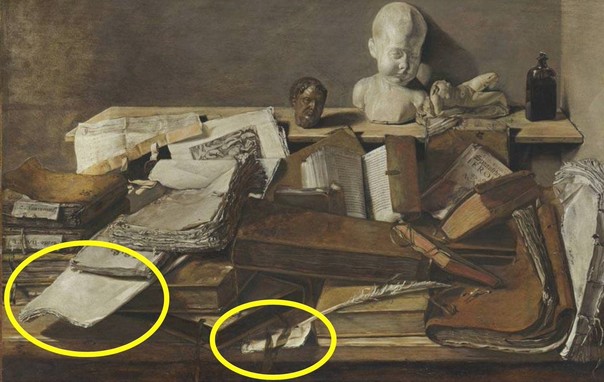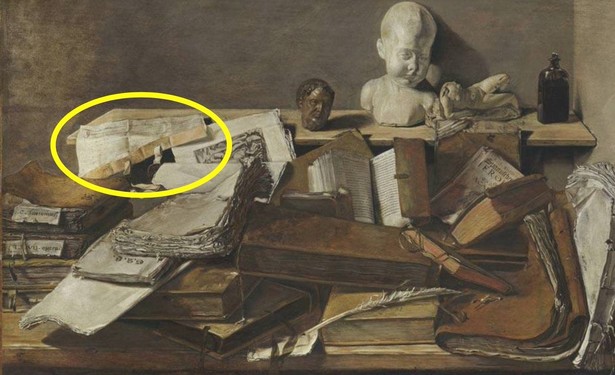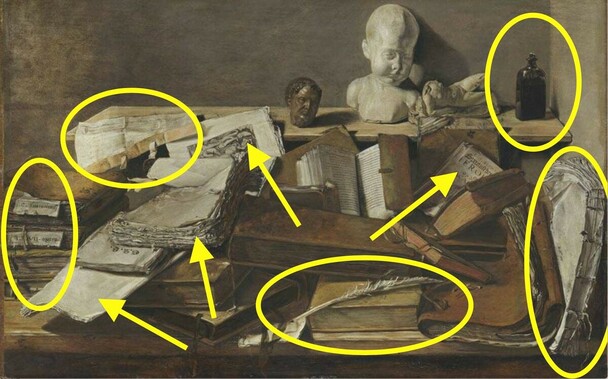
Why do we call early modern Europe a paper age? Well, let's have a look at the hints given on this painting from early seventeenth-century by Jan Lievens. Source: https://t1p.de/of6z (Alte Pinakothek, München).

A thread not only for #paperhistory and #bookhistory but for all #histodons

1/9

Sammlung | Bücherstillleben

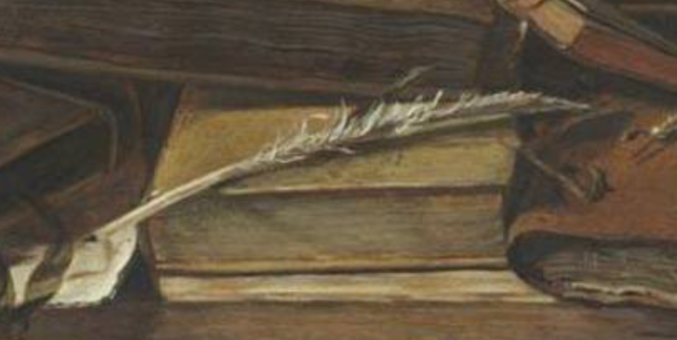
Let's start with this instrument, almost hidden, but important for paper usages: the quill. More precisely: the feather quill, often a goose feather prepared for writing. Nota bene: the word 'pen' derives from penna, Latin for feather. No quill, no fun at the secretary. #histodons, early modern Europe was an age of writing with quills on paper.

2/9

Writing letters and records was not only a content managing information battle, it was a material business too. In order to use a quill you needed ink. Your pen/quill would have to be refreshed constantly with ink. This inkwell reminds us of the material conditions of writing. In the end, it was an inky business of using papers. #histodons

3/9

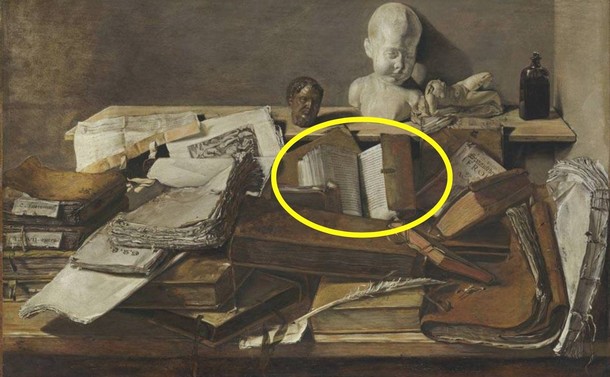
When talking about early modern paper books, some of us still get the impression that this talk is about printed books with a binding. More than one example on this painting might lead in this direction. But truth is: these bound books were a minority, only one variation. Most printed publications of the period were never bound - the print industries were an unbound content management system. #histodons

4/9

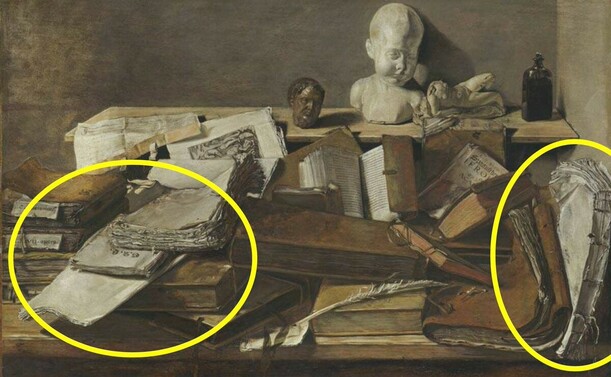
Most printed paper books of the period were unbound, very often not even stitched together. The paper books for writing purposes - for record keeping, accounting etc. - were sometimes bound. Smaller paper usages, for drafts, were all unbound, a loose paper management. #histodons

5/9

Regarding the small printed books of the period: pamphlets, newspapers, almanacs, broadsides, broadsheets, journals, etc. Most of these publications carrying text and image are nowadays "lost books". For #bookhistory: When it comes to copies from print-runs, most paper products from Europe's printing industries are gone. Our recently growing digital databases of premodern printed artifacts are collections of the survival paper evidence. Not more. #histodons

6/9

The most important product of both the communication flows and administration activities of the period was paper. Handmade paper sheets to write on and to print upon. And these blank "unused" sheets came in many formats and qualities:

https://mastodon.social/@dbellingradt/109393842551980086

Purchasing fresh, unused, paper sheets was important. Paper was sold and purchased as single-sheets, in units of 5 sheets, in units of 24/25 sheets, but the most common trade unit in Europe was the ream (500 sheets).

#paperhistory

7/9

The "paper states" of early modern Europe ran on paper work: in administration and communication. Next to "books", letters, and wrapping usages, much paper was used and needed in the cultural management of information - for example in archives. The highlighted sealed contract reminds us of these usages.

#paperhistory #histodons

8/9

Highlighting all these papers - fresh and used, written, printed and drawn upon - is making way for an alternative master narrative for the European epoch of Early Modernity (and elsewhere). No more “printing era”, historiography, it's time for a paper age narrative. Read more, #histodons:
https://doi.org/10.1163/9789004424005_002

9/9

Chapter 1 The Paper Trade in Early Modern Europe: An Introduction

"Chapter 1 The Paper Trade in Early Modern Europe: An Introduction" published on 07 Apr 2021 by Brill.

Brill
@dbellingradt than you for sharing the essay.
@MagdaTeter You are welcome.