Belatedly sharing our recent **preprint** exploring the utility of WGS for syphilis epidemiology in the UK
https://www.medrxiv.org/content/10.1101/2022.12.02.22283031v1
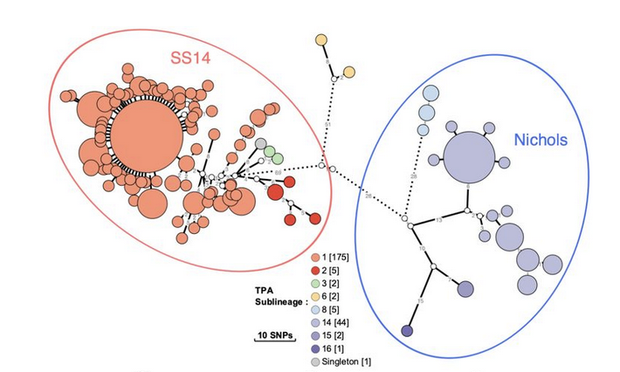
UK Syphilis rates are rising, and there's a need to understand the epidemiology better. The global & national (UK) population structures of T. pallidum are super clonal and the molecular clock rate is v low, so there was definitely a question about WGS could add any resolution, or whether everything would just be the same.
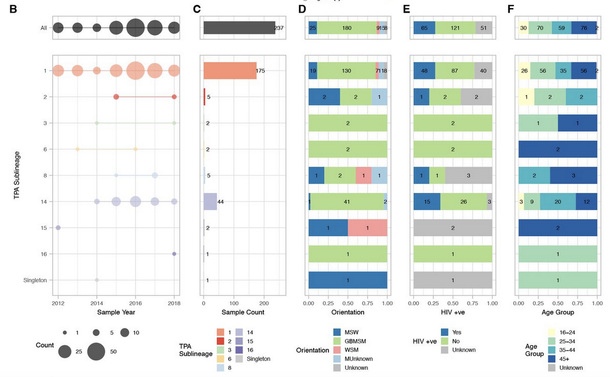
However, there are some regional differences between the common sublineages. The blue sublineage (14) here was absent from northern England

And when we looked at the sociodemographic characteristics of the patients, those two major sublineages (1 & 14) also have different profiles (sublineage 14 is associated with older GBMSM)
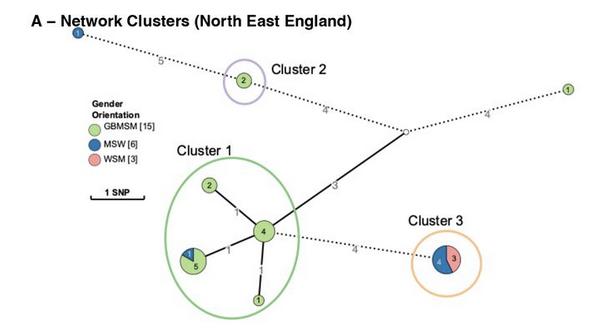
By clustering identical and near-identical genomes, we found that we could discriminate clusters of heterosexuals and GBMSM. This suggests we can potentially use WGS to identify/exclude outbreak membership. However, very unlikely that WGS could ever be used to infer patient-2-patient transmission in syphilis.
This has been a useful and important collaboration between the Sanger Institute, UKHSA, LSHTM, and a number of local UK NHS labs. Many thanks to all the staff involved in sample collection and management, patient metadata retrieval and analysis.