
En ce #InternationalMountainDay 2022, puisque le sujet semble intéresser ces jours-ci, quelques infos sur l’évolution passée & future de la #neige en #montagne.

Commençons par l’évolution à l’observatoire nivo-météo du #ColDePorte (Chartreuse)

https://www.ecologie.gouv.fr/impacts-du-changement-climatique-montagne-et-glaciers

🧵 [1/14]
Impacts du changement climatique : Montagne et Glaciers

Afin de décrire l'état du Climat et ses impacts sur l'ensemble du territoire français, l’ONERC (Observatoire national sur les effets du réchauffement climatique) s’est doté d’indicateurs. Un indicateur est une information, associée à un phénomène, permettant d’en indiquer l’évolution dans le temps, de façon objective, et pouvant rendre compte des raisons de cette évolution. Dans cette fiche, les indicateurs s'intéressent à la montagne et aux glaciers.
Ministères Écologie Énergie Territoires
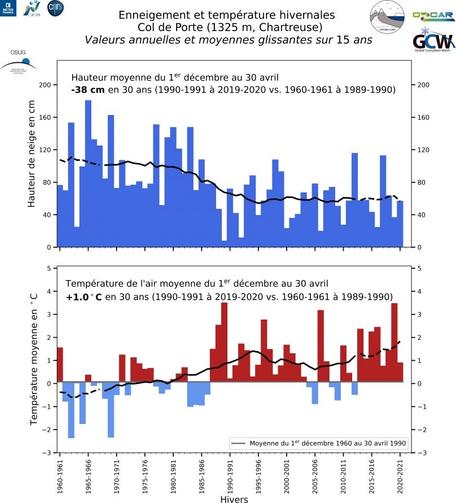
Au #ColDePorte, les observations depuis le début des années 1960 indiquent une baisse de près de 40cm de l’épaisseur de neige en hiver, et une augmentation de 1°C de la température hivernale [2/14]
Ce site de moyenne #montagne (1325 m d’altitude) illustre le double effet de la hausse des températures à moyenne altitude: précipitations de plus en plus souvent sous forme de #pluie plutôt que #neige, fonte accélérée en hiver et au printemps dans un #climat plus chaud [3/14]
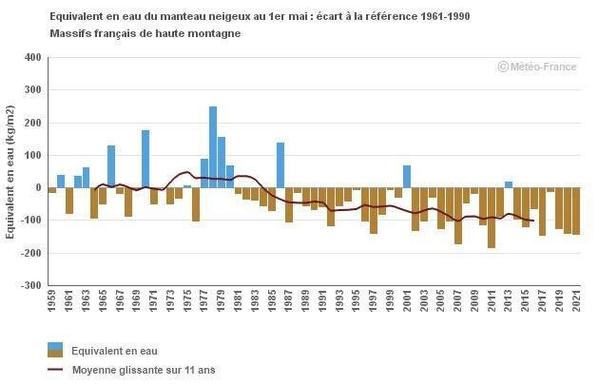
Ce résultat est constaté a l’échelle de l’ensemble des massifs montagneux français, ici par exemple la tendance (-12% par décennie) du stock de neige au 1er mai pour Alpes& Pyrénées (tendances légèrement différentes, voir https://www.ecologie.gouv.fr/impacts-du-changement-climatique-montagne-et-glaciers pour en savoir plus #ONERC) [4/14]
Impacts du changement climatique : Montagne et Glaciers

Afin de décrire l'état du Climat et ses impacts sur l'ensemble du territoire français, l’ONERC (Observatoire national sur les effets du réchauffement climatique) s’est doté d’indicateurs. Un indicateur est une information, associée à un phénomène, permettant d’en indiquer l’évolution dans le temps, de façon objective, et pouvant rendre compte des raisons de cette évolution. Dans cette fiche, les indicateurs s'intéressent à la montagne et aux glaciers.

Ministères Écologie Énergie Territoires

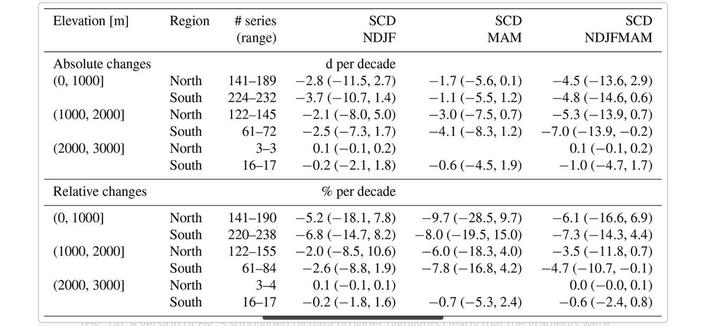
A l’échelle de l’Arc Alpin, la baisse de la durée d’enneigement est particulièrement marquée entre 1000 et 2000 m d’altitude, plus sensible au double effet de la hausse des températures.

La baisse est de l’ordre d’un mois depuis les années 1970.

https://tc.copernicus.org/articles/15/1343/2021/ [5/14]

Observed snow depth trends in the European Alps: 1971 to 2019

<p><strong class="journal-contentHeaderColor">Abstract.</strong> The European Alps stretch over a range of climate zones which affect the spatial distribution of snow. Previous analyses of station observations of snow were confined to regional analyses. Here, we present an Alpine-wide analysis of snow depth from six Alpine countries – Austria, France, Germany, Italy, Slovenia, and Switzerland – including altogether more than 2000 stations of which more than 800 were used for the trend assessment. Using a principal component analysis and <span class="inline-formula"><i>k</i></span>-means clustering, we identified five main modes of variability and five regions which match the climatic forcing zones: north and high Alpine, north-east, north-west, south-east, and south and high Alpine. Linear trends of monthly mean snow depth between 1971 and 2019 showed decreases in snow depth for most stations from November to May. The average trend among all stations for seasonal (November to May) mean snow depth was <span class="inline-formula">−</span>8.4 <span class="inline-formula">%</span> per decade, for seasonal maximum snow depth <span class="inline-formula">−</span>5.6 <span class="inline-formula">%</span> per decade, and for seasonal snow cover duration <span class="inline-formula">−</span>5.6 <span class="inline-formula">%</span> per decade. Stronger and more significant trends were observed for periods and elevations where the transition from snow to snow-free occurs, which is consistent with an enhanced albedo feedback. Additionally, regional trends differed substantially at the same elevation, which challenges the notion of generalizing results from one region to another or to the whole Alps. This study presents an analysis of station snow depth series with the most comprehensive spatial coverage in the European Alps to date.</p>

À plus haute altitude l’effet de la transition pluie -> neige joue moins, il fait encore assez froid pour que les précipitations tombent le plus souvent sous forme de #neige. Mais la fonte est accélérée au printemps. [6/14]

En ce qui concerne l’évolution future de la #neige en #montagne, rappelons qu’elle est conditionnée aux émissions futures de gaz à effet de serre, qui gouvernent l’évolution future de la température, en #montagne comme ailleurs.

https://www.ipcc.ch/report/ar6/wg1/ @[email protected] [7/14]

Climate Change 2021: The Physical Science Basis

The Working Group I contribution to the Sixth Assessment Report addresses the most up-to-date physical understanding of the climate system and climate change, bringing together the latest advances in climate science.

On avait étudié dans un article de 2018 la relation quasi directe entre durée d’enneigement en moyenne #montagne (ici Chartreuse 1500m) & niveau de réchauffement planétaire.

Environ 1 mois de durée d’enneigement par °C de réchauffement planétaire

https://tc.copernicus.org/articles/12/1249/2018/ [8/14]

Multi-component ensembles of future meteorological and natural snow conditions for 1500 m altitude in the Chartreuse mountain range, Northern French Alps

<p><strong class="journal-contentHeaderColor">Abstract.</strong> This article investigates the climatic response of a series of indicators for characterizing annual snow conditions and corresponding meteorological drivers at 1500 m altitude in the Chartreuse mountain range in the Northern French Alps. Past and future changes were computed based on reanalysis and observations from 1958 to 2016, and using CMIP5–EURO-CORDEX GCM–RCM pairs spanning historical (1950–2005) and RCP2.6 (4), RCP4.5 and RCP8.5 (13 each) future scenarios (2006–2100). The adjusted climate model runs were used to drive the multiphysics ensemble configuration of the detailed snowpack model Crocus. Uncertainty arising from physical modeling of snow accounts for 20 % typically, although the multiphysics is likely to have a much smaller impact on trends. Ensembles of climate projections are rather similar until the middle of the 21st century, and all show a continuation of the ongoing reduction in average snow conditions, and sustained interannual variability. The impact of the RCPs becomes significant for the second half of the 21st century, with overall stable conditions with RCP2.6, and continued degradation of snow conditions for RCP4.5 and 8.5, the latter leading to more frequent ephemeral snow conditions. Changes in local meteorological and snow conditions show significant correlation with global temperature changes. Global temperature levels 1.5 and 2 <span class="inline-formula"><sup>∘</sup></span>C above preindustrial levels correspond to a 25 and 32 % reduction, respectively, of winter mean snow depth with respect to the reference period 1986–2005. Larger reduction rates are expected for global temperature levels exceeding 2 <span class="inline-formula"><sup>∘</sup></span>C. The method can address other geographical areas and sectorial indicators, in the field of water resources, mountain tourism or natural hazards.</p>

Le rapport @[email protected] #SROCC de 2019, chapitre 2, illustre l’effet de différents scénarios d’émissions, en fonction de l’altitude, sur l’évolution de la température et l’enneigement en #montagne

https://www.ipcc.ch/srocc/download/ [9/14]

Download Report — Special Report on the Ocean and Cryosphere in a Changing Climate

Également couvert dans un article de @[email protected] et al. paru en début d’année, qui montre l’évolution de la masse de neige en hiver entre 1981–2010 et 2070–2099 pour plusieurs scénarios, de fortes émissions (RCP8.5) à fortes réductions (RCP2.6) [10/14]

https://link.springer.com/article/10.1007/s00382-022-06303-3

21st Century alpine climate change - Climate Dynamics

A comprehensive assessment of twenty-first century climate change in the European Alps is presented. The analysis is based on the EURO-CORDEX regional climate model ensemble available at two grid spacings (12.5 and 50 km) and for three different greenhouse gas emission scenarios (RCPs 2.6, 4.5 and 8.5). The core simulation ensemble has been subject to a dedicated evaluation exercise carried out in the frame of the CH2018 Climate Scenarios for Switzerland. Results reveal that the entire Alpine region will face a warmer climate in the course of the twenty-first century for all emission scenarios considered. Strongest warming is projected for the summer season, for regions south of the main Alpine ridge and for the high-end RCP 8.5 scenario. Depending on the season, medium to high elevations might experience an amplified warming. Model uncertainty can be considerable, but the major warming patterns are consistent across the ensemble. For precipitation, a seasonal shift of precipitation amounts from summer to winter over most parts of the domain is projected. However, model uncertainty is high and individual simulations can show change signals of opposite sign. Daily precipitation intensity is projected to increase in all seasons and all sub-domains, while the wet-day frequency will decrease in the summer season. The projected temperature change in summer is negatively correlated with the precipitation change, i.e. simulations and/or regions with a strong seasonal mean warming typically show a stronger precipitation decrease. By contrast, a positive correlation between temperature change and precipitation change is found for winter. Among other indicators, snow cover will be strongly affected by the projected climatic changes and will be subject to a widespread decrease except for very high elevation settings. In general and for all indicators, the magnitude of the change signals increases with the assumed greenhouse gas forcing, i.e., is smallest for RCP 2.6 and largest for RCP 8.5 with RCP 4.5 being located in between. These results largely agree with previous works based on older generations of RCM ensembles but, due to the comparatively large ensemble size and the high spatial resolution, allow for a more decent assessment of inherent projection uncertainties and of spatial details of future Alpine climate change.

SpringerLink
Dans cet article on illustre aussi l’évolution de l’enneigement hivernal en fonction de l’altitude, de l’échéance et du scénario futur d’émissions pour le massif du Mont-Blanc. Effets beaucoup plus marqué à 1200m qu’au delà de 2000m [11/14]
Ceci montre bien que l’évolution climatique passée & future de la #neige en #montagne est quasi partout à la baisse (questions ouvertes à très haute altitude), avec forts contrastes en fonction de l’altitude. L’information locale existe (cf Drias http://www.drias-climat.fr/accompagnement/sections/215) [12/14]
DRIAS, Les futurs du climat - Accompagnement

L’évolution de la #neige en #montagne (et la #cryosphère plus largement) a des conséquences multiples sur les ressources en eau, les risques naturels, le tourisme, l’énergie, l’agriculture etc.

Petite synthèse pour en savoir plus dans cet article: https://www.annales.org/re/2022/resumes/avril/09-re-resum-FR-AN-avril-2022.html#09FR [13/14]

Responsabilité et Environnement - N° 106 - Avril - Adaptation au changement climatique

Responsabilité & Environnement - N° 106 - Avril - Adaptation au changement climatique, Montagne, climat, neige, risques naturels, glaciers, tourisme, adaptation, Mountain, Climate, Snow cover, Natural hazards, glaciers, tourism, adaptation

C’est tout pour ce petit fil sur l’évolution passée & future de l’enneigement en #montagne. Il reste beaucoup de questions scientifiques sur ce sujet passionnant mais on en sait déjà beaucoup pour nourrir réflexions & actions pour limiter les dégâts #adaptation #reduction [14/14] https://twitter.com/smlmrn/status/1602004185146429440
Samuel Morin @[email protected] on Twitter

“En ce #InternationalMountainDay 2022, puisque le sujet semble intéresser ces jours-ci, quelques infos sur l’évolution passée & future de la #neige en #montagne. Commençons par l’évolution à l’observatoire nivo-météo du #ColDePorte (Chartreuse) https://t.co/O6pBY9GRQf 🧵 [1/14]”

Twitter