It is splashdown day for the Orion spacecraft!
Splashdown in 5 hours at 12:40 EST in the Pacific Ocean near Guadalupe Island, 250 miles SSW of San Diego.
The 6th and final trajectory correction burn occurring right now.
Shortly before the service module separates from the crew module, comms will be switched from NASA’s Deep Space Network to its Near Space Network and the TDRS satellite.
https://eyes.nasa.gov/apps/solar-system/#/sc_artemis_1?rate=0&time=2022-12-11T12:40:00.000+00:00
Webcast from 11:00 EST at https://www.youtube.com/watch?v=xzZPzmMtQA8
Go #Artemis #Orion #NASA #ESA
1/n
Eyes on the Solar System - NASA/JPL

Explore the 3D world of the Solar System. Learn about past and future missions.

Eyes on the Solar System - NASA/JPL
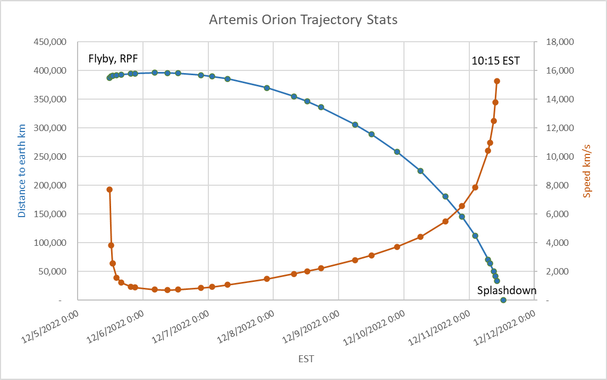
Here is a graph of Orion's speed and distance from Earth since the Dec 5 lunar flyby and RPF burn.
The Artemis blog site states that Orion's speed will be close to 40,000 km/h during reentry, as it accelerates rapidly during the last few hours of its return journey.
https://blogs.nasa.gov/artemis/
Data source: https://www.nasa.gov/specials/trackartemis/
Go #Artemis #Orion #NASA #ESA
2/n
Artemis

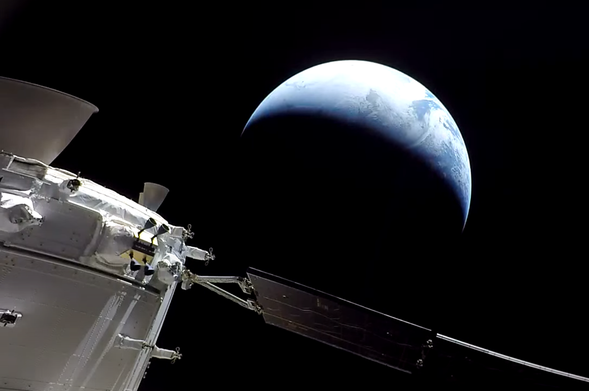
Orion (and us virtual astronauts) taking a loving look yesterday at a crescent Earth.

"That's here. That's home. That's us. On it everyone you love, everyone you know, everyone you ever heard of, every human being who ever was, lived out their lives.
To me, it underscores our responsibility to deal more kindly with one another, and to preserve and cherish the pale blue dot, the only home we've ever known" - Carl Sagan.

More pics at https://www.flickr.com/photos/nasa2explore/with/52555610193/
Go #Artemis #Orion #NASA #ESA
3/n

NASA Johnson

Explore NASA Johnson’s 63,197 photos on Flickr!

Flickr
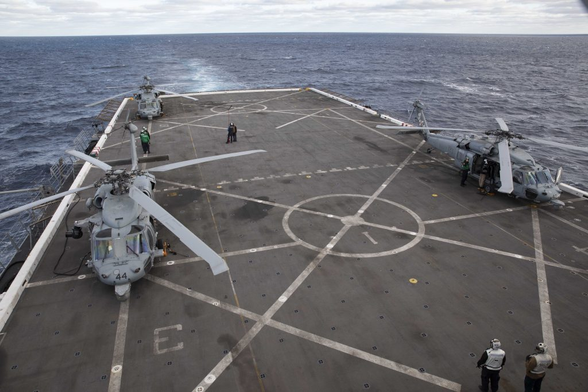
NASA's Landing and Recovery Team is well prepared for today's event. Few days ago, off the coast of San Diego, they were practicing bringing a mock Orion capsule into the well deck of the USS Portland (LPD 27).
More pics at https://www.flickr.com/photos/nasa2explore/with/52555610193/
Also see https://blogs.nasa.gov/artemis/
Go #Artemis #Orion #NASA #ESA
4/n
NASA Johnson

Explore NASA Johnson’s 63,197 photos on Flickr!

Flickr
"The Landing and Recovery Team consists of personnel and assets from the U.S. Department of Defense, including Navy amphibious specialists and Space Force weather specialists, and engineers and technicians from Kennedy Space Center in Florida, Johnson Space Center in Houston, and Lockheed Martin Space Operations."
From https://blogs.nasa.gov/artemis/
Go #Artemis #Orion #NASA #ESA
5/n
Artemis

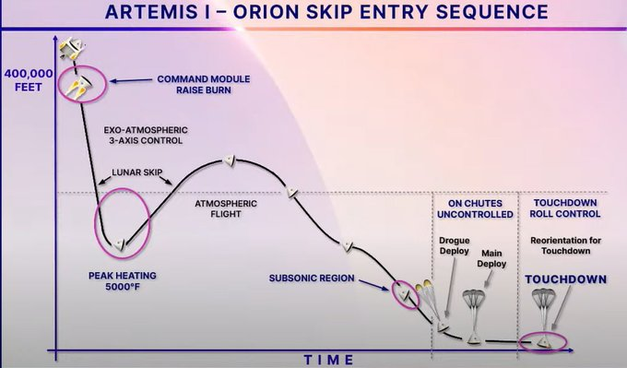
For today's reentry, Orion will use a “skip entry” technique, which has never been tried before with a human-rated spacecraft.
Orion will dip into the upper part of Earth’s atmosphere at 40,000 km/s, partially slow down, skip back out of the atmosphere, then reenter for final descent using parachutes.
Advantages:
Improved landing accuracy.
Lower g-forces on astronauts.
Lower heat rate.
https://www.nasa.gov/feature/orion-spacecraft-to-test-new-entry-technique-on-artemis-i-mission
Screen cap from https://www.youtube.com/watch?v=MkEBfxtg4Xg
Go #Artemis #Artemis1 #Orion #NASA #ESA
6/n
Orion Spacecraft to Test New Entry Technique on Artemis I Mission

Orion Spacecraft to Test New Entry Technique on Artemis I Mission

NASA
Orion update 10:15 EST : Orion altitude from earth's surface = 33,666 km. It is now closer to earth than geo-synchronous satellites like TDRS at 35,786 km altitude.
Speed = 15,255 km/s and rapidly increasing.
Go #Artemis #Orion #NASA #ESA
7/n
Oh, what a wonderful sight from Orion at 10:30 a.m. EST!
Home Sweet Home ... beckons.
Distance ~ 30,000 km.
Screen cap from https://www.youtube.com/watch?v=GFbVREEtc1Y
Go #Artemis #Orion #NASA #ESA
8/n
Artemis I Live Feed from Orion Spacecraft (Official NASA Broadcast)

YouTube
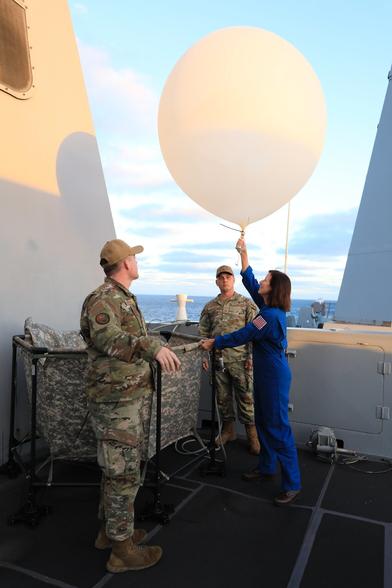
"Astronaut Shannon Walker prepares to release a weather balloon from the deck of the USS Portland alongside members of the U.S. Space Force 45th Weather Squadron ahead of the splashdown of the Orion spacecraft on Dec 11."
Weather measurements and modeling are used, by a planning tool called Sasquatch, to predict where various parts of Orion will fall, so that they can be recovered quickly.
Sasquatch: https://www.nasa.gov/feature/searching-with-sasquatch-recovering-orion
More pics at https://www.flickr.com/photos/nasa2explore/52556510176/
Go #Artemis #Orion #NASA #ESA
9/n
Searching with Sasquatch: Recovering Orion

During Artemis missions, NASA’s Orion spacecraft will be traveling at 25,000 mph as it reenters the Earth’s atmosphere, which will slow it down to 325 mph.

NASA
NASA Artemis 1 webcast has started.
https://www.youtube.com/watch?v=xzZPzmMtQA8
Go #Artemis #Orion #NASA #ESA
10/n
NASA’s Artemis I Mission Splashes Down in Pacific Ocean

On Dec. 11, the Artemis I mission will conclude with the entry, descent, and splashdown of the Orion spacecraft. After 25.5 days in space, and a 1.3-million-...

YouTube
NASA has reporting from the flight deck of the USS Portland.
Go #Artemis #Orion #NASA #ESA
11/n

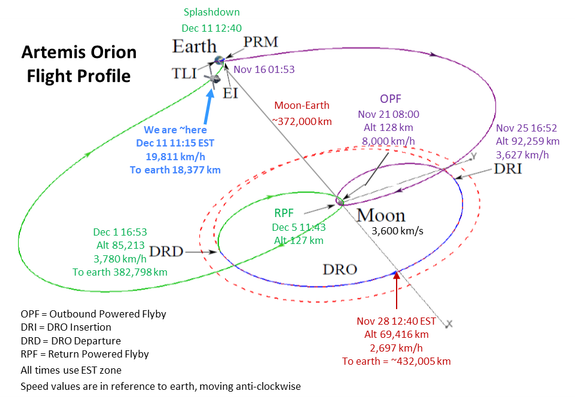
We have come a long way Orion!

Moon-centric graphic source: https://ntrs.nasa.gov/api/citations/20180001259/downloads/20180001259.pdf + updated overlays by me.
Go #Artemis #Artemis1 #Orion #NASA #ESA
12/n

One more hour before Orion splashdown!
Here is a graph of Orion's speed and distance from Earth since the Dec 5 lunar flyby and RPF burn.
The Artemis blog site states that Orion's speed will be close to 40,000 km/h during reentry,.
Orion has picked up quite a bit of speed during the last hour.
https://blogs.nasa.gov/artemis/
Data source: https://www.nasa.gov/specials/trackartemis/
Go #Artemis #Orion #NASA #ESA
13/n
Artemis

Orion Command Module Separation will occur around 12:01:30 EST.
Screen cap from https://www.youtube.com/watch?v=MkEBfxtg4Xg
Go #Artemis #Orion #NASA #ESA
14/n
NASA Preview of Artemis I Splashdown

YouTube
Orion Command Module Separation was completed around 12:01:30 EST.
Orion is now somewhere over Antarctica as it travels North into the Pacific Ocean towards the Baja.
Now comes the challenging 40 minutes of the reentry and landing sequence. 🚀 🔥 🤞
Comm is now via the NASA TDRS satellite, not NASA DSN.
Go #Artemis #Orion #NASA #ESA
15/n
Current location of Orion, west of S. America.
The heat in on 🔥
Comm blackout now.
The graphs on the left show the spacecraft altitude and speed after the start of Orion's re-entry sequence.
Screen cap from https://www.youtube.com/watch?v=xzZPzmMtQA8
Go #Artemis #Orion #NASA #ESA
16/n
NASA’s Artemis I Mission Splashes Down in Pacific Ocean

On Dec. 11, the Artemis I mission will conclude with the entry, descent, and splashdown of the Orion spacecraft. After 25.5 days in space, and a 1.3-million-...

YouTube
Orion was indeed traveling close to 40,000 km/h just before the blackout period,
Go #Artemis #Artemis1 #Orion #NASA #ESA
17/n
At 12:32 EST, visual observations of Orion.
Speed down to 20,000 km/h.
Comm and live video from Orion at 12:35 EST!
12:38 EST - 20,000 ft
12:39 EST - parachutes deployed!
Go #Artemis #Orion #NASA #ESA
18/n
12:41 EST - Orion Splashdown!
A textbook entry by Orion.
Congrats to the worldwide team that made this possible and to humanity.
Go #Artemis #Orion #NASA #ESA
19/n
A precision landing by Orion, very close to the recovery team and equipment, thanks to the "skip entry” technique, the technological innovations and the innovators that made it possible.
Go #Artemis #Orion #NASA #ESA
20/n
The last view of earth from Orion at 11:40 EST, an hour before splashdown, from an altitude of ~23,000 km.
Screen cap from https://www.youtube.com/watch?v=xzZPzmMtQA8
Go #Artemis #Orion #NASA #ESA
21/n
NASA’s Artemis I Mission Splashes Down in Pacific Ocean

On Dec. 11, the Artemis I mission will conclude with the entry, descent, and splashdown of the Orion spacecraft. After 25.5 days in space, and a 1.3-million-...

YouTube

Continued coverage of the Orion recovery mission at https://youtu.be/Si2iks2-T34

For those who are wondering why it is taking so long, here is what NASA says - "Engineers will perform several additional tests while Orion is in the water and before powering down the spacecraft and handing it over to the recovery team aboard the USS Portland."
https://blogs.nasa.gov/artemis/
Go #Artemis #Artemis1 #Orion #NASA #ESA
22/n

Artemis I - Splashdown

YouTube

We finally caught it!
Time to haul it in 🐳
And whose idea was it to bring that silly harpoon?

Screen caps from https://www.youtube.com/watch?v=Si2iks2-T34
Go #Artemis #Artemis1 #Orion #NASA #ESA
23/n

Artemis I - Splashdown

YouTube

The special cradle in the USS Portland where Orion will rest, after its fantastic 26-day voyage.

Next stop - the U.S. Naval Base in San Diego and then the Kennedy Space Center in FL for autopsy, I mean inspection, retrieval of data recordings, removal of onboard payloads, etc.

Screen cap from https://www.youtube.com/watch?v=Si2iks2-T34
Go #Artemis #Artemis1 #Orion #NASA #ESA
24/n

Artemis I - Splashdown

YouTube
@AkaSci how far space force has fallen...
@AkaSci And it went splash in an approved fashion. Well done NASA.
@AkaSci How is this different from the way the Apollo capsules did it returning from the Moon?

@martinvermeer
Take a look at this plot and also https://www.nasa.gov/feature/orion-spacecraft-to-test-new-entry-technique-on-artemis-i-mission
The green curve matches the Apollo curve.

"During Apollo, the spacecraft entered the Earth’s atmosphere directly and could then travel up to 1,725 miles beyond that location before splashing down. This limited range required U.S. Navy ships to be stationed in multiple locations.With skip entry, Orion can fly up to 5,524 miles beyond the point of entry, allowing the spacecraft to touch down with more precision."
#Artemis

Orion Spacecraft to Test New Entry Technique on Artemis I Mission

Orion Spacecraft to Test New Entry Technique on Artemis I Mission

NASA
@AkaSci Any word if the storm offshore in San Diego will affect the landing?
@AkaSci No rain for 6 hours at least by Guadalupe Island.
@adirkes
Thanks. The skies in toot #11 looked pretty clear an hour ago.