 seldo
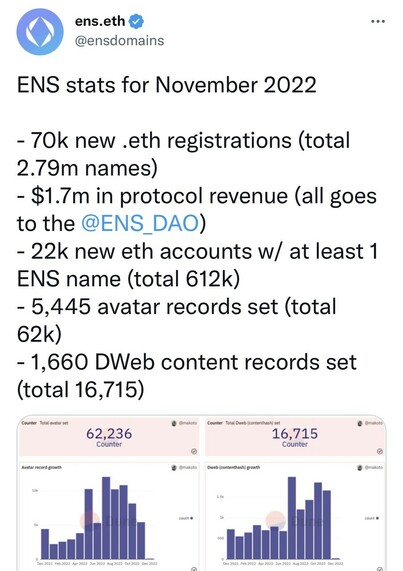
seldoAlso in crypto: who on *earth* is still buying useless fake domains in November 2022?
@seldo 🖐️
I actually end up using them daily!
(Sorry if that was a rhetorical question and you weren't actually curious)
So ENS is just like DNS in that you can have many types of records:
- You can use a record to point to an address, so that instead of seeing 0xd8dA6BF26964aF9D7eEd9e03E53415D37aA96045 you have vitalik.eth. Almost all apps support this, ex: https://etherscan.io/address/vitalik.eth
- You can use it to point to content on IPFS (a bittorrent-like thing without tokens). Brave supports it natively, otherwise you can also bridges like .limo or .link. Ex: https://ethereum.eth.limo/

The Address 0xd8da6bf26964af9d7eed9e03e53415d37aa96045 page allows users to view transactions, balances, token holdings and transfers of ERC-20, ERC-721 and ERC-1155 (NFT) tokens, and analytics.
- You can point to a twitter account too, and there are extensions that do the equivalent of the "rel=me" verification of mastodon but with .eth domains
There is more type of records, but those are the ones I use daily
@seldo I do have lots of friends who have one, and when we split bills we use them to settle things.
In non-financial things, I'm excited for communication apps like https://status.im/ where ENS can be use as a portable identity (and ENS subdomains can now be issued without involving tokens) and everything can be made serverless and open. It's not quite production ready though
Also use it to learn some maths 😜 https://vitalik.eth.limo/general/2019/09/22/plonk.html
@seldo That's about right, except for all the things I'm using it for, I'm not using it for anything.
I don't want to change your mind or anything, but I'm curious why you see it as a hopeless technology?
 Vincent Cloutier