 Cameron Haynes
 Peter Kalmus
If we ended industrial animal agriculture, there'd suddenly be more than enough food for everyone, we'd essentially end animal cruelty, no one would die, and we'd take a huge bite out of the climate and ecological emergency. We could do this basically overnight.
 Jake Rayson
@ClimateHuman yes but... one thing I have learned on social media is that you _can_ argue with the truth
 dr 🛠️🛰️📡🎧
@ClimateHuman There's already enough food for everyone. My question is would have enough *protein* for everyone "overnight"? I feel like we'd need more beans or something.
 Paskajärven kaunis Charlotta
@davidr @ClimateHuman I think there’s more than enough soy to feed humans with plenty of protein. And all the other plant proteins on top of that.
 Cedar Fen Farm
Cedar Fen Farm
Cedar Fen Farm@ClimateHuman and jobs for everyone. Small farms are the stability of a nation. Something the green revolution forgot.
 Nick Young
@ClimateHuman yes! Here's how they did it in Sikkim https://www.greenpeace.org/aotearoa/story/the-state-that-proved-its-possible-to-go-100-organic/

The state that proved it’s possible to go 100% organic - Greenpeace Aotearoa
Jacinda Ardern once told the United Nations that “We are determined to show that we can be the most sustainable food producers in the world.” But, when she made that promise in 2019, that title was already taken, and is still firmly held by a state in northeast India, called Sikkim.
 Darryl Cousins
"How much useless and expensive work would be necessary to first have the soil product eaten by cattle; cattle that is raised with great effort and additional costs. Would this not result in even greater loss? Would it not be far simpler to consume the grain ourselves and to create the fertiliser ourselves?"
Justus von Liebig, "Es ist ja die Spitze meines Lebens", 1861
 𝓐𝓷𝓭𝔂𝓣𝓲𝓮𝓭𝔂𝓮 𓀤
@ClimateHuman This assumes that all livestock feed is suitable for human consumption, which is clearly not the case. Humans cannot digest grass. Cows can and should. Goats and pigs eat many things that humans cannot.
Even if you could somehow force everyone onto a strict vegan diet "overnight", that would not produce the kind of food surplus you claim.
Lack of protein would also be a problem.
 Mrs.Hudson 🌱
Lack of protein isn't a problem for vegans. Where do you think livestock get their proteins? Yes, plants. 😉
'Overnight' wouldn't be possible IMO, but we only need a small part of all the land now used for animal feed and use it for human food.
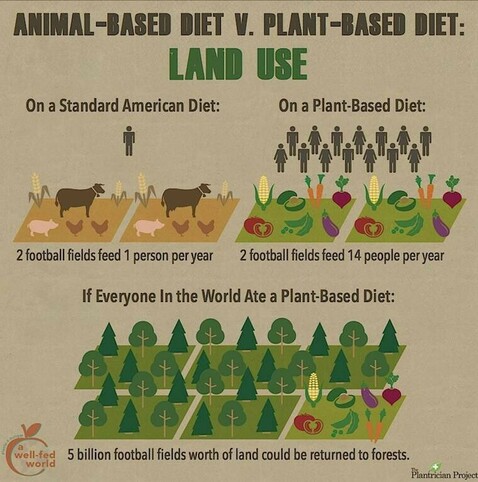
@ivereadabook
@ClimateHuman
If that is the case, it should only be necessary to transition to grass-fed beef and lamb instead of feeding them grains.
We can also stop adding grain alcohol to motor fuel while we're at it.
@ClimateHuman
If that is the case, it should only be necessary to transition to grass-fed beef and lamb instead of feeding them grains.
We can also stop adding grain alcohol to motor fuel while we're at it.
 Jonas Hellö Pr.D.
@andytiedye @ClimateHuman Humans can too digest grass, just not the hard outer lining.
But this is besides the other, because why would we? And went are you so hung up on cows? It's a fact we would need less land as vegans, you just need to accept and embrace that. That is s GOOD thing.
 Matthias Aulbach
@andytiedye @ClimateHuman He talked about _industrial_ animal agriculture, not animal agriculture altogether
 bs2
bs2@ClimateHuman In Miyakonojyo (Japan) some city hall workers' t-shirts show that pigs and chickens outnumber people. Even when the facilities are not CAFO-scale, the smell is awful while biking past a couple long greenhouse tunnels filled with laying hens. It's hard not to feel bad for the people that cross the lime-whitened ground and enter the greenhouses for work..
I wonder what an overnight replacement for their jobs would be, How to repurpose that smelly land?
- https://ourworld.unu.edu/en/the-shame-of-concentrated-animal-feedlots
I wonder what an overnight replacement for their jobs would be, How to repurpose that smelly land?
- https://ourworld.unu.edu/en/the-shame-of-concentrated-animal-feedlots

 Thaiis Thei 𓁟
@ClimateHuman Here is a great podcast about how to do this using regenerative agriculture https://www.ecofarmingdaily.com/tractor-time-episode-64-defending-beef-with-nicolette-hahn-niman/

 Shield Maiden
@ClimateHuman What would happen to all the animals?
 Mariska 🌻
@Judeet88 @ClimateHuman eventually they die?
If we stop breeding them and more and more people go vegan, we could maybe save the last ones and just let them live their own life in sanctuaries. But we really should change this:
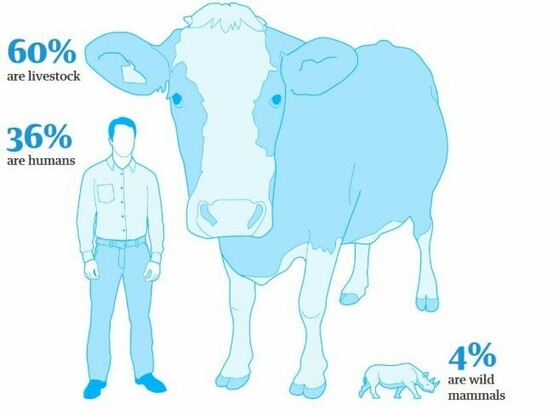
 Ronan
Ronan@Judeet88 @ClimateHuman this is not the argument you think it is. The balance is way off. Having fewer farmed animals would allow it recover
@ronanmcd @ClimateHuman Having fewer humans industrially farming animals is the other answer.
@Judeet88 @ClimateHuman basically, I think we in the west just don't need all the animal products we have become accustomed to. All a question of balance in my view. Go too far, or be too prohibitive, in any direction and it's not good. At least that's my layman's take on it!
 Daniel Brotherston
@ClimateHuman If we ended animal agriculture tomorrow all the people hungry today would still be hungry.
Today, we produce already enough food to feed everyone on the planet, the problem is not supply. The problem is our economic capitalist system which decides that some people should starve. (And also some level of inefficiency which means we throw out an entirely too large portion of the food we do have).
I don't think we could do it overnight, but if we stopped breeding livestock now, the chicken industry would soon vanish, followed by the rest in less than a year. I only wish we could.
 DominicElson
@ClimateHuman I like the idea, but I’m pessimistic about your ambitious timescale.
There are so many aspects of the industrial farming/food complex that will need to be disentangled and rebuilt. To take just one random example: small farms rely on small local abattoirs, but almost all of these have been driven out of business in recent years by the supermarket dominated market model. The supermarket system demands conformity, so rare breeds become rarer, animals must be forced to grow quickly and our diets become more homogenous and less nutritious.
As well as market reform, this requires consumer awareness to change. The message from small organic farms like ours is to eat less meat, but buy the best you can, from a trusted supplier, and be ready to try things that you probably can’t recognise but your great-grandparents would have enjoyed.
It also means eating chicken only about once a month, at most, which will be counter to the messaging from the health lobby in recent years.
It’s a system-level challenge, to be sure, but I’m up for it!
There are so many aspects of the industrial farming/food complex that will need to be disentangled and rebuilt. To take just one random example: small farms rely on small local abattoirs, but almost all of these have been driven out of business in recent years by the supermarket dominated market model. The supermarket system demands conformity, so rare breeds become rarer, animals must be forced to grow quickly and our diets become more homogenous and less nutritious.
As well as market reform, this requires consumer awareness to change. The message from small organic farms like ours is to eat less meat, but buy the best you can, from a trusted supplier, and be ready to try things that you probably can’t recognise but your great-grandparents would have enjoyed.
It also means eating chicken only about once a month, at most, which will be counter to the messaging from the health lobby in recent years.
It’s a system-level challenge, to be sure, but I’m up for it!