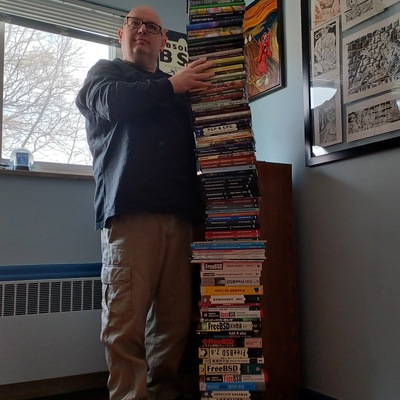
Why do we authors get angry about folks pirating our books?

Medium-sized publisher advance on a novel in 1960: $3,000.

Medium-sized publisher advance on a novel in 2022: $3,000.

Gimme my $4.99.

I put my novels out in the world under a license that says "give me $5 and you get a digital copy."

A thought for you pro-piracy folks, not one I'm going to argue here:

Why should you be allowed to violate that license, keeping in mind that I will use your exact same argument to justify a closed-source Linux variant that I distribute to customers.

that's not a license. no copyright license is required to receive or to keep a copy of a work, or to read it. a license is needed to make and to distribute copies, unless other circumstances apply.
copyright is your enemy as much as it is your reader's. it's corrupt law made to give publishers control and profits, exploiting authors and readers alike.

@lxo no.

Writers create intellectual property and license it. Go read The Copyright Handbook.

Copyright has problems, but you should have a basic understanding of the topic before discussing it.

yeah, sorry, you're right, I've only been studying, writing and speaking about the topic for some 25 years. you?
good advice, though. I second it.
here's some stuff you might be interested in reading before discussing further. there's more I can share if you wish.
https://www.gnu.org/philosophy/not-ipr.html
https://www.fsfla.org/~lxoliva/#Self-Defense
Did You Say “Intellectual Property”? It's a Seductive Mirage - GNU Project - Free Software Foundation

@lxo Studying and working in the field since 1985.

Yes, I've read those pages. GNU has done some clever things, but they ignore the inconvenient parts of the law.

Under the law as it stands, writers create and license intellectual property via copyright. That's why each print book has a license printed in the front of it.

cool. me, I feel it's the industry that "industry" that ignores the inconvenient parts. but it's not ignorance, really, it's an attempt to move public perception of unsettled law or often-distorted issues in whatever direction each group steers
take this "license" you mention in printed books. I went for one of my 1984 prints, the one that's not yet falling apart, and looked for a license. there isn't any to be found. below the copyright notices, there are a few paragraphs about several rights that remain reserved to the publisher, i.e., that are explicitly *not* licensed. that's not a license at all, but I guess that's how misinformed or misinforming people refer to that statement.
specifically, returning to the point you attempted to dispute upthread, I checked that it doesn't license any right to read or to have a copy or to lend it or sell it to others. it doesn't have to. those are not rights that need to be licensed. reading and having copies are not exclusive rights; lending and selling, in some jurisdictions, are, but they are exhausted by the first sale, and after that they're no longer reserved. making copies and adaptations remain reserved, but there are allowed exceptions under fair use and other provisions depending on the jurisdiction.

@lxo there is extensive case law about the rights conferred by owning a copy of a book over the last century.

Licenses as we know them today did not exist when copyright law was settled. The copyright statement is the license.

Go to any publisher, on the legal and production side, and the first lesson you get is that publishers do not sell books. They license IP. Titles are even depreciated as IP.

how can that statement be a license if it doesn't license anything? newspeak?
it's not even a licensing agreement, that publishers often try to get their customers to confuse with licenses
they're so deep down this virtual-rabbit hole that they start believing the lies they made up to twist public opinion and law
copyright grants its holder the power to exclude others from certain activities over a creative work
the holder doesn't own the work, but that power to exclude
but then the lie that they own the work starts being used to grow copyright to give them more powers to exclude other uses of the work, for longer times
and then they demand DRM to expand those exclusive rights to whatever they wish, even if they're not related at all with uses reserved by copyright law
then we get people sued and prohibited from sharing programs because they might be used to share copyrighted works. we get demands for payment to post links to news articles. we get publishing oligopolies that beat up authors while authors defend the expansion of the powers of the oligopolies. but because you've settled inside that virtual-rabbit hole, you think that's as it should be, and that people who don't fall for the lies are the bad ones.
https://mastodon.social/@mmasnick/109462530750842480
https://mamot.fr/@pluralistic/109461421731443118
Cory Doctorow's linkblog (@[email protected])

Attached: 1 image When a superdense, concentrated mass forms a black hole, the laws of physics around it change, giving rise to an eldritch zone where the normal rules don't apply. When corporations form a concentrated industry, the laws of economics likewise change. Take copyright: when I was a baby writer, there were dozens of comparably sized New York publishers. The writers who mentored me could shop their rights around to lots of houses, which enabled them to subdivide those rights. 1/

La Quadrature du Net - Mastodon - Media Fédéré

@lxo

I think this conversation has gone as far as is useful. Have a good day.