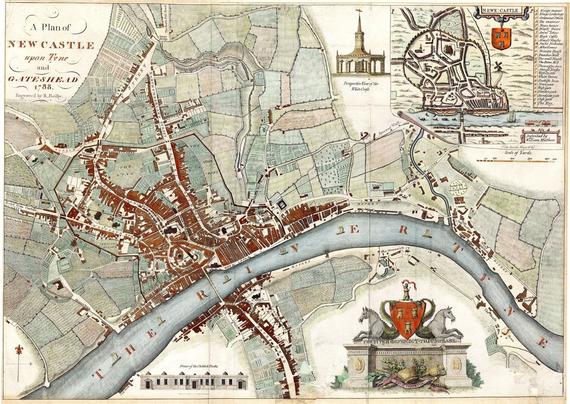
Don't ya just love an old map of the place you live? What's still here? What's not there yet? Found this 1788 map of Newcastle, which shows the old streets that have been there a LONG time, like Northumberland St, Percy St, Pilgrim St, Westgate etc. Their very names tell of their age. What's missing are the not yet built Grey Street and Grainger Street, and of course, the railway. Fascinating.
A little surprised to see what's now called Cut Bank and Byker Bank, out to the east, crossing the Ouseburn are there. Cool.
And Gateshead, though a very old settlement, since Roman times, and mentioned by Bede in the 7th century, is still at this point, apparently mostly just focused around the Great North Road and spreading out along the river a bit.
It's also of course very strange to see only one bridge crossing the Tyne there! We're currently up to 7. Or 9 if you count the ones along at Scotswood.
Make that 10 - I forgot about the old railway bridge at Scotswood.
More thoughts occurring to me as a look at it - that thick black line that's not a road - that's the city walls. Only a few bits of them are still there today. Note the gates in them. Note what's outside them, including Gallowgate. I'm sure you can guess what used to happen there. (The football ground is there now and the south end of the stadium is called the Gallowgate end.)

Also important to remember that "gate", especially in the north of England, with influence from the Danes and the Vikings, doesn't always literally refer to a gate, but is from Old Norse "gata", meaning street. So you might run across streets with "gate" in their name that were never anywhere near a city gate.
@beecycling A few of these things struck me quite forcibly when I first started learning Norwegian (which is basically modern Norse). Suddenly I could see Scandinavian names all over Yorkshire, and Scandinavian words in Yorkshire/Lancashire dialects. Eg "by" is just the ordinary word for a town (Whitby, Kirkby, Grimsby etc).
@timtfj Which is how we end up with places whose names are, if translated literally, Towntown Town Town.

@beecycling Yes. Isn't there a famous one of those? Or at least, famous in a pub quiz sort of way?

I think I came across a Welsh one once where something odd had happened like the original name being mistranslated into English then back into the correct Welsh for the wrong English . . .

@timtfj @beecycling there is torpenhow hill in Cumbria which (from googling) torr is old English for hill penn is old welsh and how (haugh) is old Norse. Of course all this is according to Wikipedia
@PieMan70 @beecycling That's the one I was thinking of. Pen is also head in modern Welsh. I'm going to see what NAOB (det Norske Akademis Ordbok) says about haug . . .

@PieMan70 @beecycling My old but comprehensive Norwegian→English Dictionary (coincidentally by Einar Haugen!) translates haug as "hill, knoll, mound", and NAOB defines it as a roundish raised area in the terrain ("rundaktig forhøyning i terrenget") and derives it from Norse "haugr" https://naob.no/ordbok/haug

(I'm not sure how to translate forhøyning. It's the opposite of fordypning, which is a hollow or depression. Høy means high.)

Det Norske Akademis ordbok