Ticketing and Turnout: The Participatory Consequences of Low-Level Police Contact | American Political Science Review | Cambridge Core
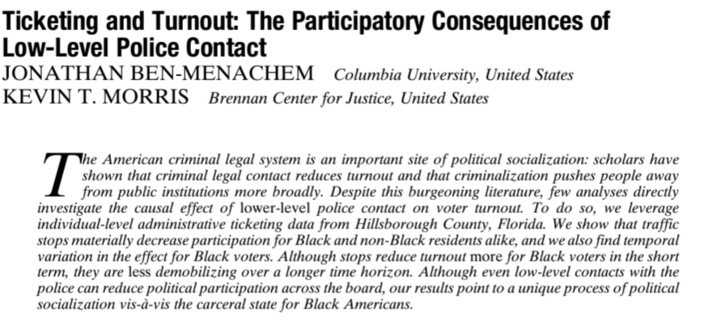
Ticketing and Turnout: The Participatory Consequences of Low-Level Police Contact - Volume 117 Issue 3
We know that high-level contact with the criminal legal system (CLS) probably demobilizes voters--from the "hidden curriculum" the CLS teaches about citizenship, to "legal estrangement"--people who've been locked up or faced major life disruptions from the CLS (understandably) aren't too keen on the government
But what about lower-level contact? Gerber et. al (2017) have an interesting aside in their discussion: incarceration “is an outcome that often follows a long series of interactions with the criminal justice system.” So how might earlier interactions shape participation?
On the one hand, we argue that a traffic stop is less disruptive than incarceration, so it might have smaller effects (and also see @leahchristiani's recent work with Kelsey at JREP in this vein). On the other hand, it might "teach" folks more, since it likely comes earlier in the socialization process
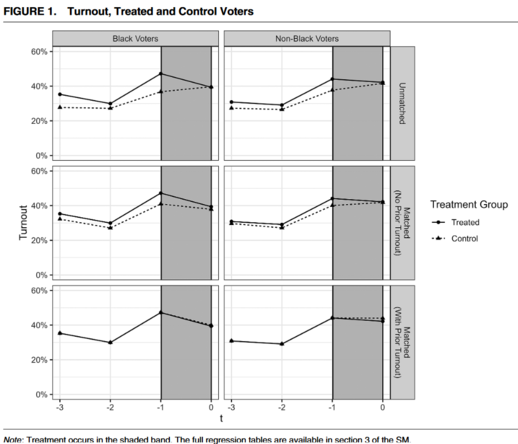
To answer the question, we turn to Hillsborough County where (problematically from a social perspective) the name and date of birth of everyone stopped by the police is published online. We match to the voter file, and the compare voters stopped before the election to voters stopped after an election:
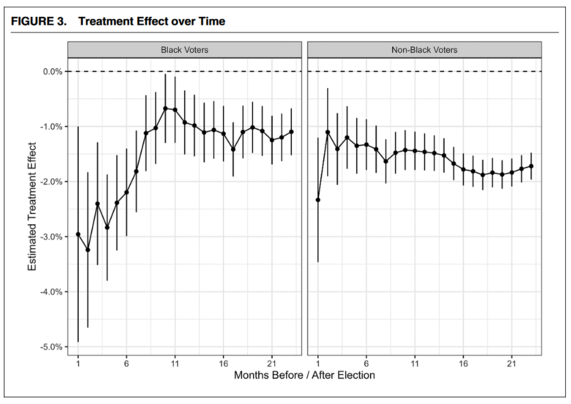
But we also wanted to know how these effects differed for Black and non-Black voters. In particular, we were curious whether there was different temporal variation. On the one hand, Black voters already know A LOT about the CLS, so there's maybe less potential learning. On the other hand, they can be more traumatic and deadly for Black motorists. It turns out that stops are *more* demobilizing for Black voters in the short-run, and *less* in the long run
 Kevin Morris