🄳 Very excited to announce the publication of the first paper of my PhD 🄳

In this single-authored pre-registered paper in @ElectoralStdies I ask:

What shapes voter expectations of Muslim politicians’ views on homosexuality: stereotyping or projection?
https://doi.org/10.1016/j.electstud.2022.102553

I ran conjoint experiments in which I randomize politician religion, migration background and gender in France, Germany and The Netherlands. I asked respondents whether they expect these politicians to be in favor of or against same-sex adoption, in line with the work by @sveinungarnesen
There is a lot of literature in political science about the issue stereotypes voters hold of politicians. The work by @RDancygier points out that party selectors are hesitant to include Muslim politicians on party lists because that might scare off voters in favor of LGBT-rights.
But do voters really expect Muslim politicians will be against same-sex adoption? Well, yes. Given the Homonationalist context Western Europe is moving towards, this is no surprise. See the work by @jkpuar on how LGBT-rights are weaponized to discredit Muslims.
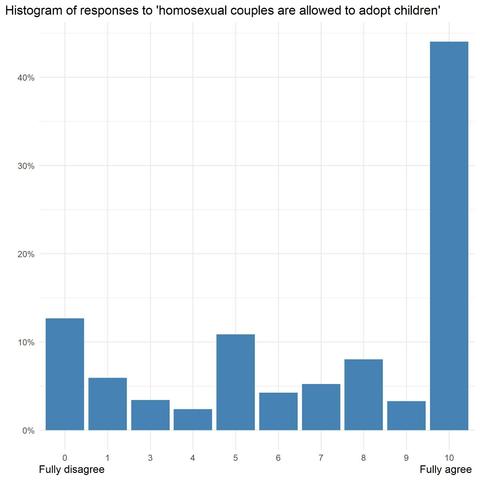
Building on work by @tabouchadi I ask respondents what their own views are on same-sex adoption. I divide the responses in three categories: ā€œanti-flankersā€ who fully disagree, ā€œpro-flankersā€ who fully agree and ā€œmoderatesā€ in the middle. Pro-flankers are the most common.
The work by @amyelerman and @MeredithSadin inspired me to look into projection as well. Turns out, voters not only stereotype, they also project their views onto politicians.
So which is most important? Stereotyping or projection? Turns out it really matters what your own views are. Flankers project their views onto politicians, whereas moderates stereotype.
Why do flankers project while moderates stereotype? Well, in my exploratory analyses I show that pro-flankers might be more inclined to project their views onto Muslim politicians because of their slightly higher perceived similarity with Muslims. But I discuss many other explanations in the discussion as well.
The implications are nonetheless clear: party selectors should not fear that the voters who are most in favor of LGBT-rights will stereotype Muslim politicians for their presumed views.

Special thanks to the anonymous reviewers - they helped give this paper much more focus and depth.

Without the advice from @Hakhverdian and @CatherineDVries I would have never gathered data about issue stereotypes to begin with.

I would like to thank @OrlySiow @ZahraRunderkamp @ASchotel @JudithdeJong4 @TheresaJKuhn for their feedback and support.

Then there were @AnnKristinKolln @niceonecombo @MaarjaLuh @zacdgreene @DrKolpinskaya who cheered this paper on at @psaepop – thanks so much!