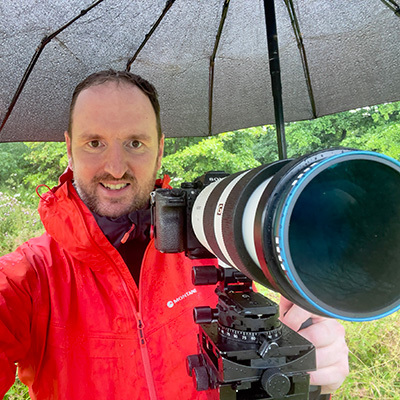
Today is the start of #NationalTreeWeek in the UK.

It’s the start of the planting season, which is from the end of November until March.

#trees planting is frowned on by some who favour only natural regeneration, but there’s a place for both if planting is done to complement & reconnect smaller fragments of ancient #woodland on a landscape scale.

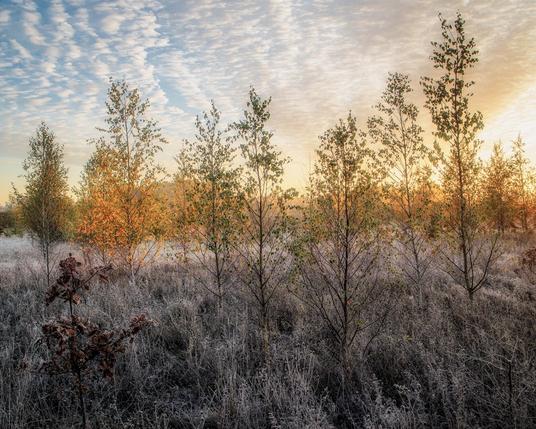
It can have a massive positive impact on biodiversity as seen at Heartwood #Forest in St Albans.

Here’s an image from there.
#photography #nature

@timsmalley I know there has been a lot of tree-planting in some areas, but also that many of them have died due to not being watered or due to this summer's heat/water shortage. I wonder whether an "adopt a tree" might work, with people walking up to see theirs with a couple of litres of water...?
@Judeet88 yes, a lot will have struggled last summer. It is perhaps an option for families, but I know the logistics around specifying exactly where tree dedications were planted (down to a What3Words location) at the Woodland Trust were pretty difficult. The scale was such that they couldn't say exactly where the dedicated tree went (other than the site where it was planted) as there are upwards of 5 million trees going in the ground each year. . . .

@Judeet88 . . . .The struggle is that, depending on the size of the site and the planting event, there may be upwards of 1,000 trees being planted on any given day and perhaps 50-60k planted in a season on just one site. While plant passports have got better, the passport generally ends at the planting site without significant additional overhead.

As the trees are planted very close together (science reasons), it would be difficult to navigate to individual trees without damaging others.

@timsmalley Yes, it's fraught with problems. I've done some random planting of acorns here and there whilst out walking, where other oaks are already doing ok...and have 3 trees in my very small terraced house garden.

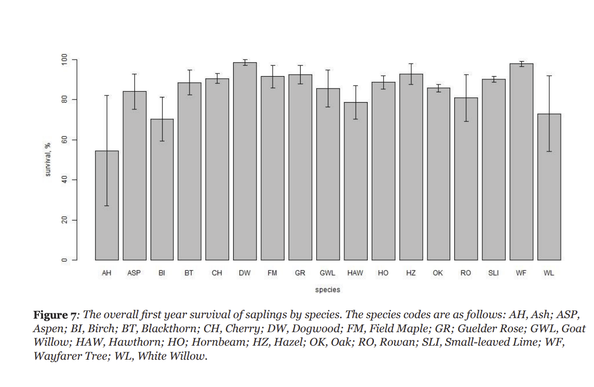
@Judeet88 btw, here's something I hadn't seen before... it's the sapling survival rate by species at Heartwood, 1 year after planting. There were 2 years left to plant at this point, so the data is based on approx 500k saplings.

Ash is the main anomaly due to chalara ash dieback being discovered on the site in 2012. It's pretty effective at killing young saplings - in some cases it can take a matter of weeks for the disease to rip through a sapling's water transport system.

@timsmalley It's good to find actual stats...so, it's not as bad as I've been thinking...what year is the chart from?