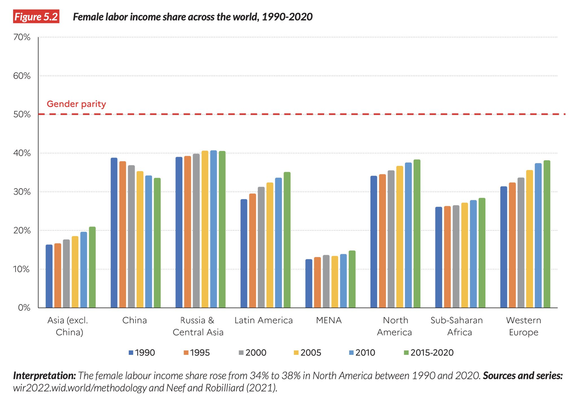
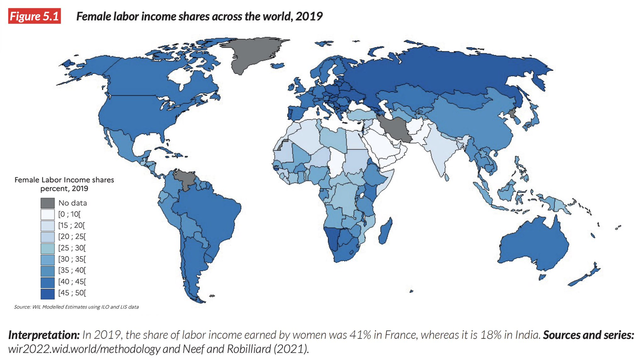
Women in France earn 41% of total labour income
Russia: 40%
Brazil: 38%
India: 18%
Somalia and Chad: 8%

The first ever calculation of the gender gap in labour income!

@economics #econtwitter @histodons https://wir2022.wid.world/www-site/uploads/2022/03/0098-21_WIL_RIM_RAPPORT_A4.pdf
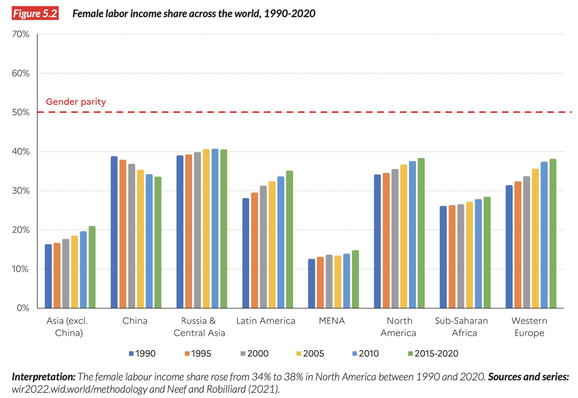
Women’s share of total labour income has rapidly increased in Latin America, North America and Western Europe.

Whereas in the Middle East and North Africa, men have continue to earn about 85% of total labour income. No change.

This is what I call “THE GREAT GENDER DIVERGENCE!”

@economics #econtwitter

But as you can see, all countries are patriarchal.

Nowhere in the world do women earn as much labour income as men.

Obviously, these are regional averages and obscure heterogeneity (especially in SSA).

@economics

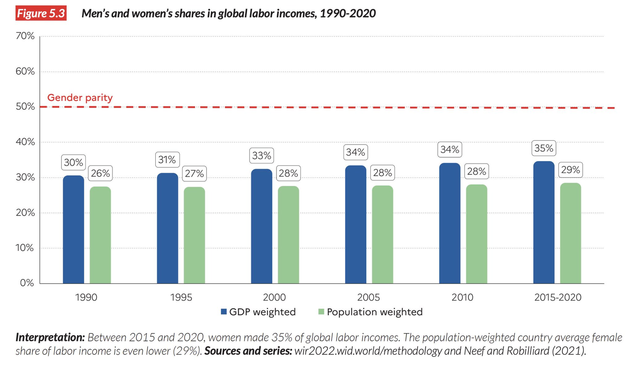
Net, there has been barely NO change in men and women’s shares of GLOBAL labour income.

(This must reflect Chinese women’s fall in total labour income)

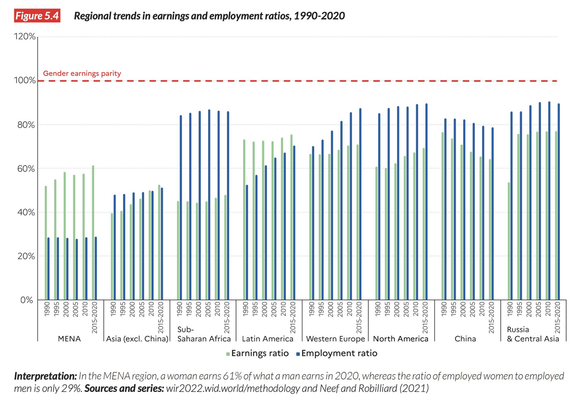
Why do women earn less of total labour income?

In MENA, there is large gender gap in both pay and employment.

In SSA and North America, there are large gender gaps in pay.

In Russia, women approximate men in both pay and employment.

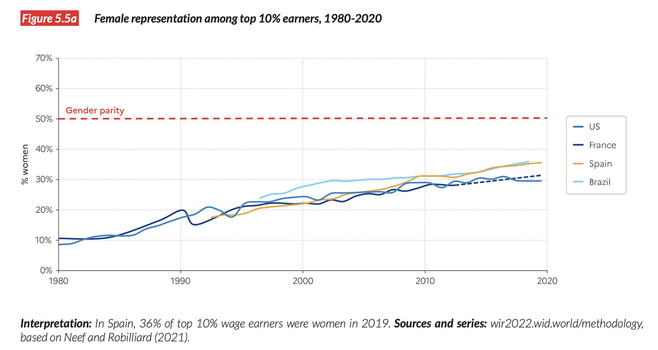
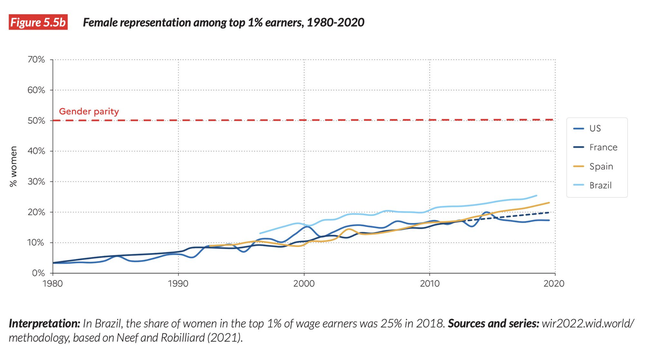
What’s Spain’s feminist secret?

Why do women comprise a larger share of top earners in Spain, compared to the USA? What’s driven this change?

[Loyal followers know that I have a long-standing fascination with rapid social change in Spain]

Men still comprise more than 75% of the top 1% of earners - in the US, France, Spain and Brazil.

But this gap has closed considerably, within the past four decades.

APPLAUSE:

This is totally novel!

No one has ever calculated this before!

Bravo to Theresa Neef & Anne-Sophie Robilliard

@draliceevans Reading through the report, what I'm most stricken by is EEurope. Russia's labor income is 40%, a hair less than France and more than the US and UK, but wife-beating has been legalized and women are largely excluded from power (for example, compare how many women there are in the Russian cabinet vs. the French one).
@Alon yes I wrote about this on my blog. Totalitarian communism suffocated feminist activism so there isn’t strong pressure for government protection against male violence or for female representation ,
@draliceevans In SSA, is unpaid farm labor a big part of the problem? And is this wage labor income in the formal economy?
@draliceevans
Because women, even those who are employed for $, do 90% (just a guess, what’s yours) of the UNPAID domestic labor, taking their time & energy away from the labor market
Patriarchy is built on individual & communities & societies of men in forcing this unfair, unpaid labor on women, making them, in the most sexist cultures, de facto chattel
Labor statistics that do not take account domestic work, WHICH HAS FUNDAMENTAL VALUE, both reveal & support patriarchy
✌🏽⚖️🏳️‍🌈🌳🌎
@Bick52 @draliceevans 1975’s Icelandic women’s strike cast this into sharp perspective.
Nice backgrounder on it by Kirstie Brewer (2015)
https://www.bbc.co.uk/news/magazine-34602822
The day Iceland's women went on strike

In 1975, the women of Iceland took a "day off" from their usual jobs - and relations between Icelandic men and women were never quite the same again.

BBC News
@draliceevans Very interesting thread! Any idea on the causes behind the downward trend in China (more acute in pay than in employment)?