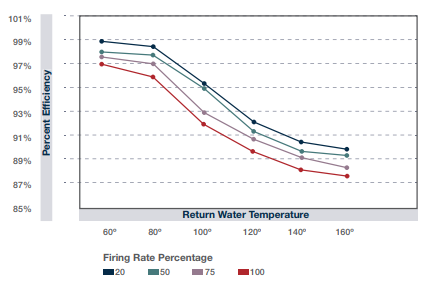
Due to a change in my home heating needs, I have spent the last week trying to optimize my hot water radiator system. If there's one thing to know if you have a modern condensing boiler, it's this graph: efficiency is higher at lower return water temps + running at low % of max.

My boiler was poorly configured and ran way too hot, leading to frequent on/off cycles.

Now it runs for hours at 20% of max and the house is incredibly uniform in temp with far less gas used. Yay!

(I say this because my system was installed by some absolutely fantastic local folks who I would use any day, but the installers have an incentive to make sure you're never too cold & behaves like old system, as opposed to actually optimizing for the temperatures at which you keep your house. It was well worth going into the contractor mode of my boiler and spending some time setting up a good outside temperature response curve. Easy, too.)
This curve happens because a "condensing" boiler uses the cool return water to condense the water vapor out of the exhaust stream, recovering the heat in it. The cooler the water, the more energy it can suck out of that exhaust. It's how boilers went from 80-85% efficient to 95%+. But they're only that efficient when the return water temperature is low.
@dave_andersen literal steampunk! Are there physical knobs that you are turning to control the firing rate percentage?

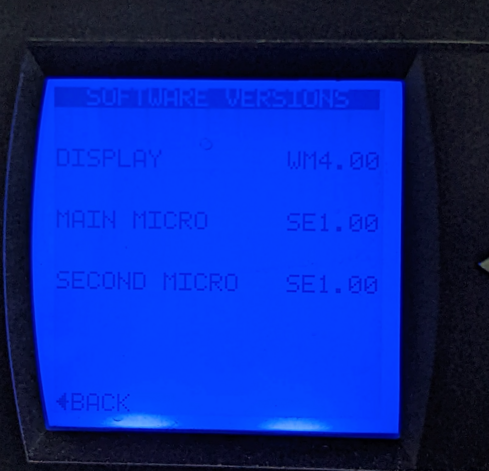
@kisonecat Nope - it has a little embedded computer and you just scroll through an LCD. Poor image - it's hard to photograph with a digital camera.

The firing rate is calculated based on a curve determined by the outdoor temp, a min supply temp, and a max.
(For mine, when outdoor temp = -20, supply temp = 148F. When outdoor temp = 65F, supply temp = 86F. And it ramps between.)

@dave_andersen That is really neat. It's fun to optimize things!
@dave_andersen Just get a Rinnai tankless water heater. Zero cost when not in use and unlimited hot water. Also, the latency is pretty good.

@smolix This is the house hydronic heating boiler, not a hot water heater. Radiators.

(When we have to replace the HW heater I'm probably going to use this existing boiler to provide DHW as well. It will likely require a storage tank but then I have only one boiler and a very efficient one at that.)