New report from us
at Urban Institute. We review data on effects of life near highways & examine exposure in Louisville.

We show:
—Highways pose a public health threat throughout US
—Low-income residents disproportionately live near highways in Louisville

https://www.urban.org/research/publication/polluted-life-near-highway

The Polluted Life Near the Highway

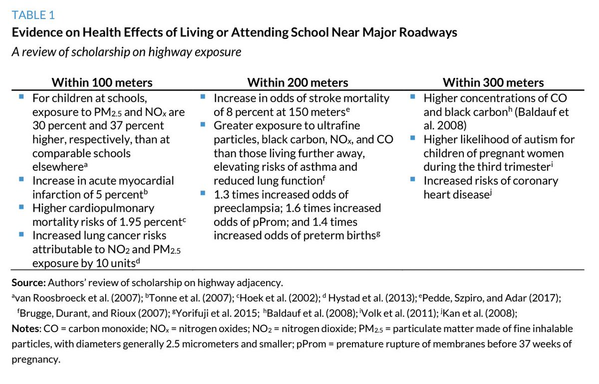
In this review of national scholarship, we document the considerable evidence showing that people living, working, and learning within 300 meters of arterials and interstates are exposed to greater levels of hazardous air and noise pollution than the population overall.
Urban Institute

Our new report can serve as a useful literature review for those hoping to understand what health effects noise & air pollution have on the surrounding areas.

The negative effects are most pronounced with 100 meters—but they extend up to 300 meters from highways 🛣️⤵️

We then examine Louisville specifically, which is currently undertaking an equity review of its zoning code, including examining potential changes related to building near highways https://t.co/w1GWSSuXa3
Land Development Code Reform

The Land Development Code (LDC) regulates how land throughout Louisville Metro is used and built upon. The LDC Reform is an equity focused approach to revise the LDC consistently with Plan 2040 to allow for increased housing choices and opportunities in new and existing neighborhoods, to create procedures and regulations that are easier to use, and increase the quality of life by reducing the concentration of environmental hazards near housing. 

LouisvilleKY.gov

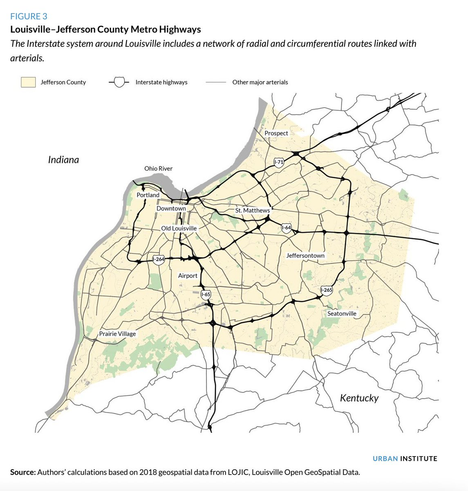
We show that 48% of Louisville's population lived within 300 meters of an arterial & 13% live within 300 meters of an Interstate.

44% of jobs are located within 150 meters of arterial highways, as are 35% of schools.

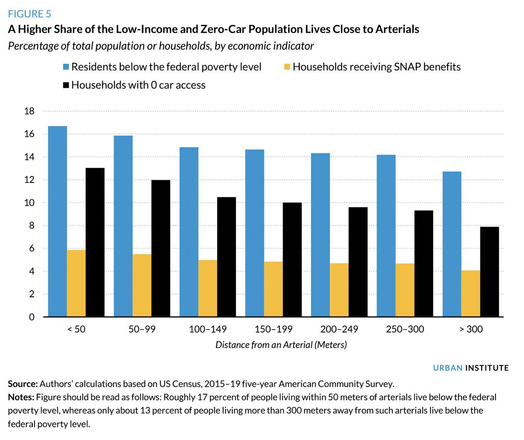
Perhaps most concerningly, low-income families, people receiving food stamps, and households without cars are more likely to live near highways than others.

People without cars are disproportionately exposed to the air & noise pollution produced by *other* peoples' vehicles.

@yfreemark this is so interesting! I think that in European cities, meaning all the urban differences considered, there are very similar situations. It's a socio-economical trait, prevailing somehow the traditional differences in urban lifestyle