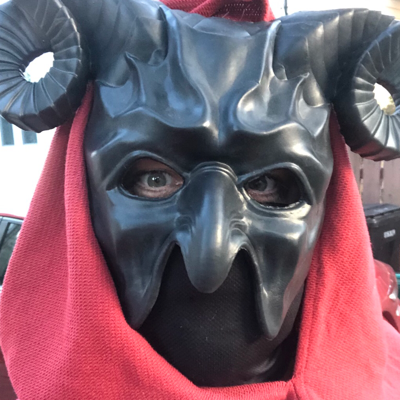
“The Cancer of Danger”

Chapter 1: Time Flies When Flies Time

It was a dark and stormy night. Too dark. And too stormy. The kind of weather in late November that made Gem Lembeck think twice about the dog shitting in his condo. What were the odds Fancy would do it? Pretty damn good since Gem found Fancy eating baked goods from the kitty litter box again. How that Chinese Crested mix found her way to the basement Gem didn’t know. He just wasn’t ready to chance an accident on the Persian rug.

The rug came from Damascus, but Gem’s mother Eileen always called it Persian, so the name stuck. As a child Gem would get lost in the intricate pattern of geometry woven into textile. It was one of two heirlooms he demanded at her funeral. The other was a piece of steel from the same city. He loved them the most, nostalgic for the magic carpet rides he imagined before twelve turns thirteen, and that kind of pretend goes into repose for other people’s pleasures. At 30 that included Fancy’s walk.

But the night was still dark and stormy. How many nights like these had he spent walking that naked ugly dog for Vicky? Too many to count. Several dozen at least since she moved her toothbrush and retainer into his bathroom. She wore it at night to keep her teeth in line—her cuspids long ago domesticated. The last thing she said after popping it in: “You’ll take Fanshy out one lasht time, righsht?”

He didn’t answer. She knew he would for the sake of domestic tranquility and his Persian rug.

“Come on, ya fat rat,” Gem muttered, not looking at the dog sleeping on a quilt lining his couch. Fancy cracked an eyelid to watch Gem put a rain coat over his robe. Gem would not have been comfortable knowing the length of his robe was designated a skirt, nor would it be comfortable after this walk—soaking up the rain running from his slicker in streams. He walked towards Fancy, still prostrate, to clip her collar with the six-foot leash. The clip snapped, lightning crackled, the dog popped up.
They both looked at the driving rain when Gem opened the front door. Fancy looked up at Gem. Seriously? was the expression on the little dog’s face. “Yup,” was Gem’s response. He caught something shuffle in the corner of his eye. The cat he called Fatty stopped to condescend to them both across the warm, dry, well-lit room.
“Fuck you, Fatty,” Gem offered. The calico did not care. She was a shaggy bag of skin and gut, and had never left the condo in the two years since her discovery as a kitten.
Regret hit both man and animal with their first step outside. Fancy regretted not shitting in the house, and Gem regretted forgetting Fancy’s raincoat. For the uninitiated a Chinese Crested is mostly hairless, with mottled pink-grey skin save four socks on its feet, a flowing horse’s tail, and a mullet that breeders call a crest. Vicky had picked up Fancy on the cheap following her mom’s affair with a bulldog. Fancy had width and a flattened snout that were against breed standard, but no coat.
The dog curled its cold wet body into a tight immovable unmotivated ball once it touched the ground. Fancy pulled her neck back towards the living room, hoping Gem would be merciful. Gem wasn’t; he picked up the dog under her barreled chest and walked her into the driving rain. He kept walking as the wind howled around them, drowning his string of curse words unseparated by breath. It was a reliable maneuver: carry Fancy to a far spot she regularly marked and then let her retreat to home base.
Gem and Fatty lived with Fancy and Vicky in Endecott Gardens, a condominium complex that infringed on the marshland running out of town. Buggy in the summer and floody when it rained, Endecott Gardens was built in the late 70s when cocaine mattered more than building codes. From that moment to this it served bachelors, single parents, immigrants, and the forgotten. Gem stormed past his neighbors’ condos with built-in garages collecting water. He could not afford such luxury. He parked outside.
Fifty yards from his front door and Gem lowered Fancy across the parking lot above an ineffective culvert. A crash of symbols echoed from the overflow. Gem never told Fancy that two years earlier he’d found a scrawny kitten down below; it was instinct to commemorate the spot with urine and feces.
“Come on you stupid horrible primadonna. Shit and we can run back home! No one wants to be out on a night like this. And I refuse to suffer without something coming out of your—”
Fancy hunched her back.
As Gem felt relief at Fancy’s relieving a street light turned on the far end of the lot. The few working were sensitive to motion, and it was true to its design, discriminating between the driving rain and its discovery of denizens, a dozen of them, determined to demonstrate.
The complexity of Endecott Gardens involved a series of dead ends, figurative as mentioned but also literal. Parallel parking lots bisected by one main exit, with condo footprints configured in Ls and 7s on both sides.
Gem lived at the end of the last L on the left, number 63 at the bottom of Endecott Gardens. As he kicked Fancy’s leavings into the marsh, the dog began pulling Gem home. Gem did not follow. It was a dark and stormy night. Too dark and too stormy for a dozen assholes standing in the middle of it fifty yards away. Three more joined the cast from the end of the last 7 on the right. Fifteen people in the rain, standing still in front of number 64 at the bottom of Endecott Gardens.
“What the fuck.”
Gem got an answer. Amidst the percussion of water on the yellow vinyl of his hood, the crash of water inside the culvert, and the howl of wind around him, Gem heard from behind what sounded like the clicks of plastic teeth when you run your thumb along a comb, or pull a zip tie. He suddenly smelled the rank air of low tide during the summer that made him light headed. But this was intense. The world spun and he went with it. The dog barked, then yelped, as his eyes went dark and his mind stormy.
Chapter 2: Where Heathen Gods with Praise Are Crown’d
The names of English settlements in the early 1600s were pretty straitforward: king (Charlestown), colonizer (Endicott), birthplace (Boston), and biblical concept (Providence). If Algonquian words made it onto a navigator’s map they outlived their native tongues more out of political convenience than polite convention. The tidal marshes ten miles north of Boston, called Saugus by the Naumkeag, were rebranded in 1656 for a reverend.
Michael Wigglesworth came to the New World a young boy with his father, Edward, and mother, Ester, in 1638. Michael was seven. Boston was eight. And New College was two years into teaching proper religion in Newtowne, renamed Cambridge by alumni of their English alma mater. Everyone would be a year older before New College took the name Harvard.
Young men of rank who did not die went to Harvard. Wigglesworth was no exception, graduating first in his class of ten at Harvard’s tenth Commencement.
Opportunity was not immediate. Cromwell’s Civil War and Dutch hostilities meant English ministers found colonial favor outside the fields of combat. Wigglesworth would have to wait. Tutoring at Harvard, Michael felt the constant disapproval of the Lord his God and communicated that to his discipuli. His sensitivity provoked a frail constitution and a talent for poetry. Only when Cromwell was established as Lord Protector in late 1653, and the tide of ministers ebbed, did Michael find his flock.
As early as 1633, settlers from nearby Endicott had made their way to the wilderness indigenously called Saugus. The marsh provided shellfish, the woods provided timber, and the Smallpox provided little resistance. Within twenty years the new residents had built a mill for grist and a furnace for pig iron, but neither a meeting house to define their heaven nor a legal charter to define their earth. To secure both it made sense to obtain spiritual counsel, and Harvard had the perfect candidate.
In under two years, Michael Wigglesworth helped shape the civic and religious structures of this settlement, physically and ideologically. And despite a perpetual lack of self-worth due to his inherent human depravity—or specifically because of it—Wigglesworth was ordained minister of its congregation in 1656. To commemorate the occasion the elders of Saugus voted to sin against their new reverend’s humility, renaming the settlement Wigglesworth. Despondent, its namesake fell ill for six months.
The reverend would get better (eventually) but refused to call the community by his name for the rest of his days. During convalescence, poetry was the only balm to his restoration. Metaphysical meditations bearing biblical allusion with alternating rhyme, and often meter:
'Tis not Affliction barely
That doth my Soul distress:
But rather multitude of sins
And mine own wickedness.
Nor is it former faults
That now are brought to minde,
So much, as swarms of present sins
And hateful Lusts I finde.
They were not all so positive. In darker moods Reverend Wigglesworth would set his mind and verse on the Black Man that could be found, travelers whispered, waiting for the vulnerable on a heath within the densest thicket of the forest. To clarify, not African. European lineaments chiseled in a monolith of obsidian, whose words vibrated with the many tongues of Babel, and whose gaze could shake the oaken faith of all but Jesus Christ. There you made your mark in the skin of his ancient tome.
Those woods remained nameless for generations, suspected by rumor and invested with superstition. Pirates buried treasure in its caverns. Natives baked the unbaptized in its limepits. And Quakers practiced equality in its pastures.
But far beyond these profane acts against God and man were those committed by the Black Man’s covent. While witchcraft had run rampant in Connecticut colony some years before, unblemished were the residents of Massachusetts Bay before 1692. Well, maybe.
Reverend Wigglesworth had spent two score years witnessing the presence of the divine since his Commencement from Harvard. He also had occasion to challenge the infernal. Milk clotted from the cow’s udder. The married men in a family tree found withered at the root. A suckling pig born with cherubic face. Convulsions, and crawling, and curses were all confronted with the power of Christ, which he balanced with the medicinal properties of God’s garden. The latter trick was quaint and uncommon.