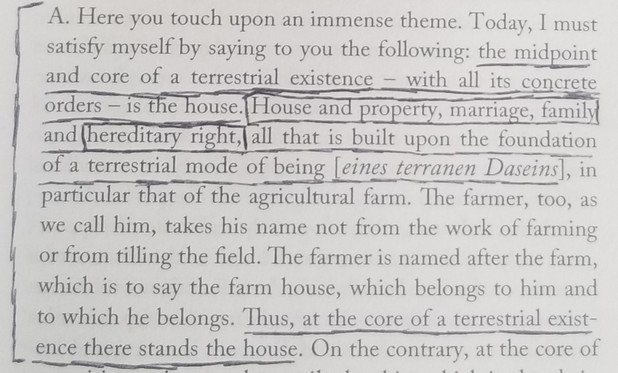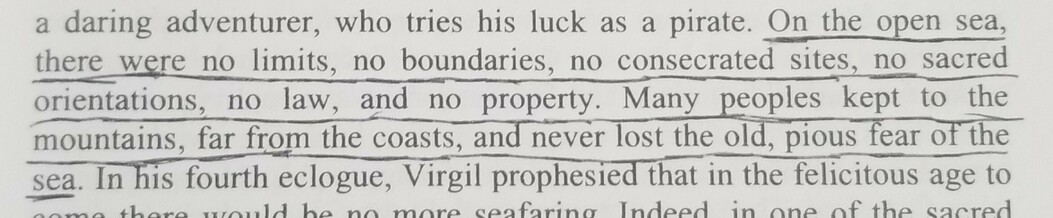
My queer pessimism seems to best be explained via both Deleuze and Schmitt's readings of Kierkegaard, and the function spatiality [Ordnung und
Ortung] and Nomos [as normative law] play in the works of Schmitt and Heidegger (this specific post will be focusing on Deleuze & Schmitt *more* than Heidegger). Deleuze & Heidegger here being used as a more ontological framework and Schmitt as a more ontical framework.
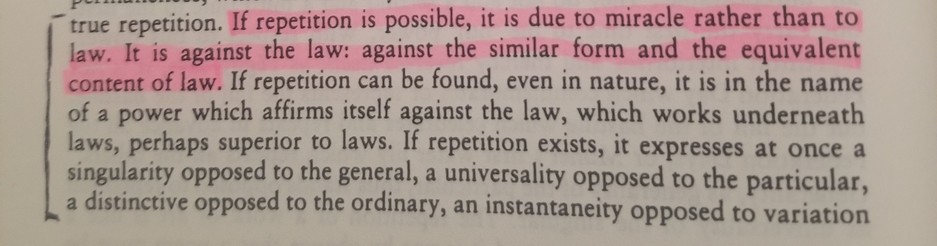
There are some incongruities between their readings of π‘Ήπ’†π’‘π’†π’•π’Šπ’•π’Šπ’π’ and 𝑭𝒆𝒂𝒓 𝒂𝒏𝒅 π‘»π’“π’†π’Žπ’ƒπ’π’Šπ’π’ˆ, but the underlying problematic remains: Sovereign power must repeat via miracle/exception to preserve itself. The problem of the state is existential. 𝑰𝒕 (the commonwealth) repeats because π’Šπ’• (the authors) are temporal. The state can only exist so long as it has subjects to rule over.
The problem then becomes a matter of reproduction, and as such the normative position of society is necessarily a heteronormative position. The queer/abnormal is essentially othered, defined by what it is not: a normal civilian. And it is not by breaking positivistic law, but by breaking Nomos that the queer is necessarily π’‰π’π’”π’•π’Šπ’” π’ˆπ’†π’π’†π’“π’†π’” π’‰π’–π’Žπ’‚π’π’Š [enemy of the human race]; in the same vein as the pirate under Roman law.
It may even be comforting to have a romantic view of the pirate considering the direct link society has placed in land appropriation as hereditary, a little reward for keeping not only the state alive but traditional family model it needs to survive (see quotes 7&8). However, the pirate can not fully escape society any more than the queer. Both are included via their exclusion. 𝑰𝒕 (queerness) repeats because π’Šπ’• (normative law) is necessary for society to preserve itself.

As such, not only must Nomos be abolished, but the queer identity will eventually have to undergo its own self-overcoming, self-abolition, or self-abandonment.

If one fails. BOTH fail.

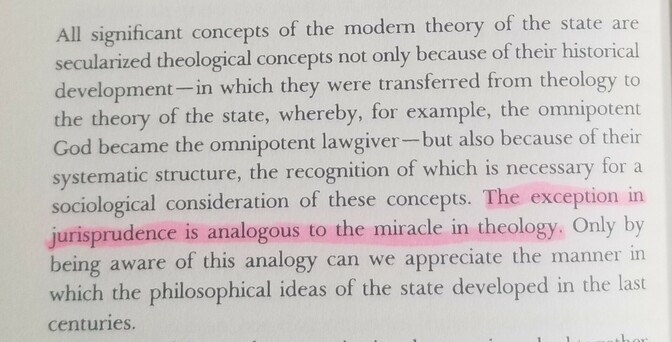
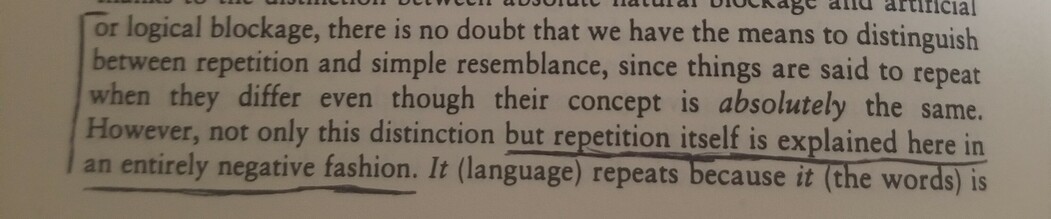
Photo 1: π‘«π’Šπ’‡π’‡π’†π’“π’†π’π’„π’† 𝒂𝒏𝒅 π‘Ήπ’†π’‘π’†π’•π’Šπ’•π’Šπ’π’ by Gilles Deleuze (pg. 2)

Photo 2: π‘·π’π’π’Šπ’•π’Šπ’„π’‚π’ π‘»π’‰π’†π’π’π’π’ˆπ’š by Carl Schmitt (pg. 13)

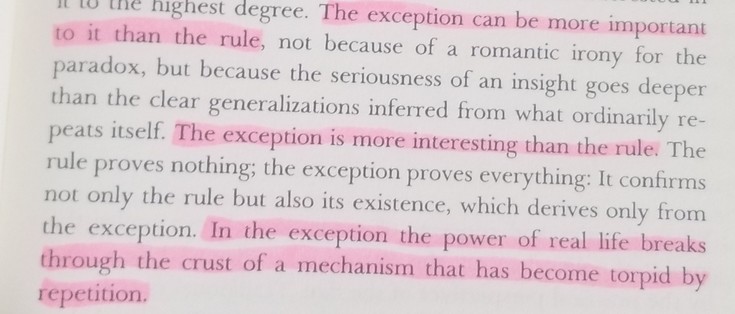
Photo 3: π‘·π’π’π’Šπ’•π’Šπ’„π’‚π’ π‘»π’‰π’†π’π’π’π’ˆπ’š by Carl Schmitt (pg. 36)

Photo 4: π‘·π’π’π’Šπ’•π’Šπ’„π’‚π’ π‘»π’‰π’†π’π’π’π’ˆπ’š by Carl Schmitt (pg. 15)

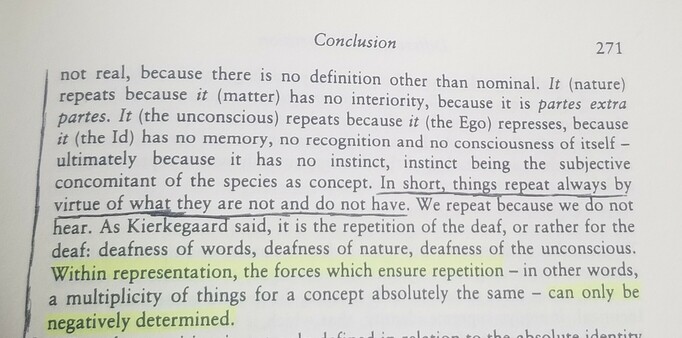
Photos 5&6: π‘«π’Šπ’‡π’‡π’†π’“π’†π’π’„π’† 𝒂𝒏𝒅 π‘Ήπ’†π’‘π’†π’•π’Šπ’•π’Šπ’π’ by Gilles Deleuze (pg. 270&271)

Photo 7: π‘«π’Šπ’‚π’π’π’ˆπ’–π’† 𝒐𝒏 π‘΅π’†π’˜ 𝑺𝒑𝒂𝒄𝒆 by Carl Schmitt (pg. 21)

Photo 8: π‘΅π’π’Žπ’π’” 𝒐𝒇 𝒕𝒉𝒆 𝑬𝒂𝒓𝒕𝒉 by Carl Schmitt (pg. 43)