Can Big Social just swoop in and take over the Fediverse on a whim?

Realistically, that can't happen.

1. Pivoting a big business is like captaining an aircraft carrier: it is slow and takes deliberation
2. Most businesses don't like to kill their cash cow, and the network effect that they own is their cash cow
3. Big Social itself is in disarray and doesn't have the wherewithal to make good strategic decisions

And there's other reasons too! 🧵

Big Social are no longer the innovators they were.

In actuality, for the past 10 years, most innovations in social media have been created by small, nimble players—which Big Social then attempts to either acquire or copy.

In essence, they've replaced R&D with M&A.

Thus, they probably have nothing new to add to the Fediverse.

The Fediverse is one thing that Big Social cannot acquire or copy.

No one owns the Fediverse, so that's not an option.

And to copy or integrate the Fediverse is to kill their own cash cows.

In essence, the Fediverse targets the chunk in their armour.

Big Social is obsessed with metrics, and proving value through metrics.

What metrics prove the Fediverse's value?

No one knows. Every metric regarding the Fediverse is at best conjecture. Nobody even knows its true size.

Hard to convince a CEO to buy into an idea when nothing is probable through metrics.

Nobody has validated the Fediverse as a place to make money.

Sure, tiny web-hosts might charge for services, but the average Big Social executive isn't looking to make tiny increases in a new venture. They want to 100x or 1,000x their ROI.

Somebody might eventually try this, but Big Social isn't going to be first.

Yes, Big Social has more than enough money and tech to upset the Fediverse.

What they don't have is the capacity to onboard knowledge about the Fediverse quickly and easily.

This is because the actual inner workings of the Fediverse are held by only a small handful of people.

Believe it or not, most people who work at Big Social are *not* social media nerds, and have zero interest in how the technology works.

When they look at Mastodon, their response is pretty much the same as everyone else's: they throw up their hands and say, "This is too complicated!"

And then they close their browser tab.

The only way Big Social challenges the Fediverse is through small competing skunkworks projects.

Which has actually happened with Jack Dorsey's Blue Sky project.

And to be honest, I'm skeptical about Blue Sky for many reasons—which I may talk about in a separate thread.

But more to the point, Blue Sky has been around for 4 years—and why aren't we using Blue Sky?

Before the Fediverse took off this month, Big Social was already intent on pivoting their big aircraft carriers into other "Next Big Thing" initiatives. Too much money and manpower has been staked into making stuff like the Metaverse happen.

They're not going to suddenly stop their current pivot to pivot again into the Fediverse.

Money can do a lot of things but it cannot guarantee you a future. And we're seeing this shake out currently with what's going on with Twitter.

If $44 billion isn't enough to guarantee Twitter's future success, why would that same amount guarantee success pivoting to the Fediverse?

There's the matter of culture. When Big Social sees the Fediverse, all they see is a bunch of deviant upstarts.

Joining the Fediverse, and thereafter hijacking it, means getting comfortable with a bunch of misfits that often aren't even currently welcome on Big Social.

And if there's a culture clash, it's not happening.

Finally, a previous parallel for what's happening right now with Big Social and the Fediverse:

At one time, Microsoft owned 98% of the OS market.

Then a tiny community of raggedy upstarts built their own free and open source OS called Linux.

Microsoft did everything possible to keep Linux from growing. They weren't successful at all.

Now Linux is the most dominant OS in the world, and it continues to be free and open source.

If Microsoft can't win, why would Big Social?

/END TREAD

@atomicpoet my suspicion is that this is Mastodon/the Fediverse's fight to lose, rather than big socials to win.

My take is there's one important risk; a big influx of users happens (e.g. Twitter fails entirely), Mastodon or the Fediverse hit some unknown scaling limit, the new users have a terrible experience, the press slam the Fediverse, and everyone returns to big social. Those of us left mourn the lost opportunity to fundamentally change how people experience the internet.

@atomicpoet This is why I think serious analysis of the scaling characteristics of Mastodon/the Fediverse is needed. Not of scaling individual instances, but how it scales as a distributed system.
@chopsstephens @atomicpoet I don't think the Fediverse really cares about winning or losing. It's just there. It worked fine before the influx of birdsite users and will work fine if they all leave again. The Fediverse is more about quality than quantity and certainly doesn't rely on quantity to survive, like monolithic social media.
@Naich @atomicpoet I think the world is a better place when speech leaves monolithic corporate platforms for decentralised community managed platforms. At this point, it's actually possible for that to happen.
@atomicpoet I think competition law had a vital role in controlling Microsoft & their wish to make Windows & Internet Explorer the only platforms. Apple and others were pushing open standards
@davidallengreen
@atomicpoet It’s very hard to compete with free.

@dfeldman
> It’s very hard to compete with free.

Free as in beer or free as in speech? I'm guessing you meant the former, but I think the latter had more to do with GNU/Linux dominance. MS made strong arguments about TCO (Total Cost of Ownership), which could have stemmed the flow of enterprise users away from Windows if the main issue was financial cost.

@atomicpoet

@atomicpoet Go Linux 👍Break free from Microsoft 🤗

@atomicpoet @davidallengreen interesting.

However, much like the tale of Linux, there still seems a risk the open nature might be embraced and extended with popular proprietary features to make popular spaces which are essentially privately controlled (even if the core underlying aspects are technically open).

i.e. the Embrace/Extend/Extinguish tactic demoed in https://news.ycombinator.com/item?id=33545541

I think the real danger for the Mastodon/greater Fediverse community is that, sh... | Hacker News

@kasilas @davidallengreen If you haven't looked into it, take a look at the AGPL.

@atomicpoet @kasilas @davidallengreen The AGPL isn't especially helpful or relevant against this risk, because the _protocol_ is open. The risk is that (as has happened before with XMPP) big players release a new service with great fanfare that initially federates with other systems, and then quietly turn off federation once they have a sufficient critical mass of users.

There are probably defences, but this one won't be solved by licensing.

@cjwatson @atomicpoet
they probably would not even have to turn off federating. Indeed, meekly supporting competition in fields you will, in time, dominate has some legal advantages.

They could just let their well-funded instance slowly capture users through an ever-so-slightly better service. Few will leave it when they are there, unless the mods go wild a là Elon.

I am sure there are defences but they are not obvious to me at the moment.

@atomicpoet Linux (or Unix) might be underneath both Android and macOS, but most client devices in use still run a proprietary OS (or at least a version of an open source OS merged with proprietary services in the case of Android).
@atomicpoet Uhm no. That is not how that happened. At all, sorry.
@atomicpoet Linux/UNIX was always the server OS to go to. And that Linux would replace Windows as "the desktop system" remains a pipe dream until this day. This is why we have the running joke that next year will be the year of Linux Desktop.

@atomicpoet

Unfortunately, #Mickeysoft is far from defeated.

They've long since jumped on the linux train (but thankfully failed to extend-extinguish so far),

They own #LinkedIn which is another of those "big social" things based on socially coercive marketing;

They "own" many companies and even public services infrastructure-wise and force their crap on millions of employees via this lever

They've succeeded in making restricted boot a thing in the laptop market

They're in the cloud market

@atomicpoet mmmmmmmmm. Linux never did conquer MS’s core domain though, did they? Linux on the desktop still doesn’t move the meter. Now, if you include web servers and android - both of which rely on either no UI or a completely mobile-centric overlaid one - then yes, Linux does indeed rule. But it’s never even challenged windows.

@basexperience
> Linux on the desktop still doesn’t move the meter

You could say that about the the 'verse relative to the used numbers still on the Datafarms. Let's look at direction, not current state. MS failed to leverage their desktop monopoly to dominate the mobile OS space; mobile Windows was about as successful as Ubuntu Touch. Windows as default OEM OS on consumer laptops has been a big barrier. Now there are more companies selling GNU/Linux laptops than ever before.

@atomicpoet

@atomicpoet all my personal computers run Linux. Have been since at least 2004, maybe even earlier than that.

I don't trust Microsoft with my personal data.

For work? Hey. It's their machine. They can put whatever they want in it.

@atomicpoet @jeffjarvis #Microsoft is much more profitable now than when it owned 98% of the desktop OS market.

Microsoft is arguably the biggest Linux distributor on the desktop via WSL2.

Microsoft owns GitHub and therefore the namespaces of most of the world's open-source projects.

Booting Linux on your new laptop depends on Microsoft's goodwill in giving you the signing keys for Secure Boot, and on some new laptops booting Linux isn't permitted.

The vast majority of Linux users run Android, where they don't have root and aren't permitted to recompile their kernel.

This isn't what free and open-source Linux winning would look like. It's better than a Windows monoculture would have been, but it's a much, much less free world than 25 years ago.

@atomicpoet the only place to go when you are at the top is down
@atomicpoet Which is odd because you would think that operating systems and social media networks would be natural monopolies
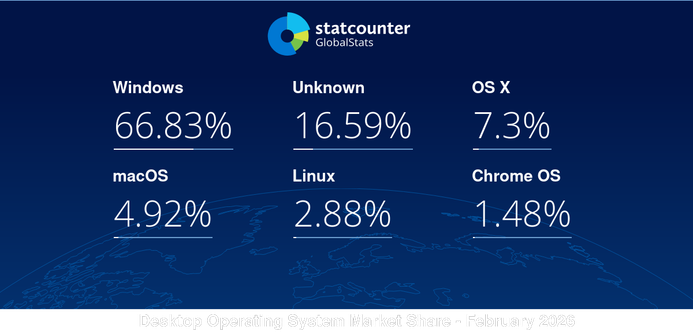
@atomicpoet There are parallels, but I'm intrigued to learn what criteria you're using to call Linux the world's dominant operating system when Windows still holds over 75% of the desktop market to Linux's 2.6%. https://gs.statcounter.com/os-market-share/desktop/worldwide
Desktop Operating System Market Share Worldwide | Statcounter Global Stats

This graph shows the market share of desktop operating systems worldwide based on over 5 billion monthly page views.

StatCounter Global Stats
@atomicpoet my Poe’s Law sensor is broken.

@atomicpoet

You're kidding, right? Linux represents a mere 1% of computer OS instances worldwide. Windows is #2 at 30%, just behind Android at 42%. These numbers are readily accessible from any number of reputable data sources. Not a good 'parallel' to push a wishful success of Mastodon.

@labboypro Android is basically Linux.