
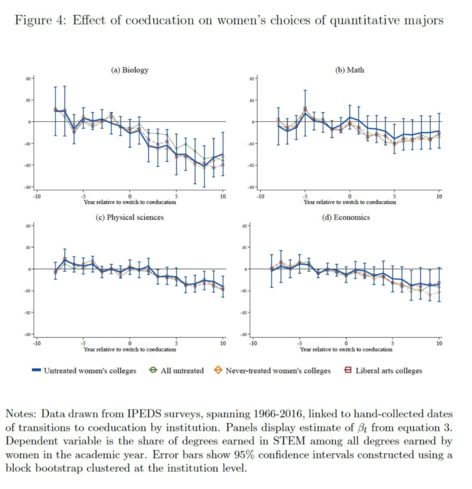
When US colleges went co-ed, fewer women majored in STEM.

These results imply that 36% of the gender gap in STEM is bc schools are co-educational

Clearly, it's not just about biology & innate abilities, but safe spaces that support women to flourish in diverse ways.

This has important implications for future earnings (since STEM jobs are high-paying).

by Calkins, Binder, Shaat and Timpe. https://files.osf.io/v1/resources/5374q/providers/osfstorage/62b3245254dfbe23665bbfe7?action=download&direct&version=1 @economics

Personally, I would be curious to see what happens when co-educational schools create single-sex classrooms for STEM.

I think that should be tested empirically.

@economics

Share of women in STEM is only one aspect of gender

Co-educational schools can foster other kinds of gender equality

By sitting next to each other, learning from each other, girls and boys may become more at ease with each other’s company, more comfortable, less shy, less sexualised

If boys never study with girls, if they grow up in all male environments, and only ever interact with girls as potential girlfriends, they may come to see them in a very narrow sexualised way.

So single-sex education is not a panacea for gender equality.

@draliceevans once upon a time, We had a paper with Caterina #Calsamiglia (paused it in 2017, never retook it) that showed that in South Korea, the relative disadvantage girls usually have at high-stakes exam (compared to boys), was reversed, i.e. , instead of « choking » under pressure, girls outperform boys even more under (super) high stakes than under lower stakes. We found that effect was driven by girls (randomly assigned) in #single-sex schooling.