I've figured out what pisses me off so much about Facebook's Galactica demo.

It's not because people can use to to write bad essays for their homework. There are plenty of large language models that can do that. It's because Facebook is presenting it as something that it most definitely is not.

Facebook is selling it as a knowledge engine, a "new interface to access and manipulate what we know about the universe."

Actually it's just a random bullshit generator.

http://galactica.org

Galactica Demo

Let's take a look. Galactica can generate wikipedia articles, supposedly.

So let's see what they look like. Here's one for Brandolini's law, the principle that bullshit takes another of magnitude less effort create than to clean up.

Left: Galactica's attempt at creating a wikipedia entry
https://galactica.org/?prompt=wiki+article+on+brandolini%27s+law

Right: The actual wikipedia entry
https://en.wikipedia.org/wiki/Brandolini%27s_law

wiki article on brandolini's law - Galactica

Here's the kicker. It's not that Galactica picked the wrong law. It is that the Padua economist to whom Galactica attributes the law, Gianni Brandolini, DOES NOT EXIST.

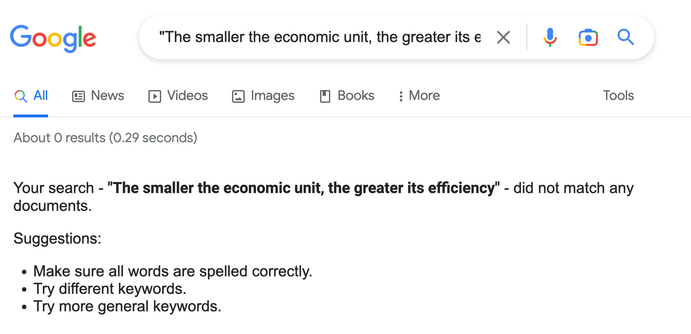
Galactica's phrasing of the law itself? That does not exist either. No one has ever said that phrase online (rather a surprise, tbh).

Galactica doesn't let us "access and manipulate what we know about the universe." It generates *pure bullshit* — which, incidentally, will be orders of magnitude more difficult to clean up.

UW researcher Robert Wolfe pointed out to me that there is a fundamental category mistake in how #galactica is being pitched.

This is not a machine learning system that is designed to represent scientific facts, models, and the structures that associate them. (There are other research efforts that attempt to do that.) This is a large language model that is designed to produce semantically plausible text using scientific terms and conforming to our expectations for various technical formats.

This is why, when I called it a bullshit generating machine, I was using the term bullshit in its technical sense. Philosopher Harry Frankfurt explained, in On Bullshit, that bullshit is speech intended to be persuasive without concern for the truth. For Frankfurt, the difference between a liar and a bullshitter Is this a liar knows the truth and is trying to lead you elsewhere where is the bullshitter either doesn’t know or doesn’t care wants to sound like they know what they’re talking about.

That’s more or less exactly what a large language model like this does.

It is trained to produce text it seems like it was written by a competent person. In this case #galactica also uses a technical vocabulary, frequent citation, structured argumentation, numbers, etc. to create a veneer of legitimacy—all tools frequently employed in the sort of new-school bullshit that we treat in our book.

it doesn’t care about facts. It has no representation of them beyond their semantic relations.

@ct_bergstrom I think of these models as a step beyond the "bag of words" models that were popular for text in the early 2000s. The main difference is that LLMs have decent local temporal structure, in particular they produce correct grammar and even sub-topic similarity, which is not nothing & is a success for ML! I appreciate @emilymbender and colleagues' work to help us not be fooled by these models. It is a new type of second-order BS that we are not used to filtering!