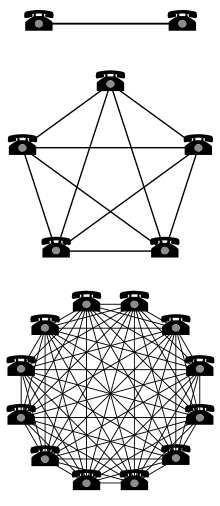
The Fediverse is the biggest communications revolution in a generation.

I know, sounds like hype.

Many tech revolutions have been promised and haven't arrived.

Where's my 3D-printed house? My self-driving car? My AR glasses?

Compared to those things, the Fediverse looks less grandiose.

So am I sure about this Fediverse revolution? So far, this just looks like Twitter.

Yes, I'm sure.

The Fediverse fixes one of the Internet's biggest pain points. Let me explain. đź§µ

Before I talk about the Fediverse -- and how revolutionary it is -- it's important to understand what a network effect is.

To sum up: much of technology's effectiveness is tied to the number of users that can use it.

Let's take a telephone.

If only two people in the world had a phone, it would barely be usable as technology. After all, you can only talk to two people.

But if everyone had a phone, now it's extremely effective. https://en.wikipedia.org/wiki/Network_effect

Network effect - Wikipedia

Now why is the Internet effective? Because it's a series of protocols that increase the network effect.

The more people who use email, the more effective it is.

The more people use the web, the more effective it is.

The more people use BitTorrent, the more effective it is.

This is why when the Internet was in its infancy, it was built on open protocols: nobody was going to use the web if HTTP was proprietary.

Now a funny thing happened when the Internet matured: for profit-corporations tried to gain monopolies over the network effect of the Internet.

Google used their dominance in search to wield dominance in news, maps, advertising, etc.

Facebook built social networks to monopolize a network effect, and shape it to its will.

Even old tech like email was compromised as corporations felt it was within their interest to contract the reach of the network effect.

The biggest problem of the Internet today: everything depends on a network effect owned by someone else.

Usually, that "someone else" is a giant tech company.

Your options for building the network effect are:

1. Google
2. Big Social
3. Email

If I don't want to use someone else's network effect, I will have effectively siloed myself.

And this isn't why we use the Internet, is it?

After all, we're here to build connections.

Because the Internet's network effect has become effectively monopolized, can we even call it the "open web" anymore?

Not at all.

If you want to be discovered, you have to play ball with a big tech monopoly.

Personally, what if Google doesn't like me -- and they want to wipe me off the face of the Internet?

Or worse, what if I don't like Google because they've enabled human rights violations?

Too bad! It's their network effect! https://mashable.com/article/saudi-app-control-women-google-apple

Apple, Google pressured to drop Saudi app that tracks women

One U.S. senator said it enables the "abhorrent surveillance and control of women."

Mashable

Here's one more problem with the modern Internet.

Novel and new innovations of the network effect are no longer built as open protocols.

Instead, they're built as proprietary APIs, or are based on someone else's proprietary API.

This is what effectively happened with Twitter. Their API was only "open" insofar as they allowed access. The moment they pulled access -- too bad for everyone building off their so-called "open" API!

To wit, new open protocols were (and are!) needed.

As the Internet's network effect has become more consolidated and monopolized, it's become harder to make new connections, discover new experiences, build new apps.

20 years ago, we used to surf the net. People would gather around the computer and see what's new. It was fun!

Who surfs the Internet anymore? Nobody.

And if the network effect gets further monopolized, the only site we'll be visiting is netapploogbooksoft.com.

So why is the Fediverse revolutionary? And why does it change the outcome of current network effect trends?

Open protocols!

Open protocols are the bones of the Fediverse. There's five in active use:

1. ActivityPub
2. Diaspora
3. OSStatus
4. Zot (and Zot6)
5. Matrix

Collectively, these protocols can be used to build apps, instances, and tools based on a network effect that's owned by no one!

No corporation owns them. They are completely free.

But there's more reasons the Fediverse is revolutionary.

If I want to make a social app, the hardest part is building the network effect.

As I said, technology is only as good as the number of people who use it.

Why did Google+ die? Why did Ello meet the same fate? Does anybody remember Color?

Without a network effect, social apps die.

But the Fediverse provides a solution!

The Fediverse's open protocol's mean that social networks never have to build their own network effect. Ever.

The problem of "You can't talk to anybody on that app" is gone forever.

And why?

Because once your social app supports ActivityPub, for example, your users can instantly talk to their friends.

The Fediverse saves devs, marketers, and investors time, effort, and money.

Billions -- if not trillions -- of dollars can be saved once this hits critical mass.

Social app development only scratches the surface of the Fediverse's potential.

Once every website supports Fediverse protocols, an entirely new approach to communication will be unleashed.

People ask me about open journalism. In my view, journalism becomes open when all news media sites are on the Fediverse.

What about office productivity apps? Now it becomes more social!

And there's so much potential for gaming too!

The Fediverse can change our lives!

The key fact about the Fediverse is that most of it hasn't been built yet.

Most people use it as a Twitter replacement.

And that's fine. In fact, it's fantastic. It's the first step in building critical mass.

But replacing Twitter is just one use case scenario.

In actuality, the sky is the limit. Anything can be built. Your only limit is your imagination.

When it comes to the Fediverse's future, there's so many possibilities. What do you want to do?

The power of the Fediverse isn't just in the instances you join or the apps you use or whatever tool gets built.

The revolution is in the open protocols.

The burning question: how will you use those protocols?

@atomicpoet to look at cat pictures, duh
@atomicpoet
Actually, let’s use that as an example. Say I have an unprecedented collection of extraordinarily photogenic cats and I want to build a Rate My Cat Photo app, what does the fediverse help me do (and what does it stop me doing eg monetise?)

@mykd If I were building a Rate My Cat app for the Fediverse, the net effect is that everyone who uses it can send cat pictures to the Fediverse, and your users will be able to receive updates from the Fediverse.

And trust me, Rate My Cat would be extremely popular on the Fediverse.

@atomicpoet

Hehe, I bet it would.

So day one it’s giving me “login” and “sign up for updates” features. I still have to host all those pictures and build the voting mechanism, I guess?

I could see “Sign In with Fediverse” being a nice option alongside Google/Facebook/Apple etc. but what’s the next step that makes me go OMG?

@mykd Off the top of my head, you could build:

1. Hot or not
2. Segment by breeds
3. Build groups

Lots of possibilities.

@atomicpoet

Haha, I’m not picking your brain for ideas for my cat business, just trying to see where the fediverse transforms what I could even be thinking of.

eg I don’t get what mastodon+fedipics+bookwyrm gives me that twitter+flickr+goodreads doesn’t.

@mykd The Fediverse give you a network effect that isn't built on an API someone else owns.

You don't have to ask Twitter or Flickr or Goodreads' permission to do something.

You can build whatever you like.

@atomicpoet
Okay, so if Flickr looked at the ActivityPub API and said "this looks good, we'll allow our users to choose to make their photos available using it, and comments can be added via the same route," would they then be part of the fediverse? If not, why would my cat photo site be fediverse, but not their photo site?