
The Fediverse is the biggest communications revolution in a generation.

I know, sounds like hype.

Many tech revolutions have been promised and haven't arrived.

Where's my 3D-printed house? My self-driving car? My AR glasses?

Compared to those things, the Fediverse looks less grandiose.

So am I sure about this Fediverse revolution? So far, this just looks like Twitter.

Yes, I'm sure.

The Fediverse fixes one of the Internet's biggest pain points. Let me explain. 🧵
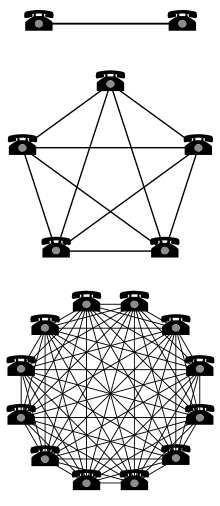
Before I talk about the Fediverse -- and how revolutionary it is -- it's important to understand what a network effect is.

To sum up: much of technology's effectiveness is tied to the number of users that can use it.

Let's take a telephone.

If only two people in the world had a phone, it would barely be usable as technology. After all, you can only talk to two people.

But if everyone had a phone, now it's extremely effective. https://en.wikipedia.org/wiki/Network_effect

Network effect - Wikipedia

Now why is the Internet effective? Because it's a series of protocols that increase the network effect.

The more people who use email, the more effective it is.

The more people use the web, the more effective it is.

The more people use BitTorrent, the more effective it is.

This is why when the Internet was in its infancy, it was built on open protocols: nobody was going to use the web if HTTP was proprietary.

Now a funny thing happened when the Internet matured: for profit-corporations tried to gain monopolies over the network effect of the Internet.

Google used their dominance in search to wield dominance in news, maps, advertising, etc.

Facebook built social networks to monopolize a network effect, and shape it to its will.

Even old tech like email was compromised as corporations felt it was within their interest to contract the reach of the network effect.

The biggest problem of the Internet today: everything depends on a network effect owned by someone else.

Usually, that "someone else" is a giant tech company.

Your options for building the network effect are:

1. Google
2. Big Social
3. Email

If I don't want to use someone else's network effect, I will have effectively siloed myself.

And this isn't why we use the Internet, is it?

After all, we're here to build connections.

Because the Internet's network effect has become effectively monopolized, can we even call it the "open web" anymore?

Not at all.

If you want to be discovered, you have to play ball with a big tech monopoly.

Personally, what if Google doesn't like me -- and they want to wipe me off the face of the Internet?

Or worse, what if I don't like Google because they've enabled human rights violations?

Too bad! It's their network effect! https://mashable.com/article/saudi-app-control-women-google-apple

Apple, Google pressured to drop Saudi app that tracks women

One U.S. senator said it enables the "abhorrent surveillance and control of women."

Mashable

Here's one more problem with the modern Internet.

Novel and new innovations of the network effect are no longer built as open protocols.

Instead, they're built as proprietary APIs, or are based on someone else's proprietary API.

This is what effectively happened with Twitter. Their API was only "open" insofar as they allowed access. The moment they pulled access -- too bad for everyone building off their so-called "open" API!

To wit, new open protocols were (and are!) needed.

As the Internet's network effect has become more consolidated and monopolized, it's become harder to make new connections, discover new experiences, build new apps.

20 years ago, we used to surf the net. People would gather around the computer and see what's new. It was fun!

Who surfs the Internet anymore? Nobody.

And if the network effect gets further monopolized, the only site we'll be visiting is netapploogbooksoft.com.

@atomicpoet Evegny Morozov used the useful metaphor of the "flaneur" who window shops aimlessly through the streets of Paris to describe "surfing the web." He was skeptical about it not getting co-opted
@JoseMarichal Co-opted? Now "surfing the web" does not exist.
@atomicpoet Not that surfing the web would get o-opted but that the web itself would become centralized and co-opted
@JoseMarichal Yep, centralization is baked into the web due to the server/client paradigm. But that's a different matter for a different thread.