 Akos T Kovacs
Manuel Kleiner @Manuel_Kleiner (from @NCState @NCStateCALS; #NNF_INTERACT #NNF_InRoot) on understanding key microbial functions related to plant-microbe interactions using metaproteomics
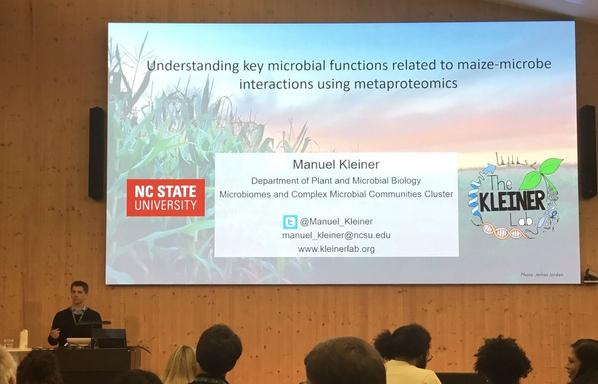
Manuel Kleiner @Manuel_Kleiner (from @NCState @NCStateCALS; #NNF_INTERACT #NNF_InRoot) on understanding key microbial functions related to plant-microbe interactions using metaproteomics
Manuel microbes in a microbiome, but what are they doing? 🟰 metaproteomics‼️
However, cell lysis is an important step in the pipeline
See @NatureComms 👇🏼
https://www.nature.com/articles/s41467-017-01544-x

Convenient methods for assessing microbial community structure in terms of biomass are lacking. Here, the authors present a metaproteomics-based approach for assessing microbial community structure using protein abundance as a measure for biomass contributions of individual populations.
Manuel describes their very recent study on plant microbiome proteome (note: lots of plant proteins as well that you can analyze)
#PlantMicrobeInteractions2022
---
RT @jmharris777
Evaluation of Protein Extraction Methods for Metaproteomic Analyses of Root-Associated Microbes - valuable analysis by Fernanda Salvato et al https://apsjournals.apsnet.org/doi/10.1094/MPMI-05-22-0116-TA #OpenAccess
https://twitter.com/jmharris777/status/1591603215430479872


Metaproteomics is a powerful tool for the characterization of metabolism, physiology, and functional interactions in microbial communities, including plant-associated microbiota. However, the metaproteomic methods that have been used to study plant-associated microbiota are very laborious and require large amounts of plant tissue, hindering wider application of these methods. We optimized and evaluated different protein extraction methods for metaproteomics of plant-associated microbiota in two different plant species (Arabidopsis and maize). Our main goal was to identify a method that would work with low amounts of input material (40 to 70 mg) and that would maximize the number of identified microbial proteins. We tested eight protocols, each comprising a different combination of physical lysis method, extraction buffer, and cell-enrichment method on roots from plants grown with synthetic microbial communities. We assessed the performance of the extraction protocols by liquid chromatography-tandem mass spectrometry–based metaproteomics and found that the optimal extraction method differed between the two species. For Arabidopsis roots, protein extraction by beating whole roots with small beads provided the greatest number of identified microbial proteins and improved the identification of proteins from gram-positive bacteria. For maize, vortexing root pieces in the presence of large glass beads yielded the greatest number of microbial proteins identified. Based on these data, we recommend the use of these two methods for metaproteomics with Arabidopsis and maize. Furthermore, detailed descriptions of the eight tested protocols will enable future optimization of protein extraction for metaproteomics in other dicot and monocot plants. Copyright © 2022 The Author(s). This is an open access article distributed under the CC BY 4.0 International license.
Manuel on Roberto Kolter’s 7 members SynCom (assembled based on maize endophytes) in vitro and on plant proteomics, including general response of certain SynCom members to plant root colonization