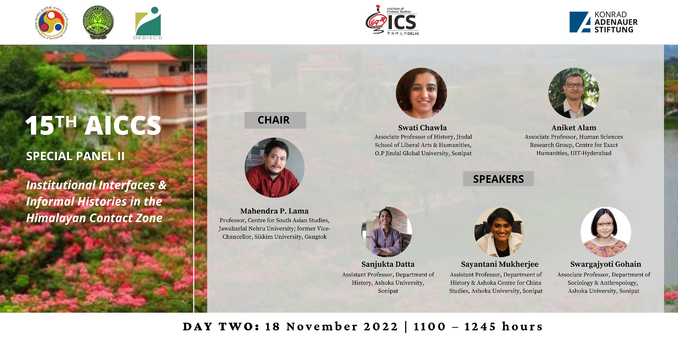
Presenting a paper at the 15th All India Conf of China Studies, on a panel looking at "Institutional Interfaces & Informal Histories in
the Himalayan Contact Zone.'

I am trying to use oral history sources to understand how people living on the India-China border in the Western Himalayas have (had?) visualised divisions of territory and space before the modern lines came about on the map.
Abstract:

In the past few decades
there has been extensive, and insightful scholarship, which has critiqued the border-making projects of the imperium as well as of the post-colonial nation-states. The paper will engage in some detail with Curzon’s ideas of a Himalayan frontier from the early 20th century and with some recent scholarship on borders and borderlands (Bérénice Guyot-Réchard, Nayanika Mathur, Benjamin Hopkins, Kyle Gardner).

Abstract (cont):

While recent scholarship has critiqued imperial and post-colonial border-making, it has been less successful in providing alternatives to current political boundaries and conflicts.
In the proposed paper, I will draw on oral histories and traditions as recorded by Tika Ram Joshi (1911) and Rahul Sanskrityayan (1949) in Kinnaur (Western Himalayas), as well as those recorded by me during fieldwork there in 2021 and 2022.

Abstract (cont):

The paper will argue for the need to learn from imaginings of boundaries, borders, distances and divisions of Himalayan communities over the 20th century. The oral histories and traditions of pastoral, trade and divine journeys will show how Himalayan states and communities mediated separation, division, as well as engagement and collaborations.

Abstract (cont):

If successful in its objectives, this proposed paper hopes to contribute to a new and different understanding of contemporary borders in the Himalayas, and encourage scholarship to listen to the lived experiences of people on the ground as it searches for solutions to conflicts.