Today officially marks 8 billion humans on Earth. Meanwhile humanity has wiped out 70% of wild animal populations since 1970. We don't live outside of nature.
Animal populations experience average decline of almost 70% since 1970, report reveals

Huge scale of human-driven loss of species demands urgent action, say world’s leading scientists

The Guardian
The immediate path to minimizing the risk of large-scale collapse is to end the fossil fuel and animal agriculture industries as quickly as possible. We are currently doing neither.
English — The Fossil Fuel Non-Proliferation Treaty Initiative

The Fossil Fuel Non-Proliferation Treaty Initiative
@ClimateHuman We should also be doing the easier things, such as insulating residences and improving public transport. They won’t solve the problem, but they will buy us more time to fix the hard things.
@ClimateHuman nitpick: wouldn’t that, without appropriate replacements already in place, just accelerate collapse of civilization? I would think we need to focus on deploying replacements instead of destroying energy sources we currently rely on. I think of fossil fuels as the seed corn which we’re currently gorging in instead of planting it (leveraging) for clean energy replacements.
@ClimateHuman @Robotbeat It is staggering how inefficiently we use energy. Driving a multi ton car several miles to a store to buy a few pounds of groceries at a time is completely typical in the USA. And then going back the same day for forgetting something… Or keeping one’s house hotter in the winter than in the summer. Constantly buying, discarding, and then buying again. Waste is everywhere in our systems and doesn’t even contribute to our quality of life!
@bhorst @ClimateHuman Inefficient use of energy matters a whole lot less if we’re not using fossil fuels. I suspect the fastest road to a survivable climate is to rapidly replace fossil energy with clean energy.
@Robotbeat @ClimateHuman While that is true to some extent, I think the scale of the problem, and the reality of human behavior, requires both approaches to be pursued aggressively and simultaneously.
@bhorst @ClimateHuman agreed! I just think emphasizing the abundance brought about by sustainable energy is more politically tractable.
@Robotbeat @ClimateHuman This is the fundamental principle behind the IRA Act, which funnels funds to expand clean energy options. 2021 was the first year more money went to clean energy than fossil fuel development. Now is the time to accelerate that transition.
@EdWNorris @ClimateHuman Yes, for all its flaws (like handouts to really dumb uses of hydrogen), the IRA is a big deal.
@Robotbeat @ClimateHuman Next up, permitting reform. There's a criminally monumental quantity of clean energy in queue in the US, and hundreds of gigawatts need to be freed to reach users.
@Robotbeat @ClimateHuman my personal take, in the US at least, is we should start rapidly phasing out all subsidies to fossil fuels and phase in way more subsidies to renewables, and green infrastructure . We are spending billions on destroying the planet
@ClimateHuman One of those things is good and necessary. The other would directly lead to my death.
@ClimateHuman Can you please embed an Alt description? Blind people cannot read the image. Thanks. =)
@ClimateHuman That is not the success of a species, this is suicide.
@ClimateHuman This is horrifying. It’s hard not to see stats like this and feel absolutely hopeless. But I know we have to keep fighting to save what we still can.
@ClimateHuman
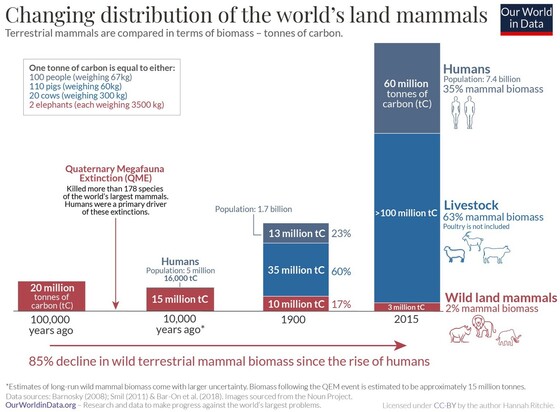
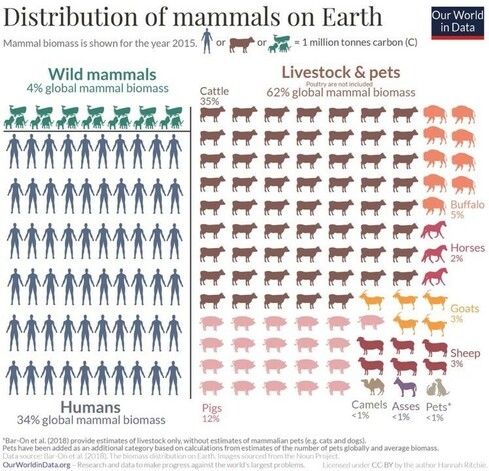
I just leave these two images here as further emphasis of your point
@ClimateHuman
I'm so glad to find you here.
Very sad pictogram.
All the Biomass of Earth, in One Graphic

Our planet supports nearly 8.7 million species. We break down the total composition of the living world in terms of its biomass.

Visual Capitalist
@ClimateHuman : which cluster is "cats and dogs" and where are the "mouses"?

@ClimateHuman We are also nature's babies. We're the only natural species who has let greed, corruption & selfishness to override innovative intelligence, strong community building & avenues to equitable ecojustice. Humans destroy the very habitats that we need to keep surviving.

Far too many humans have become too disconnected from natural life forces of earth, sky, water & astros. You destroy what you're not connected to & when that is nature - you inevitably destroy parts of yourself.
@ClimateHuman I wonder which of the blocks are the chickens? The bunch at the top above the humans perhaps?