 RAOF
RAOFA very interesting talk from @eylul at #ubuntusummit about the connections between FOSS and art.
Inspired by a small part of that talk, I wonder what a Right of Repair for software would look like? Would that be a good idea?
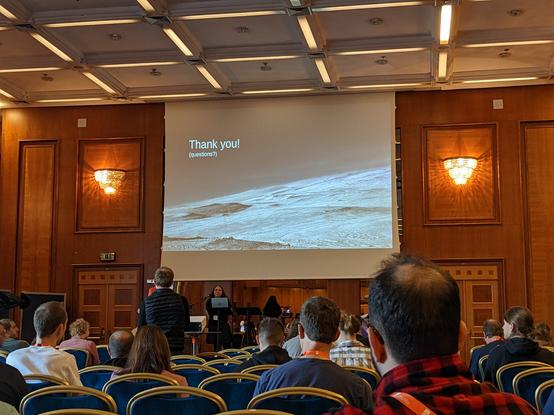
A very interesting talk from @eylul at #ubuntusummit about the connections between FOSS and art.
Inspired by a small part of that talk, I wonder what a Right of Repair for software would look like? Would that be a good idea?
@gaditb I think I've been unclear.
Freedom 1 is much broader than what I'm thinking about: a continuation of the physical Right to Repair campaign into software.
There's basically no chance in the foreseeable that the EU would (or even *could*) mandate that all software sold needs to come with source; a movement for a software Right to Repair needs to have an attainable intermediate goal that *would* be possible to mandate.
I'm not sure if there *is* such an intermediate proposal; this is what I'm thinking about. Maybe mandating unobfuscated debug symbols be available? Maybe mandating that users be able to disable (some level of) software integrity checks, so that binary-patching can be assured to work? Maybe something else?
What *could* be done, what could be worked towards with a reasonable chance of political success? Free/libre software, for all its benefits, is not that project. What is?
@RAOF I was more disagreeing with Halcy than with you (to the extent that I was disagreeing with anyone) -- the work that the FSF has done towards that goal of Right-To-Repair-Software has been circling around Freedom 1 rather than the GPL as a broad thing. (The GPL is an attempt to defend Freedom 1, but just one attempt in one direction.)
I think Free/Libre Software as a movement IS and SHOULD BE a project towards that -- but I think that copyright-licensing as a tool is not (nor ever has been) sufficient to the task. Political and legislative work is also necessary and also falls under their purview. (No matter how much organizations might have blindered themselves from those avenues.)
(But to be fair I'm weird about this. I also think Freedom 0 is incorrect and needs to be patched.)
@RAOF But on a direct level -- I think you're right that there needs to be an intermediate proposal, and those seem like good thoughts to start from. (But, like, what do I know.)
Probably the people we'd want to drag together are a combination of policy wonks and people who regularly mod and patch software. (Gamers are a bunch of them -- anyone else? the Tumblr XKit people, maybe?)
And see what they hash out.
@RAOF I wonder if one way of approaching it would be to make lists of specific CAPACITIES we want to ensure are available -- like "translating strings" or "exporting text output to a screenreader program" or "replacing image textures" or "passing images through a filter" or stuff. (We'd probably want more than that -- I'm not doing the best job being creative here. Possibly we could look to software mods, try to classify different capacities commonly used.)
Then asking the policy people which of those things might align best to current political climates and legal systems, while asking the modders what internal structures and symbols and options would make accomplishing those in particular easiest.
@gaditb I think that disagreeing in part with Freedom 0 is not, in fact, a particularly niche view.
It's not ascendant, but things like the ethical source movement are pretty visible and seem to have a fair number of high-visibility supporters.
@RAOF I mean, yes, but I don't think I've seen other people arguing that the Four Freedoms basis for action IS the correct framing, and that Freedom 0 needs to be slightly patched and somewhat extended. Most of the criticism I've seen -- like the Ethical Source stuff -- goes for passing on the specific focus on user freedoms in favor of broader ethics.
(Which, like, I don't disagree with -- user freedoms are not the only dimension of ethics in software, and we should push for ethics in all directions (and trying to first find a Perfectly Aimed List Of Requirements is silly, just do multiple contradictory things instead) -- but I don't think I've seen anyone else saying "there is still work to be done in the specific focus on user freedoms, and a place to start on that is patching Freedom 0.)
 halcy
halcy 
 Gadfly (-booq-)