
Let’s talk about #ResearchConsent: what it is, and why it matters! The case of #HenriettaLacks is a prime example of why research consent matters.
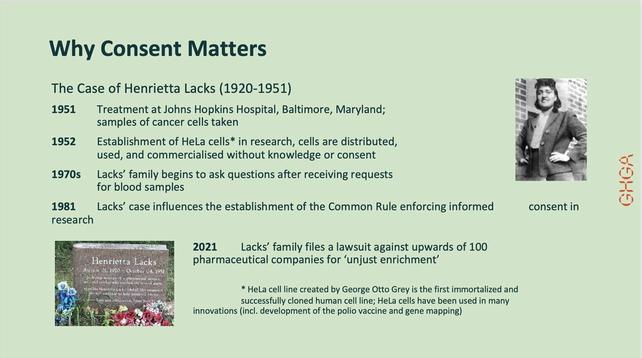
Lacks, an Africian-American woman, was treated for cervical cancer when samples were taken without her knowledge or consent. Used to create the first immortalised human cell line, #HeLacells have contributed to numerous medical innovations (e.g. the polio vaccine).
While the samples were taken in 1951, neither Lacks, who died shortly after the biopsy was taken, nor her family were aware that the cells generated from the biopsy were widely used for research until 1975.

Following a justified outcry around concerns about privacy and patients' rights, Lacks’ case influences the establishment of the so-called Common Rule requiring informed consent in research in 1981

read more about the common rule here: https://www.hhs.gov/ohrp/regulations-and-policy/regulations/common-rule/index.html

Federal Policy for the Protection of Human Subjects ('Common Rule

Federal Policy for the Protection of Human Subjects or the “Common Rule”

HHS.gov
Informed Consent and the Revised Common Rule

Updates to the federal regulations that protect human research participants pose new challenges and benefits in the way of giving informed consent

This case allows us to easily see the two sides of the coin that is research: 1) medical research allows us to understand, diagnose, and treat medical issues and health conditions.
2) research on human subjects has the potential to infringe on basic human rights (e.g. autonomy & privacy) and to perpetuate exploitation and exclusion. Research requires appropriate ethical and legal governance to realise its potential benefits while resisting potential harms.
Essentially, consent can be understood as an ethical governance method, which ensures that participants freely contribute to the planned research activities and are NOT treated as means to an end.
Consent is not the whole solution to the problem, it's one of 6 legal bases for processing personal data under GDPR,Art 6.1.a - For more information on valid research consent, its challenges and current resources, tune in to our recorded webinar on youtube https://youtu.be/T8rEja9M0OU
GHGA Webinar - Introduction to Research Consent w/ Andreas Bruns

YouTube