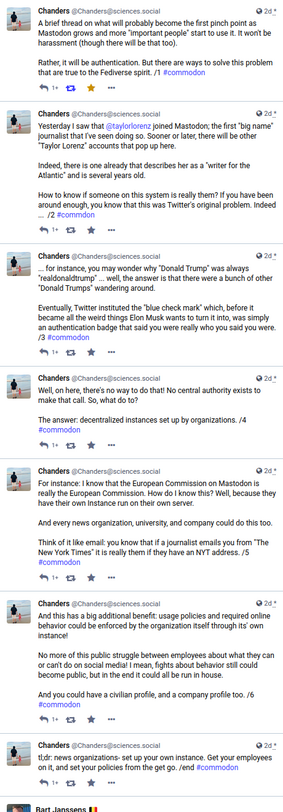
A brief thread on what will probably become the first pinch point as Mastodon grows and more "important people" start to use it. It won't be harassment (though there will be that too).

Rather, it will be authentication. But there are ways to solve this problem that are true to the Fediverse spirit. /1 #commodon

Yesterday I saw that @taylorlorenz joined Mastodon; the first "big name" journalist that I've seen doing so. Sooner or later, there will be other "Taylor Lorenz" accounts that pop up here.

Indeed, there is one already that describes her as a "writer for the Atlantic" and is several years old.

How to know if someone on this system is really them? If you have been around enough, you know that this was Twitter's original problem. Indeed ... /2 #commdon

... for instance, you may wonder why "Donald Trump" was always "realdonaldtrump" ... well, the answer is that there were a bunch of other "Donald Trumps" wandering around.

Eventually, Twitter instituted the "blue check mark" which, before it became all the weird things Elon Musk wants to turn it into, was simply an authentication badge that said you were really who you said you were. /3 #commodon

Well, on here, there's no way to do that! No central authority exists to make that call. So, what do to?

The answer: decentralized instances set up by organizations. /4 #commodon

For instance: I know that the European Commission on Mastodon is really the European Commission. How do I know this? Well, because they have their own Instance run on their own server.

And every news organization, university, and company could do this too.

Think of it like email: you know that if a journalist emails you from "The New York Times" it is really them if they have an NYT address. /5 #commodon

And this has a big additional benefit: usage policies and required online behavior could be enforced by the organization itself through its' own instance!

No more of this public struggle between employees about what they can or can't do on social media! I mean, fights about behavior still could become public, but in the end it could all be run in house.

And you could have a civilian profile, and a company profile too. /6 #commodon

tl;dr: news organizations- set up your own instance. Get your employees on it, and set your policies from the get go. /end #commodon

Addendum: @danhon wrote an about this idea earlier, and in better detail than I did. See it here:

https://newsletter.danhon.com/archive/s13e17-a-proposal-for-news-organization-mastodon/

@Chanders I wonder which will be the first major news org to do so? Prob not a US one, but I could totally see a major Euro outlet do so, e.g. FAZ, La Repubblica, Gazeta W (the latter having a particular history of being with it online)
@henrikornebring @Chanders I'm just wishing news organizations would add a share-on-Mastodon button to story pages. (Would also send a lovely message to Musk.)
@jeffjarvis @henrikornebring @Chanders I’m hoping that Influence metric places like Altmetric start factoring toots into their scores. Maybe there will be more impetus for this since so many academics are part of the #TwitterMigration. There is already a server asking for scientists’ publication records before allowing them to join.
@jeffjarvis: totally with you on that. a nice mastodon icon on the pull-down would be nice.
@henrikornebring my understanding is that there is v high usage of Mastodon in Germany (makes sense given the origins) and I wouldn’t be shocked to see a German news org do it.

@Chanders i've also been thinking about this, and a few inter-related complications:
1. workplace organising? (e.g. strikes, boycotts, walkouts)
2. labour implications of employer-provided official social media (not least metrification - though with caveats from @Angelec's work on how this plays out)
3. more-than-professional sociality (is one mainly using social media in official capacity?)
4. moving jobs/roles (without losing posting history)

given these things, wonder if there's (also) a place for professional/disciplinary associations (including, e.g. #AoIR), for more worker/employee-based instances (community-of-practice-owned, rather than employer-owned)? which could even be supported through things like sliding scale member dues?

in case of universities, i suspect IT policies may make this very slow to happen for many institutions. in meantime, perhaps we can look to support independent instances through things like research budgets to boost capacity?

@Chanders also, crucially..
5. employers having users' DMs/social graphs/contacts, which may include all kinds of other more-than-professional accounts and interactions. (also thinking here of recent attempts to criminalise climate activist groups - might some employers bow to official pressure to block/blacklist these?)

but as there is also some urgency here with scale and capacity, i wonder if (as well as experimenting with employer-run instances) employers might provide material support for a range of community/field/practice-based associations through existing independent third-parties with their own governance arrangements? curious if there are already examples of this? (e.g. not sure who set up akademienl.social or if it has institutional backing..). as you have previously mentioned from your own work these kinds of multi-organisation things can be fragile, political and hard to set up - so perhaps a case to go with professional associations which already exist and have done this work?

@jwyg I don’t disagree with any of this per se. In the end what I am putting forth here is a system weighed in power terms toward institutions, which has many problems.

I am also thinking about, though, what happens the first time a popular journalist gets impersonated on here, writes about it, and concludes “well this is why federated spaces don’t work man Twitter was great.” There ARE ways to do it on here …

@Chanders yo simply enforce user emails to end up with the organization domain name, and boom, you have an organization only server.
@Chanders @FakePlasticRuby @[email protected] Bovenstaand draadje legt goed uit waarom pakweg een krant als De Morgen best een eigen Mastodon instance opzet. Jullie hebben al een paar goede artikels geschreven over Mastodon, tijd voor de volgende stap?
@janssens_bart @Chanders @joeldeceulaer ik zie geen draadje vrees ik
@FakePlasticRuby @Chanders Zou normaal moeten uitklappen als je op mijn post of een daarboven klikt, zoals in deze screenshot?
@janssens_bart @Chanders bij mij klapte het dus niet open. Merci - ik neem het mee!