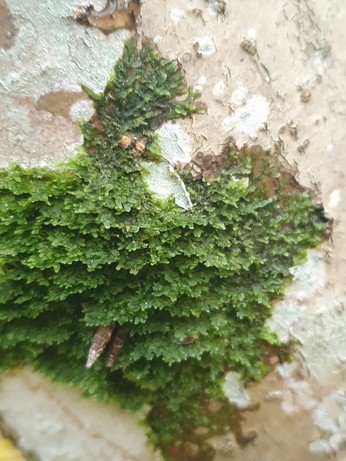
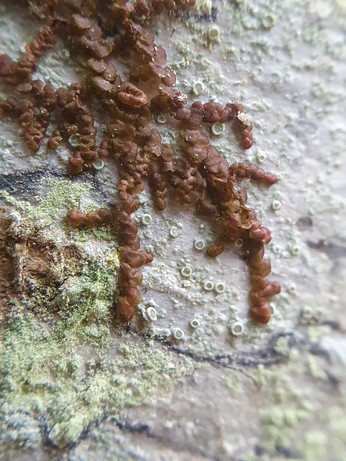
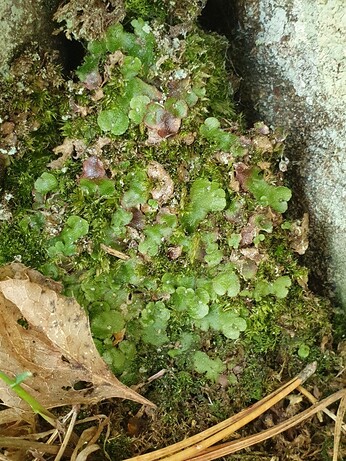
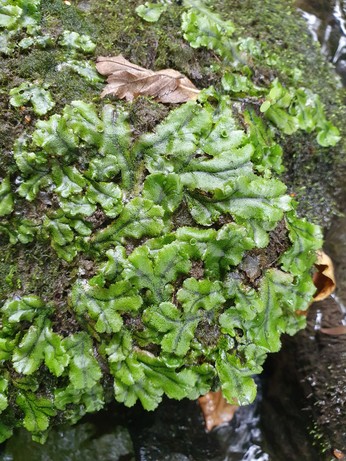
Soo... #Liverworts, anyone? Kinda like wonky mosses, but currently placed in their own phylum, Marchantiophyta. Most of them are not uncommon, but they're easily overlooked; small and bubbly guys that are really hard to photograph! Here are a few cool ones I've seen recently (names in img description):
#mosstodon
@jensu Love the non-vascular embryophytes. Tracheophytes (and angiosperms in particular) understandably get all the love, but we gotta appreciate the little plants too ❤️
@delve Aww, I'll always be there for those little guys tbh

@jensu This is reminding me I need to pick up a copy of Dr. Robin Wall Kimmerer's "Gathering Moss". "Braiding Sweetgrass" by her was wonderful, so I'm sure "Gathering Moss" will be too.

Moss is seriously underappreciated stuff. In ecology, we love to talk about successional and pioneer species, but where does that succession start? It starts with mosses and lichens that can live on rocks and break them down into usable minerals for later plants.

Something else thing that pops into my mind that we can also thank moss for is a lot of our knowledge in anthropology. Pray tell, where do bog bodies come from again? Oh, yeah, that's right: peat bogs. Much of which is comprised of peat moss.

And one more neat thing I learned about moss (from Dr. Kimmerer IIRC) is that some Native American groups historically used dry moss as a diaper. Dry moss can apparently absorb up to 20 or 30 times its weight in water. Which is kinda amazing.
@jensu
In conclusion, moss is awesome (one might even say mossome), and so are other non-vascular land plants. Thank you for coming to my TED Talk
@delve Great TED Talk! Peat moss has also been used for insulation and for dressing wounds, I believe. And in Swedish, many mosses have names like house moss, roof moss and wall moss, so I imagine they also have been used for insulation.
@delve @jensu I research liverwort development and mosses are totally bizarre. Some intense evolving went on after mosses and liverworts diverged. For example, what you see of a moss is kinda only the sexual reproductive structure, the rest of the moss is a mass of branching filaments in the soil, sound familar? I have a pet hypothesis that mosses evolved to behave more like a fungus thereby eliminating the need for a mycorhizal symbiosis which most plants rely on. 🍄