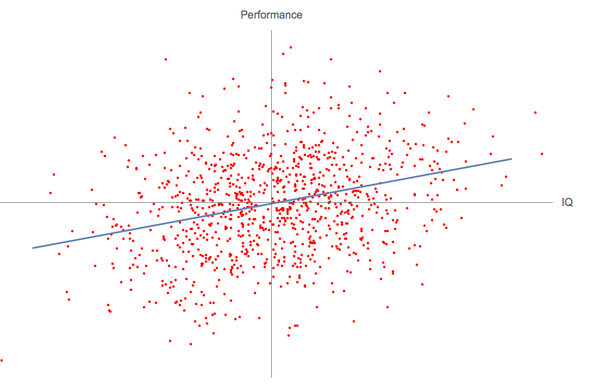
The thing about people who have a lot of whatever it is that we're measuring with IQ is that they quite often tend to be way _more_ wrong than those who have less of whatever it is that those points stand for.

High IQ is kind of like superglue for opinions

Not only doesn't IQ compensate for ignorance or poor methodology, it acerbates the issue.

Rationalisation is a powerful drug. Most people can convince themselves of almost everything but those with high IQ tend to be _extraordinary_ at it.

Reasoning from first principles about unfamiliar fields is a popular past-time among many smart people in tech. They love to try to "solve" long-standing fields based on nothing more than their wits and personal observation.

But most fields have points in their history where they were stuck in false paradigms or fallacies because those were the conclusions a smart person would draw based on their wits and observation.

It takes years of collective work for fields to break out of these fallacies

For example, a smart person, adhering to an ad hoc "I'm smart therefore what I see is true" process, reasoning from first principles, would come to the conclusion that the earth is at the centre of the solar system

It'd be next to impossible to change their minds with data

The effort to reason from first principles creates an emotional investment in the (wrong) conclusion that makes the conviction extremely hard to undo afterwards.

Now smartypants tend not to apply this to astronomy, because the story of Galileo is a powerful warning tale about exactly the problems with thinking like this. But biology, art, and sociology remain popular targets despite this.

Now that's normally fine. If you want to make shit up in your head about neuroscience, fine arts, or human behaviour when you're at home, kicking back on the sofa, and want to indulge in feeling like a smartypants, have at it. Enjoy yourself.

It becomes an different issue if you're in a position of power and influence and you begin to affect public policy or opinion. Which is pretty much where we're at with the US's current plague of dunce-savant tech CEOs

I can't change their minds so I'm appealing to the rest of you. Don't be like that. Approach fields with a genuine curiosity and try to engage with their history

Try not to pay attention to the tech types who are too far gone down this road. We'll all be better off for it

What these guys miss (and the tech industry misses because it's largely run by these guys) is that collective work using a structured process will trump high-IQ every time. It's the basis of progress in most fields: the scientific method, arts and humanities, construction, etc

Reading up one unfamiliar fields is actually a lot of fun. You can study and follow the arguments made in a field over the years and even come to a reasoned disagreement based on the current state of the field

Fields are rarely homogenous blobs with only one opinion. Odds are if you disagree with a field's orthodoxy, there will be a heterodox movement within it that's based on the current state of the field

Have a little bit of curiosity about other people's ideas. It's fun!

/fin

@baldur i must say that i disagree with a lot of the things you wrote. i think your assessment of "smart people in tech" as high-IQ idiots who constantly get things wrong out of ignorance and through poor methodology is sharply contrasted by their economic success.

Beyond that, I must strongly oppose your application concept of "collective work". it is not, as you imply, the work of a collective insofar as the collective is wholly involved in all parts of the work. instead, a collective work is work by individuals, who enter the collective through the way their individual work fits together with other works. So for any heterodoxy to form, individuals have to step up (and maybe also take a step back) and question the consensus.
@ic3l9 @baldur > sharply contrasted by their economic success

The frequent failure of economic success to correlate with any kind of virtue or talent is pretty well-known by now.

@baldur in my experience, a lot of this posturing involving anti-expertise or anti-establishment mindsets tend to revolve around the people in question feeling "gatekept" from being given positions of power in any field as a matter of fact (because they're obviously so brilliant and cool, why can't anyone else see that?)

this is how you get cryptocurrency bros reinventing centralized banking and financial insurance from "first principles"; the goal was never the ideology or its supposed benefits ("decentralized currency", which we've more broadly had for millennia in the form of "barter and trade"), but for them to become kings over their own two-bit fiefdoms

the fallacies involved become less about the problems of a field and more about how much social and financial prestige they can extract out of the situation before the jig is up

@AmyZenunim @baldur so well said. And they all want power over instead of power with.
@AmyZenunim @baldur i agree, but I do think they are being shut out of power, because thats what rich people do. i feel like the crypto bros are just the next generation of capitalists who have a new lingo, as you eloquently stated.

@baldur
I am (slowly, painfully) trying to work out a proposed melding of
* online social media
* activism
* the ethos underlying the communal practice of science

beyond the scope of "fields" to facilitate the interactions that will permit us to collectively apply the principles you espouse in order to, you know, survive the future:

https://asorrybowl.blog/seizethemeansofcommunity-notes-towards-a

#SeizeTheMeansOfCommunity

SeizeTheMeansOfCommunity: Notes Towards a... Manifesto?

The following was originally intended to be a thread on Mastodon. Since I don't yet fully understand how posting to Mastodon works, I man...

A Sorry Bowl
@baldur technocrats gon technocrat... https://youtu.be/wNkDiBOO4H0?t=2580
Patrick Wood: Technocracy Rising Interview (Part 1 of 3)

YouTube

@baldur "dunce-savant tech CEOs" 🤣 perfect

This flawed thinking seems to be especially prevalent in tech for some reason.

Probably the most valuable class I ever took was psych 101, learning about false memories and logical biases taught me to doubt my own flawed brain

Nassim Nicholas Taleb's Wisdom on Twitter

“"3) The CEO of the company is not the entrepreneur w/skin in the game, but often some acroparasite actor milking the system." - Nassim Nicholas Taleb”

Twitter
@baldur "The causal relationships... in nature are just too entangled for man to unravel through research and analysis. Perhaps science succeeds in advancing one slow step at a time, but because it does so while groping in total darkness along a road without end, it is unable to know the real truth of things. This is why scientists are pleased with partial explications and see nothing wrong with pointing a finger and proclaiming this to be the cause and that the effect." -Masanobu Fukuoka
@baldur First read that as “rationalism is a powerful drug” and, honestly, it works either way. This is one of the clearer explanations of this I’ve ever read. Thanks!
@baldur Excellent thread. Bookmarked to have as a source for when my students ask me again why I feel nothing but contempt for the high IQ CEO techbros
IQ is largely a pseudoscientific swindle

Background : “IQ” is a stale test meant to measure mental capacity but in fact mostly measures extreme unintelligence (learning…

Medium
@baldur > High IQ is kind of like superglue for opinions

There's some truth in it, but I hope you are not too attached to that opinion. Intelligence and arrogance can combine in striking ways, but I don't think they are as inseparable as that. A lack of wisdom will lead just as surely to error no matter one's level of talent for IQ tests.
@baldur Maybe it should be renamed RQ? (Rationalization quotient)