 Erin M. May, PhD
I've arrived to the conference and my poster is all hung up and ready to go! Excited for the #Science talks that start tomorrow and to see all my colleagues that I haven't seen in 2+ years!
(CW: image contains eye contact)
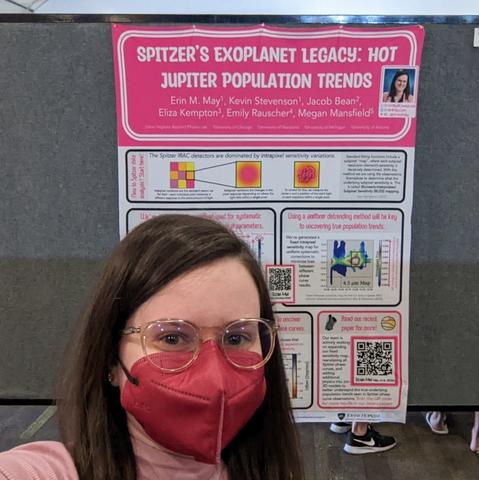
I've arrived to the conference and my poster is all hung up and ready to go! Excited for the #Science talks that start tomorrow and to see all my colleagues that I haven't seen in 2+ years!
(CW: image contains eye contact)
With over 30 phase curves observed during the warm Spitzer mission, the complete data set provides a wealth of information relating to trends and three-dimensional properties of hot Jupiter atmospheres. In this work we present a comparative study of seven new Spitzer phase curves for four planets with equilibrium temperatures of T$_{eq}\sim$ 1300K: Qatar-2b, WASP-52b, WASP-34b, and WASP-140b, as well as the reanalysis of the 4.5 $\micron$ Qatar-1b phase curve due to the similar equilibrium temperature. In total, five 4.5 $\micron$ phase curves and three 3.6 $\micron$ phase curves are analyzed here with a uniform approach. Using these new results, in combination with literature values for the entire population of published Spitzer phase curves of hot Jupiters, we present evidence for a linear trend of increasing hot spot offset with increasing orbital period, as well as observational evidence for two classes of planets in apparent redistribution vs. equilibrium temperature parameter space, and tentative evidence for a dependence of hot spot offset on planetary surface gravity in our $\sim$ 1300 K sample. We do not find trends in apparent heat redistribution with orbital period or gravity. Non-uniformity in literature Spitzer data analysis techniques precludes a definitive determination of the sources or lack of trends.
Also, yes, my poster IS hot pink! Thanks for noticing!
Pink is my favorite color and this poster I decided I didn't care if people found my poster "unprofessional" because of the color, I wanted to have fun with it!
Lots of other people made fun colored posters for this conference too, and I'm excited to see them all!
What matters is the science, not the colors and designs you use (as long as it's legible!)
 Jim
Jim