@pesasa Gah! I'm misreading my own previous thread 😺
And yes, I'd introduced belief there, so that's on me...
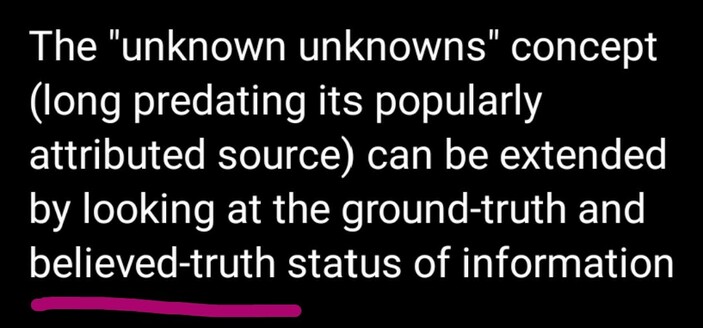
Context: that toot was based on an earlier HN thread. I'd looked to that to try to suss out What I Was Even Thinking in writing that, and the context in which it emerged. That's well worth taking a look at (it's a short thread).
To clarify for discussion:
The grid is based on "known" and "unknown", and "truth" and "falsity". K, U, T, and F.
Apparently I'd equated or at least connected "known" with "belief" writing the toot in Sept., 2021. That is, "Believed truth".
"Ground Truth" status is the T/F dimension.
By way of clarification, I'm reading myself as saying that T/F are independent of knowledge or belief, that is, T/F is ground truth, not some awareness or belief, which ... falls more into the K/U axis. A belief is a subset of that which is known.
That noted, the grid is what I call a naive extrapolation based on a state matrix. If you have knowledge and truth each with two states each, you can expand them to the sixteen combinations shown. And as I'd originally said, I'm not sure how useful that is, though it seems interesting.
as I'd said on HN:
In the known-knowns model, you have knowledge and metaknowledge (what you know, what you know you know).
That is, "unknown unknowns" is about your awareness of your own scope of knowledge and ignorance.
In that context, then your comment seems accurate: an unknown unknown is not a believed truth. It is in fact a domain in which there is neither belief or awareness that a belief need be necessary.
That leaves us with the question of a fact falling into the status of unknown unknown, but having possible truth values. And again, I'm not sure how useful that is, outside simply filling out the combinatorial matrix.
#truth #belief #UnknownUknowns #GroundTruth #JustifiedTrueBelief
 Doc Edward Morbius ⭕
 Petri Salmela