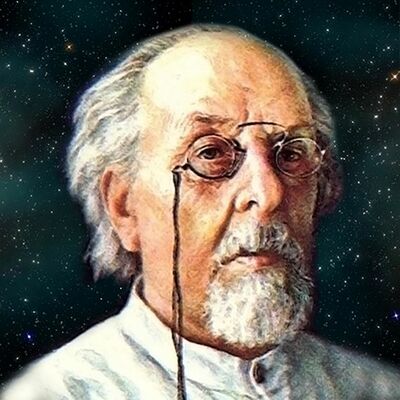
 Weird Uncle Konstantin
At the Frontiers of Science conference online, might livetoot! It's being livetweeted too, but I'm not on twitter so I'm not sure where
Late start due to tech issues
This is an #astrobiology conference coming straight out of Yorkshire, don't think I mentioned this.
First talk postponed because Zoom is not happy with anyone sharing their screen
First up is Rowena Ball from Australia National University, prerecorded, on anamolous thermal fluctuation distribution favouring primordial chemical evolution
Pitched at a very general audience, apparently the structure is explaining each term in turn
On to explaining a simple model for the origins of life and primitive vesicles, very basic metabolic cycle, etc
A normal distribution of temperature fluctuation inputs doesn't result in a normal distribution of temperature fluctuation outputs - it skews hotter
To explain this she's diving into the temperature sensitivity of alpine ecosystems, as an analogy to the temperature sensitivity of the biological models, with hotter temps favouring more complex products
Forgot the CW, sorry for the text walls
Now talking about the implications - higher temperatures favour life, but can produce unstable conditions
They modelled two types of vesicles in the model rock pool - simple vesicles, and more complex, more thermally stable vesicles, competing for the same substrate
More "storminess" means more stable vesicles, the simpler vesicles have a non-linear response with a dramitic peak, a trouch, and then a final rise
Ideal storminess is 1.6 (not sure how that's parameterised)
Not a biologist or chemist, so apologies if butchering concepts
"Net biosynthesis may occur under a fluctuating dynamic drive but eventually must fail in a calm environment"
There's also an optimal storminess
This is all in a paper by R. Ball and J. Brindley (2020), but I didn't get the rest of the ref before the slide vanished, sorry
Now Elias Chatzitheodoris, A Unified Concept to handle information in planetary exploration
Talking about the giant mass of missions to Mars, and how information is extremely fragmented between multiple places and journals, with independent post-processing of data, independent functionality of instruments, etc
He mentioned emerging databases of spectral databases and analogue samples of earth rocks that are like mars rocks etc, so I'm guessing his solution will be like that
Talking about the problem of a vast ocean of redundant and duplicate data confusing people, esp in multidisciplinary fields
I think he just finally got sick of lit reviews
So the fragmentation creates a bottleneck in data assimilation, interpretation, and evolving theories, and produces a need to standardise space law, planetary protection protocols, etc
Sorry he talks faster than the last talk so I spend more time writing
Talking now about the future of planetary science, it requires a lot of expertise over a lot of fields
There's a future focus on autonomous and collaborative distributive systems, like a ChipSat swarm but with rovers I guess
There's an M2M framework, like the IoT but bigger and good, where machines can autonomously collaborate and take actions
There's a few proprietary efforts for M2M, including from NASA (M2Mi, SILA, OneM2M)
Also the FAIR toolkit for life sciences
Typing quick and trying to catch up with the speaker, so apologies for any mistakes or lack of clarity
To emphasize he's not talking about anything super-new he's talking up Wolfram Alpha
"For planetary science we have 4 domains" *brings up slide with 3 domains on*
Information Architecture and Processing domain, Device domain, and the Interface domain (both with humans and with other machines)
OK so now we're on to having "knowledge based entities" in digital formats acting as autonomously acting databases, able to handle rapid analysis and interpretation, easily searchable, and the ability to compile knowledge into executables understood by humans and machines
Gonna have to review the recording, not sure I've followed all of this
Talking about current obvious restrains - energy requirements, TRLs, communication speeds, planetary protection, the lack of MNSS, data analysis constraints, etc
Expectations: standardised and unified formats for every research activity, human-machine collaboration becoming more natural, dense and dynamically evolving open knowledge, and proper handling of interdisciplinary knowledge
Unsure exactly how far aware his proposal is, sounds a little sci-fi
No questions, just a sea of muted black squares, so I feel for him on that point
Organiser threw him a softball about IP and accreditation, he said it'd be automatically tracked throughout the system
Apparently we have all the tools, but everything is extremely fragmented - other than that we're not very far away
A lot of people want to do something similar apparently, but not completely
Response to another question - it's less a question of machine learning and more of machine communication, having all the databases standardised and united
3rd answer - is this power in the nads of private industry, research facilities, or government?
A - wants to trust both, but should be collective effort. We're building something new, maybe outside earth.
Unsure how out-there he's being, I want to drill more into what he's actually proposing
(that's supposed to say hands, but I enjoy the typo so)
Digression on GNSS for Mars, apparently there's a proposal with several cubesats to cover a few regions of Mars
(I actually know someone doing her PhD on using existing GNSS to navigate on the moon, I should see how that's going)
Zoom is now working well enough to give the intro/welcome talk
Last Talk now - David Holmes on "Phosphine as a biosignature gas for life detection on exoplanets - The Good, The Bad, The Ugly"
Talking about detecting habitability on exoplanets via atmospheric biosignature gases
The topic is phosphine so looking forwards to getting SPICY about VENUS (not really very spicy though)
Good speaker, slow enough to easily follow and take notes but still engaging and interesting
Oh we're on Venus now!
Going down the discovery timeline, it's a saga!
(There is probably not life on Venus, and the concentration is a lot lower than initially reported in september)
He is getting excited, described it as a rollercoaster!
Key points: 1) 2 month rollercoaster!
2) Most of the papers people got excited about were on Arxiv, so not yet peer-reviewed
There is some snark
Going into the possibility of microbes in the cloud layer of venus and how unlikely it is, I think that got discussed and hashed out on here back in September
Stresses it's not impossible a priori though!
2 more missions going to Venus, Shukrayaan in 2024 and Venera-D in 2029, so wait until then to see who's right
A lot of papers recommended, "Redox chemistry in the phosphorus biogeochemical cycle", Pasek et al, PNAS, 111.43 (2014) in particular (https://doi.org/10.1073/pnas.1408134111)
He is real eager to rip apart that baines et al paper suggesting that the phosphine on venus couldn't be abiotic
This shit is personal it sounds like, he's fully getting sarcastic about it
If this was an in-person conference he'd be asking the authors to step outside to settle it
I was going to ask him about a paper my friend did that's tangentially related but now I'm scared tbh
Question - Is our knowledge of life on earth limiting our imagination as to life elsewhere?
A - He feels that life elsewhere is probably going to be similar to life here, but who really knows?
Q - Should we be looking for degradation products rather than free gas, given the amount of UV in the clouds of Venus?
A - There's a few products, and we did see them, but the key is that the gas should be out of equilibrium to be notable
Q - Apart from Oxygen, Phosphine, or Ammonia, what biosignatures should we be looking for?
A - There's no perfect biosignature, but we're looking at combinations - Methane AND Oxygen AND some nitrogen compounds
Q - Have we been here before with the Viking missions and claims by Levin?
A - Missed the phosphine signature in early Viking missions, only recovered later. Hope haven't given the impression it's easy to detect, the various fingerprints are fairly low-level...
...and only with good computational techniques when people were looking specifically for Phosphine on Mars. And that was a planet next door!
Q: Viking found perchlorates on MArs in 1974, in 2010 NASA reinterpreted the results. Would such biosignatures have any co-relation with Phosphine?
A: Perchlorates are more oxidising than oxygen, so we shouldn't find it alongside life. Look in the Atacama though - there's perchlorates and nitrates...